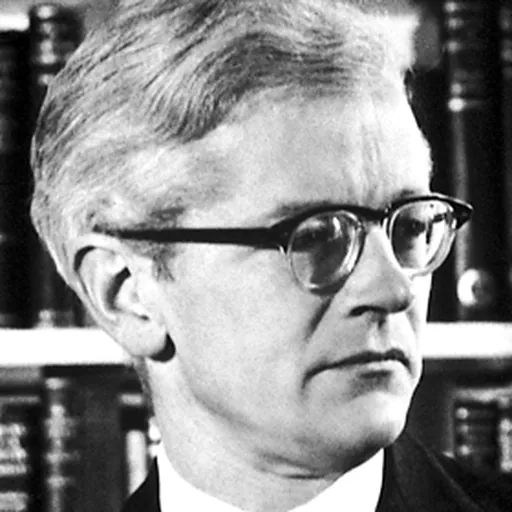
John Kendrew
English biochemist and crystallographer
About John Kendrew
Lived 1917 – 1997 (aged 80). John Kendrew was a British biochemist, molecular biologist, chemist, crystallographer, biophysicist and researcher, known for Heme.
Education and early life Kendrew was born in Oxford, son of Wilfrid George Kendrew, reader in climatology in the University of Oxford, and Evelyn May Graham Sandburg, art historian. After preparatory school at the Dragon School in Oxford, he was educated at Clifton College in Bristol, 1930–1936. He attended Trinity College, Cambridge in 1936, as a Major Scholar, graduating in chemistry in 1939. He spent the early months of World War II doing research on reaction kinetics, and then became a member of the Air Ministry Research Establishment, working on radar. In 1940 he became engaged in operational research at the Royal Air Force headquarters; commissioned a squadron leader on 17 September 1941, he was appointed an honorary wing commander on 8 June 1944, and relinquished his commission on 5 June 1945. He was awarded his PhD after the war in 1949.
Research and career During the war years, he became increasingly interested in biochemical problems, and decided to work on the structure of proteins.
Crystallography In 1945 he approached Max Perutz in the Cavendish Laboratory in Cambridge. Joseph Barcroft, a respiratory physiologist, suggested he might make a comparative protein crystallographic study of adult and foetal sheep haemoglobin, and he started that work.
In 1947 he became a Fellow of Peterhouse; and the Medical Research Council (MRC) agreed to create a research unit for the study of the molecular structure of biological systems, under the direction of Sir Lawrence Bragg. In 1954 he became a Reader at the Davy-Faraday Laboratory of the Royal Institution in London.
Crystal structure of myoglobin John Kendrew with model of myoglobin in progress. Copyright by the Laboratory of Molecular Biology in Cambridge, England. Kendrew shared the 1962 Nobel Prize for chemistry with Max Perutz for determining the first atomic structures of proteins using X-ray crystallography. Their work was done at what is now the MRC Laboratory of Molecular Biology in Cambridge. Kendrew determined the structure of the protein myoglobin, which stores oxygen in muscle cells.
In 1947 the MRC agreed to make a research unit for the Study of the Molecular Structure of Biological Systems. The original studies were on the structure of sheep haemoglobin, but when this work had progressed as far as was possible using the resources then available, Kendrew embarked on the study of myoglobin, a molecule only a quarter the size of the haemoglobin molecule. His initial source of raw material was horse heart, but the crystals thus obtained were too small for X-ray analysis. Kendrew realized that the oxygen-conserving tissue of diving mammals could offer a better prospect, and a chance encounter led to his acquiring a large chunk of whale meat from Peru. Whale myoglobin did give large crystals with clean X-ray diffraction patterns.
Later career In 1963, Kendrew became one of the founders of the European Molecular Biology Organization; he also founded the Journal of Molecular Biology and was for many years its editor-in-chief. He became Fellow of the American Society of Biological Chemists in 1967 and honorary member of the International Academy of Science, Munich. In 1974, he succeeded in persuading governments to establish the European Molecular Biology Laboratory (EMBL) in Heidelberg and became its first director.
Kendrew was married to the former Elizabeth Jarvie (née Gorvin) from 1948 to 1956. Their marriage ended in divorce. Kendrew was subsequently partners with the artist Ruth Harris.
A biography of Kendrew, entitled A Place in History: The Biography of John C. Kendrew, by Paul M. Wassarman was published by Oxford University Press in 2020.
Selected publications
Don’t just read it —
keep it.
Full-length biographies made to live with: read them, listen on the way to work, watch them tonight.
- E-book
- Audio
- Video
Instant download · yours to keep · every purchase keeps this site free
Important facts
more
Sir John Cowdery KendrewPeople in John Kendrew's life
Named in this biography and alive at the same time




Related people
Same field, nearest in time





Contemporaries
People whose lives overlapped John Kendrew's



Frequently asked questions
Who was John Kendrew?
English biochemist and crystallographer (1917–1997)
When was John Kendrew born?
John Kendrew was born on 24 March 1917 in Oxford.
When did John Kendrew die?
John Kendrew died on 23 August 1997 in Cambridge.
What was John Kendrew's occupation?
John Kendrew was a biochemist, molecular biologist, chemist, crystallographer, biophysicist and researcher.
What was John Kendrew known for?
John Kendrew was known for Heme.
What nationality was John Kendrew?
John Kendrew was British.
Sources & further reading
Cite this page
APA: Biography.guide. (2026). John Kendrew. https://biography.guide/john-kendrew-biochemist/
MLA: "John Kendrew." Biography.guide, https://biography.guide/john-kendrew-biochemist/.
Chicago: "John Kendrew." Biography.guide. https://biography.guide/john-kendrew-biochemist/.
Data last updated: 2026-09-23 · Spot an error? Report a correction.
Portrait: Wikimedia Commons · author & licence
Page generated 2026-09-27 05:05 UTC