
About John Francis Rigaud
Lived 1742 – 1810 (aged 68). John Francis Rigaud was a British painter and translator.
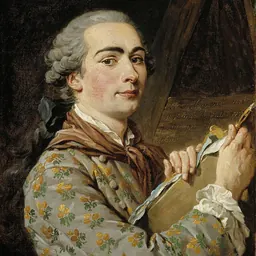
John Francis Rigaud (18 May 1742 – 6 December 1810) was a British painter who specialised in history painting and portrait painting. Of French descent, he was born in Turin and spent most of his career in England.
Early life Rigaud was born in Turin on 18 May 1742 and baptised on 9 September. He was the second son of James Dutilh or Rigaud and Jeanne Françoise Guiraudet. His father came from a family of Protestant merchants; his grandfather Jacques Dutilh had fled from Lyon to Geneva with his family after the revocation of the Edict of Nantes. Jacques died on the journey, and his widow assumed her maiden nameRigaudby which the family became known. John had a brother Jacques Etienne Rigaud born 16 Jan 1741 and died 7 Mar 1767 at Turin.
Having demonstrated an artistic ability, Rigaud studied with Claudio Francesco Beaumont of Turin, a historical painter to the king of Sardinia. He left Beaumont to travel to Italy and study painting in Florence and Bologna, where he was made a member of the Accademia Clementina in 1766. He then travelled to Rome, but had to return home due to family considerations. In January 1768, he set off once again, this time to Piacenza, Parma, Bologna, and then, once again, to Rome. He settled there and studied the city's art, particularly the old masters, and participated in life-drawing schools. There, he produced what the Dictionary of National Biography describes as "one of his most important works": Hercules Resting from his Labours.
While Rigaud consistently exhibited paintings at the Royal Academyshowing a total of 155 works there between 1772 and 1815 – "his most lucrative and engrossing employment was decorative painting for the town and country houses of the nobility, including Lord Gower, Lord Sefton, and the Earl of Aylesford". The architect William Chambers offered him work in London at Melbourne House in Piccadilly (1772 and 1774) and at Somerset House (1780). He also helped decorate the Common Council Chamber of the Guildhall in London (1794) and Trinity House (1796). According to the Dictionary of National Biography, all these works were "executed in the fashionable Italian style of G. B. Cipriani and Biagio Rebecca, being mostly classical figures and imitations of bas-reliefs". Johann Reinhold Forster and Georg Forster in Tahiti, by John Francis Rigaud 1780.
Rigaud also produced history paintings, such as Entry of the Black Prince into London with his Royal Prisoner (1775), and several works for the galleries of Thomas Macklin and Robert Bowyer, and for the Shakespeare Gallery of John Boydell in the late 1780s. According to the Dictionary of National Biography, "his historical paintings were not well received". His "descent from the Cross," painted in 1780 is now visible in the Church of St Anselm and St Cecilia which was built after the destruction of the Sardinian Embassy Chapel during the Gordon riots.
Rigaud was also a portrait painter, and painted a group portrait of the artists Francesco Bartolozzi, Agostino Carlini, and Giovanni Battista Cipriani in 1777 and another of Sir Joshua Reynolds, Sir William Chambers, and Joseph Wilton in 1782. He also painted a series of naval heroes, including Lord Nelson. According to the Dictionary of National Biography, his portraits "tend to be strongly characterized and boldly conceived, even occasionally eccentric". . Rigaud married Mary Williams (1740? – 1808) on 21 July 1774. They had three daughters and one son, Stephen Francis Dutilh Rigaud, who also became a painter.
After his wife's death, Rigaud lived with his son.
Death He died from apoplexy on 6 December 1810 at Packington Hall in Warwickshire and was buried in St James' Church, Great Packington.
Gallery
Don’t just read it —
keep it.
Full-length biographies made to live with: read them, listen on the way to work, watch them tonight.
- E-book
- Audio
- Video
Instant download · yours to keep · every purchase keeps this site free
Important facts
more
J.F. Rigaud, Jean-François Rigaud, R. A. J. F. Rigaud, J. F. Rigaud, Mr. Rigaud. R.A., Regaud, J.F. Rigaud. R.A., R.A. F. Rigaud, R.A. J.F. Rigaud, John Francis RegaudPeople in John Francis Rigaud's life
Named in this biography and alive at the same time




Related people
Same field, nearest in time


Contemporaries
People whose lives overlapped John Francis Rigaud's





Frequently asked questions
Who was John Francis Rigaud?
British artist (1742-1810)
When was John Francis Rigaud born?
John Francis Rigaud was born on 18 May 1742 in Turin.
When did John Francis Rigaud die?
John Francis Rigaud died on 6 December 1810 in Great Packington.
What was John Francis Rigaud's occupation?
John Francis Rigaud was a painter and translator.
What nationality was John Francis Rigaud?
John Francis Rigaud was British.
Sources & further reading
· Wikipedia: John Francis Rigaud
· DBpedia: John Francis Rigaud
Cite this page
APA: Biography.guide. (2026). John Francis Rigaud. https://biography.guide/john-francis-rigaud/
MLA: "John Francis Rigaud." Biography.guide, https://biography.guide/john-francis-rigaud/.
Chicago: "John Francis Rigaud." Biography.guide. https://biography.guide/john-francis-rigaud/.
Data last updated: 2026-09-25 · Spot an error? Report a correction.
Page generated 2026-09-27 05:10 UTC