
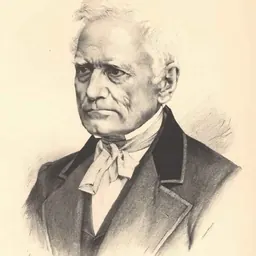
John Ferguson McLennan
British lawyer and ethnologist
About John Ferguson McLennan
Lived 1827 – 1881 (aged 53). John Ferguson McLennan was a British and Scottish anthropologist, lawyer, social anthropologist and ethnologist.
John Ferguson McLennan FRSE LLD (14 October 1827 – 16 June 1881), was a Scottish advocate, social anthropologist and ethnologist.
Life
He was born in Inverness, the son of John McLennan, an insurance agent, and his wife, Jessie Ross. He was educated in that city, then studied law at King's College, Aberdeen, graduating M.A. in 1849. He then entered Trinity College, Cambridge, where in 1853 he obtained a Wrangler's place (first class) in the Mathematical Tripos. He left Cambridge without taking a degree there.
McLennan then spent two years in London writing for The Leader, at that time edited by George Henry Lewes, and other periodicals. He may well have attended one of the Inns of Court. During this period he knew George Eliot and William Michael Rossetti, and dabbled in verse in the Pre-Raphaelite style.
On returning to Edinburgh, he was called to the Scottish bar in January 1857. He became secretary to the Scottish Law Amendment Society, and took an active part in the agitation which led to the Court of Session Act 1868 (31 & 32 Vict. c. 100). As a man of letters, he worked with Alexander Smith.
In 1870 McLennan's first wife died, and he moved back to London. In 1871, he took the post of parliamentary draughtsman for Scotland.
His health, however, was already thoroughly undermined by tuberculosis (or consumption), and while wintering in Algeria he suffered from repeated attacks of malarial fever. He died of tuberculosis on 16 June 1881 at Hayes Common, Kent.
Publications McLennan undertook the article on "Law" for the eighth edition of the Encyclopædia Britannica. It looked back to the Scottish tradition of Adam Ferguson and Adam Smith;
In 1865, McLennan published Primitive Marriage. In it he argued from symbolic and ceremonial forms of bride kidnapping (see also Types of marriage). His ideas had been partially anticipated by Johann Jakob Bachofen, writing in 1861 on matriarchy, but were independent. McLennan developed from ethnographic data a social evolutionist theory of marriage, and also of systems of kinship according to natural laws. He rejected patriarchal society as an early stage, arguing in favour of agnation as a more basic evolutionary point; he proposed an early model of social groups, a war band mainly male, practicing female infanticide and acquiring female sexual partners, with promiscuity and matrilineality salient features. of the Encyclopedia Britannica, 1911 edition.
Influence McLennan's work had implications for the field of history of religion. In the study The Worship of Animals and Plants (two parts, 1869–70) McLennan suggested a connection between social structures and primitive religions; and he coined the word "totemism" for the social function of primitive religion. This concise term proved to be useful to later historians of religion, and sociologists like William Robertson Smith and Émile Durkheim (among others). The following quote by McLennan (1865) contains the basic premise for the comparative method (as used by Robertson Smith): In the sciences of law and society, old means not old in chronology, but in the structure: that is most archaic which lies nearest to the beginning of human progress considered as a development, and that is most modern which is farthest removed from the beginning.
For Robertson Smith, McLennan's comparative method proved to be important. One of Robertson Smith's more influential essays, Animal Worship and Animal Tribes among the Arabs and in the Old Testament, directly follows MacLennan's ideas on totemism. It connected contemporary Arab nomads and ancient biblical peoples with the social function of totemism in primitive religions.
Family McLennan married twice: On 23 December 1862, to Mary Bell Ramsay McCulloch, daughter of John Ramsay McCulloch, by whom he had one daughter; On 20 January 1875, to Eleonor Anne Brandram, daughter of Francis Holles Brandram, J.P. for the counties of Kent and Sussex, who died in 1896.
Don’t just read it —
keep it.
Full-length biographies made to live with: read them, listen on the way to work, watch them tonight.
- E-book
- Audio
- Video
Instant download · yours to keep · every purchase keeps this site free
Important facts
People in John Ferguson McLennan's life
Named in this biography and alive at the same time



Related people
Same field, nearest in time

Contemporaries
People whose lives overlapped John Ferguson McLennan's




Frequently asked questions
Who was John Ferguson McLennan?
British lawyer and ethnologist (1827–1881)
When was John Ferguson McLennan born?
John Ferguson McLennan was born on 14 October 1827 in Inverness.
When did John Ferguson McLennan die?
John Ferguson McLennan died on 16 June 1881 in Hayes Common.
What was John Ferguson McLennan's occupation?
John Ferguson McLennan was an anthropologist, lawyer, social anthropologist and ethnologist.
What nationality was John Ferguson McLennan?
John Ferguson McLennan was British and Scottish.
Sources & further reading
· Wikipedia: John Ferguson McLennan
· DBpedia: John Ferguson McLennan
Cite this page
APA: Biography.guide. (2026). John Ferguson McLennan. https://biography.guide/john-ferguson-mclennan/
MLA: "John Ferguson McLennan." Biography.guide, https://biography.guide/john-ferguson-mclennan/.
Chicago: "John Ferguson McLennan." Biography.guide. https://biography.guide/john-ferguson-mclennan/.
Data last updated: 2026-09-20 · Spot an error? Report a correction.
Page generated 2026-09-27 05:33 UTC