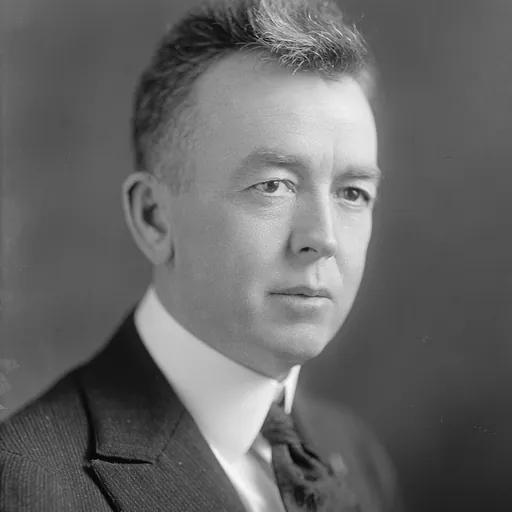
John Elliott Rankin
Former U.S. Representative from Mississippi
About John Elliott Rankin
Lived 1882 – 1960 (aged 78). John Elliott Rankin was an American politician, lawyer, journalist and university teacher.
John Elliott Rankin (March 29, 1882 – November 26, 1960) was a Democratic politician from Mississippi who served sixteen terms in the U.S. House of Representatives from 1921 to 1953. He was co-author of the bill for the Tennessee Valley Authority and from 1933 to 1936 he supported the New Deal programs of President Franklin D. Roosevelt, which brought investment and jobs to the South.
Rankin proposed a bill to prohibit interracial marriage and opposed a bill to prohibit state use of the poll tax, which southern states had used since the turn of the century to disenfranchise most blacks and many poor whites. He used his power to support segregation and deny federal benefits programs to African Americans. For instance, in 1944, following the Port Chicago disaster, the U.S. Navy asked Congress to authorize payments of $5,000 to each of the victims' families. But when Rankin learned most of the dead were black sailors, he insisted the amount be reduced to $2,000; Congress settled the amount at $3,000 per family.
He was the main House sponsor of the G.I. Bill. Rankin insisted that its administration be decentralized, which led to continued discrimination against black veterans in the South and their virtual exclusion from one of the most important postwar programs to build social capital among United States residents. In the South, black veterans were excluded from loans, training and employment assistance. The historically black colleges were underfunded and could accept only about half the men who wanted to enroll.
On the floor of the House, Rankin expressed racist views of African Americans, Japanese Americans, and Jews, accusing Albert Einstein of being a communist agitator. During World War II, Rankin supported a bill that would incarcerate all Japanese Americans in the US and its territories in what he called "concentration camps". He later helped to establish the House Un-American Activities Committee which questioned the Hollywood Ten screenwriters during the McCarthy Era. He described an anti-lynching bill as "a bill to encourage Negroes to think they can rape our white women!" while shaking his fist at a gallery of mostly colored persons.
Early life Rankin was born on March 29, 1882, near Bolands in Itawamba County, Mississippi to a family that had planter ancestors with large holdings before the Civil War. His parents were Thomas Braxton Rankin, a schoolteacher and resident of Tupelo, and Venola Modeste (née Rutledge), born in Arkansas as the daughter of Robert Rutledge and Ellen (née Conoway) Rutledge. His paternal ancestors had come to Mississippi from South Carolina in 1840.
After attending local schools and a normal school, Rankin attended college, graduating from the University of Mississippi law school in 1910. He was admitted to the bar the same year and established a practice in Clay County, near where he grew up. From 1911 to 1915, he served as the prosecuting attorney of Lee County.
He married Annie Laurie Burrous; the couple had a daughter, Annie Laurie Rankin.
He became prosecuting attorney of Lee County in 1912, a position he held until 1915.
Military service Rankin served in the United States Army, enlisting just before the end of World War I. In all, he spent 21 days at the Army's officers’ training camp. He would use his brief stint in the military to his political advantage, frequently portraying himself as a former war soldier who supported his fellow veterans.
Political career Rankin twice ran unsuccessfully for Congress, in 1916 and 1918. He then started a newspaper called The New Era, which published anti-immigrant rhetoric and openly defended segregation and lynching.
Election to Congress Since passage of a new constitution in 1890 that effectively disenfranchised African Americans, Mississippi had become a one-party state dominated by Democrats.
Roosevelt signing the Rural Electrification Act in 1935, with Rankin (left) and Senator George W. Norris (R-Nebraska) (right). In 1920, Rankin ran once again for a seat in the U.S. House of Representatives, challenging Democratic incumbent Ezekiel Candler. During the campaign, Rankin pledged to support national Jim Crow laws, using his newspaper as a venue to promote his candidacy. With the support of the local labor unions, Rankin defeated Candler in a runoff. Rankin would serve sixteen consecutive terms (March 4, 1921 – January 3, 1953) as Mississippi's First District Representative.
Southern clout Appointed to the Census Committee as a freshman congressman, Rankin played an important role in opposing a reapportionment bill that would have reduced the representation of Mississippi, as well as one to reduce the overall representation of the South. Both bills were based on the fact that Southern states had disenfranchised most of their black voters but kept apportionment based on total population in each state, resulting in outsize representation for their white populations. The powerful Democrats consistently defeated northern representatives' effort to reduce southern apportionment.
Bid for House speakership In 1932, Rankin (at the time identified with the progressive wing of the Democratic Party ) stood as a candidate for Speaker of the House. In the end, Rankin lost, gaining only 20 votes compared to 166 votes for the victor Henry T. Rainey and 112 for Rainey’s main rival John McDuffie.
Tennessee Valley Authority Rankin testifying before a joint congressional committee investigating the Tennessee Valley Authority in 1938. Rankin coauthored the bill to create the Tennessee Valley Authority, bringing major investment into the rural South. He was a supporter of the Rural Electrification Administration under President Roosevelt's administration, which also benefited many Southerners. He strongly supported Roosevelt's New Deal and advocated economic intervention in poor rural communities, but expected that most benefits would flow to southern whites.
Support for segregation He supported racial segregation and opposed civil rights legislation. He claimed that the constitutional rights of blacks were best protected through segregation throughout the United States, and that the racist use of a poll tax in elections was a defense against a Communist plot to undermine American elections.
After 1937, he became active in the Conservative Coalition that largely controlled domestic policy.
Populist issues Rankin supported the Judicial Procedures Reform Bill of 1937, known as the "court-packing plan." The bill itself never came up for a vote in either congressional chamber, although he voted for its substitute version in the U.S. House that would have provided additional incentives for the retirement of U.S. Supreme Court justices in order to ensure new appointments by President Roosevelt.
Rankin opposed the creation of the UN, stating, "The United Nations is the greatest fraud in all History. Its purpose is to destroy the United States."
In the 1948 United States presidential election, Rankin opposed the re-election of President Harry S. Truman and supported the Dixiecrat ticket headed by Strom Thurmond and Fielding L. Wright. He was subsequently removed by the House Democratic leadership from the HUAC.
Veteran's affairs Rankin chaired the Committee on World War Veterans' Legislation (Seventy-second through Seventy-ninth Congresses) and the Committee on Veterans' Affairs (Eighty-first and Eighty-second Congresses).
During the 1951 espionage trial of Julius and Ethel Rosenberg, who were charged with and convicted of passing information about the atomic bomb to the Soviet Union, Rankin was condemned by Jewish groups for repeatedly calling the Rosenbergs a pair of "communist kikes".
Japanese Americans In his first term as representative, Rankin introduced an anti-miscegenation bill to prevent whites from marrying "Mongolians" and African Americans. A decade later, in 1930 he lobbied against Hawaii's bid for statehood on the grounds that it would add "two Jap senators" to Congress.
Rankin was one of the few Southern congressmen to support West Coast politicians and lobbyists calling for the mass incarceration of Japanese Americans, proposing that every person of Japanese ancestry in the United States be deported at the end of the war. He reintroduced a defeated "concentration camp bill" to remove ethnic Japanese from the country and all U.S. territories. (Most ethnic Japanese Americans were removed from the West Coast.) As the war progressed, he continued to speak out against Japanese Americans, testifying in favor of labeling Japanese and African American blood donations to prevent them from "contaminating" white recipients and limiting the segregated 442nd Regimental Combat Team to labor battalions instead of active combat.
Senatorial aspirations In 1947 Rankin ran for the Democratic nomination for the U.S. Senate that was vacated by the death of Theodore G. Bilbo in office. He finished last among five major candidates with 13% of the vote.
Final years and death In 1952, Rankin was defeated for re-nomination to the House by fellow Democratic Congressman Thomas G. Abernethy after their districts were joined through redistricting. At that time, most blacks in Mississippi were still disenfranchised, a status that persisted until after Congressional passage of the Voting Rights Act of 1965.
Rankin died at his home in Tupelo on November 26, 1960. He is interred in Greenwood Cemetery in West Point, Mississippi.
Don’t just read it —
keep it.
Full-length biographies made to live with: read them, listen on the way to work, watch them tonight.
- E-book
- Audio
- Video
Instant download · yours to keep · every purchase keeps this site free
Important facts
People in John Elliott Rankin's life
Named in this biography and alive at the same time




Related people
Same field, nearest in time




Contemporaries
People whose lives overlapped John Elliott Rankin's




Frequently asked questions
Who was John Elliott Rankin?
former U.S. Representative from Mississippi (1882-1960)
When was John Elliott Rankin born?
John Elliott Rankin was born on 29 March 1882 in Itawamba County.
When did John Elliott Rankin die?
John Elliott Rankin died on 26 November 1960 in Tupelo.
What was John Elliott Rankin's occupation?
John Elliott Rankin was a politician, lawyer, journalist and university teacher.
What nationality was John Elliott Rankin?
John Elliott Rankin was American.
Sources & further reading
· Wikipedia: John Elliott Rankin
Cite this page
APA: Biography.guide. (2026). John Elliott Rankin. https://biography.guide/john-elliott-rankin/
MLA: "John Elliott Rankin." Biography.guide, https://biography.guide/john-elliott-rankin/.
Chicago: "John Elliott Rankin." Biography.guide. https://biography.guide/john-elliott-rankin/.
Data last updated: 2026-09-23 · Spot an error? Report a correction.
Portrait: Wikimedia Commons · author & licence
Page generated 2026-09-27 05:07 UTC