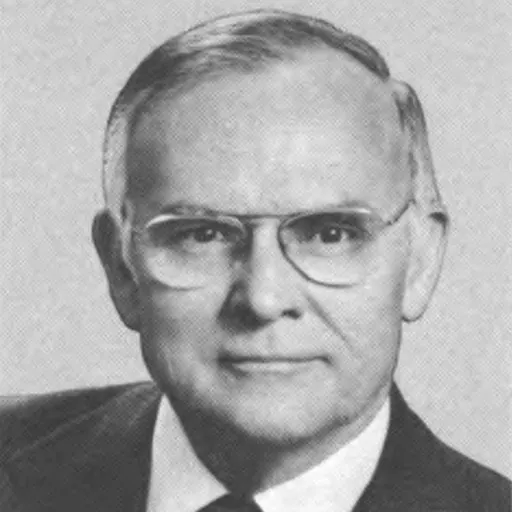
About John E. Moss
Lived 1915 – 1997 (aged 82). John E. Moss was an American politician.
John Emerson Moss (April 13, 1915 – December 5, 1997) was an American World War II veteran and politician of the Democratic Party, noted for his championing of the federal Freedom of Information Act (FOIA) through multiple sessions of the United States House of Representatives where he served from 1953 to 1978.
Biography Moss was born in Hiawatha, Utah, in 1915, and moved with his family to Sacramento, California, in 1923 where he attended public school and Sacramento Junior College. He held various sales, credit executive, and retail jobs from 1938 and 1943. In 1935 he married Jean Kueny, the daughter of Joseph and Winnefred (née West) Kueny of Galt, California. Together they had two daughters, Jennifer Afton and Allison Effie. In 1938 he joined the California Democratic State Central committee where he remained until 1980. He died in San Francisco, California, in 1997.
Moss served in the United States Navy during World War II and was elected to the California State Legislature in 1949, where he served as the Democratic floor leader until 1952.
U.S. House of Representatives Moss served in the US House of Representatives for California's 3rd congressional district for 13 terms from 1953 until he retired in 1978. He was nominated by both the Democratic and Republican parties in 1958 and ran unopposed in 1960. Moss earned the distinction of never being defeated in an election for public office.
Moss held the chair for the following subcommittees in the House of Representatives: Special Subcommittee on Government Information Foreign Operations and Government Information Subcommittee of the House Government Operations Committee Commerce and Finance and Oversight and Investigations Subcommittees of the Committee on Interstate and Foreign Commerce Oversight and Investigations Subcommittee, Committee on Interstate and Foreign Commerce
He also served on the following committees: Natural Resources Subcommittee on Water, Power and Oceans Subcommittee on Government Information and Individual Rights Subcommittee on Legislation and National Security Committees on Post Office and Civil Service and House Administration Joint Committee on Atomic Energy
Tenure
His legislative record includes: Freedom of Information Act (FOIA), which he authored and sponsored through several iterations Consumer Product Safety Act, which he authored and advocated Federal Trade Commission Improvements Act, also known as the Magnuson-Moss Act Deregulatory legislation to establish NASDAQ Consumer protection legislation, including protection against hazards related to automobiles, toys, tires, flammability standards for children's clothing, and toxins.
Moss also played an active role in furthering legislative oversight, chairing hearings related to the World Uranium Cartel, FBI foreign security surveillance during the Vietnam War, abuse in federal contracting, GAAP, defensive medicine, pricing and supply of natural gas, passive restraint systems for passenger cars, regulation of pesticides, and amendments to the Foreign Corrupt Practices Act. Congressman Moss is considered the father of modern legislative oversight.
On May 1, 1973, Moss was also the first to call for the House to set up procedures for a bill of impeachment during the Watergate scandal.
Freedom of Information Act
Moss has been noted for his determination in passing the Freedom of Information Act into law. As chairman of the Government Information Subcommittee it took Moss 6 congressional sessions (over 12 years) to get the Freedom of Information Act through Congress successfully. Much of the desire for government transparency stemmed from the Department of Defense and Congressional committees evaluation of the nation's classification system in the late 1950s. They determined that the misuse of government classification of documents was causing insiders to leak documents that were marked "confidential". The Moss Committee took it upon itself to reform confidentiality policy and implement punishments for the overuse of classification by officials and departments. The landmark bill was signed into law by a reluctant Lyndon B. Johnson on July 4, 1966.
Death and burial Moss died in San Francisco on December 5, 1997, and was interred in Odd Fellows Lawn Cemetery and Mausoleum in Sacramento.
Electoral history
Don’t just read it —
keep it.
Full-length biographies made to live with: read them, listen on the way to work, watch them tonight.
- E-book
- Audio
- Video
Instant download · yours to keep · every purchase keeps this site free
Important facts
People in John E. Moss's life
Named in this biography and alive at the same time


Related people
Same field, nearest in time






Contemporaries
People whose lives overlapped John E. Moss's



Frequently asked questions
Who was John E. Moss?
American politician (1915-1997)
When was John E. Moss born?
John E. Moss was born on 13 April 1915 in Hiawatha.
When did John E. Moss die?
John E. Moss died on 5 December 1997 in San Francisco.
What was John E. Moss's occupation?
John E. Moss was a politician.
What nationality was John E. Moss?
John E. Moss was American.
Sources & further reading
Cite this page
APA: Biography.guide. (2026). John E. Moss. https://biography.guide/john-e-moss/
MLA: "John E. Moss." Biography.guide, https://biography.guide/john-e-moss/.
Chicago: "John E. Moss." Biography.guide. https://biography.guide/john-e-moss/.
Data last updated: 2026-09-22 · Spot an error? Report a correction.
Portrait: Wikimedia Commons · author & licence
Page generated 2026-09-27 05:02 UTC