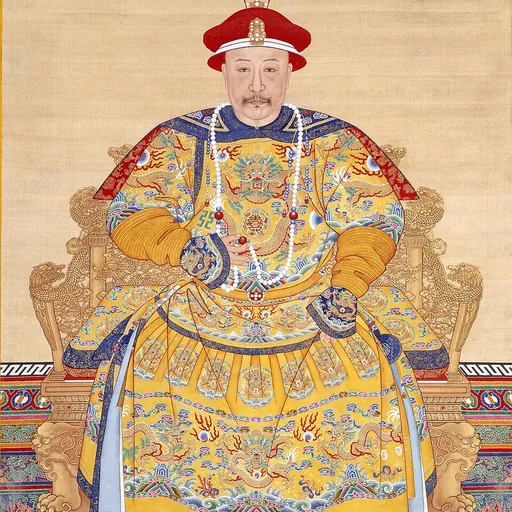
About Jiaqing Emperor
Lived 1760 – 1820 (aged 59). Jiaqing Emperor was a Chinese politician.
The Jiaqing Emperor (13 November 1760 – 2 September 1820), also known by his temple name Emperor Renzong of Qing, personal name Yongyan, was the sixth emperor of the Qing dynasty and the fifth Qing emperor to rule over China proper. He was the 15th son of the Qianlong Emperor. During his reign, he prosecuted Heshen, the corrupt favorite of his father and attempted to restore order within the empire while curbing the smuggling of opium into China. Assessments of his reign are mixed, either seen as the "beginning of the end" of the Qing dynasty, or as a period of moderate reform that presaged the intellectual movements of the 1860s.
Early years
Yongyan was born in the Old Summer Palace, 8 km (5 mi) northwest of the walls of Beijing. His personal name, "Yongyan" , was later changed to "Yongyan" when he became the emperor. The Chinese character for yong in his name was changed from the more common to the less common . This novelty was introduced by the Qianlong Emperor, who believed that it was not proper to have a commonly used Chinese character in an emperor's personal name due to the longstanding practice of naming taboo in the imperial family since the time of ancient China.
Yongyan was the 15th son of the Qianlong Emperor. His mother was Noble Consort Ling, the daughter of Wei Qingtai , an ethnic Han Chinese official whose family had been long integrated into the Manchu Eight Banners as part of a Han Banner.
The Qianlong Emperor originally had two other sons in mind for succeeding him, but both of them died early from diseases, hence in December 1773 he secretly chose Yongyan as his successor. In 1789, the Qianlong Emperor instated Yongyan as "Prince Jia of the First Rank" (; or simply "Prince Jia").
Accession to the throne In October 1795, the 60th year of his reign, the Qianlong Emperor announced his intention to abdicate in favour of Prince Jia. He made this decision because he felt that it was disrespectful for him to rule longer than his grandfather, the Kangxi Emperor, who was on the throne for 61 years. Prince Jia ascended the throne and adopted the era name "Jiaqing" in February 1796, hence he is historically known as the Jiaqing Emperor. For the next three years, however, the Jiaqing Emperor was emperor in name and rite only because decisions were still made by his father, who became a Taishang Huang (emperor emeritus) after his abdication.
After the death of the Qianlong Emperor in the beginning of February 1799, the Jiaqing Emperor took control of the government and prosecuted Heshen, a favourite official of his father. Heshen was charged with corruption and abuse of power, stripped of his titles, had his property confiscated, and ordered to commit suicide. Heshen's daughter-in-law, Princess Hexiao, a half-sister of the Jiaqing Emperor, was spared from punishment and given a few properties from Heshen's estates. The Jiaqing Emperor commuted the death sentence of the scholar Hong Liangji who had criticised the policies of the Qianlong Emperor and Heshen, instead exiling him to a remote part of northern China and pardoning him altogether in 1800.
Heshen was described as the 'primary evil' effecting the Empire, and after his removal the Emperor pursued a series of reforms of the court, civil service and treasury. He was a traditionalist in terms of his role as an ethnic Manchu leader, taking parts in imperial hunts, inspection tours, and upholding strict court protocol.
The impact of the Jiaqing Emperor's reforms are questionable, with the Emperor described by Jonathan Spence as having 'relied on rhetoric more than specific policies to cleanse his empire', with Heshen's clique soon replaced by other bureaucratic factions. Lin was later executed by slicing.
Foreign relations
In 1816, William Amherst, 1st Earl Amherst was sent as ambassador extraordinary to the court, intending to establish more satisfactory commercial relations between China and Great Britain. The Amherst Embassy proved a failure as a result of Amherst's refusal to perform a kowtow to the Emperor, but would prove to have a significant impact on British views of China and the Qing dynasty.
The Jiaqing Emperor refused the Vietnamese ruler Gia Long's request to change his country's name to Nam Việt, but agreed that it could be changed to Việt Nam instead. Gia Long's Đại Nam thực lục contains the diplomatic correspondence over the naming.
Opposition to Christianity The Great Qing Legal Code includes one statute titled "Prohibitions Concerning Sorcerers and Sorceresses" . In 1811, a clause was added to it with reference to Christianity. It was modified in 1815 and 1817, settled in its final form in 1839 under the Daoguang Emperor, and repealed in 1870 under the Tongzhi Emperor. It sentenced Europeans to death for spreading "the religion of the Lord of Heaven" among Han Chinese and Manchus. While "the Lord of Heaven" (, Tiānzhǔ) was primarily used as a translation of the name of the Christian God by Catholic missionaries and this could be taken to imply that the statute was primarily directed against Catholicism, it became clear in the 1830s that the Qing government considered the ban to apply to other forms of Christianity as well. Christians who would not repent their conversion were sent to Muslim cities in Xinjiang, to be given as slaves to Muslim leaders and beys.
Chinese nobility The Jiaqing Emperor granted the title Wujing Boshi to the descendants of Tang essayist Han Yu.
Personal life and interests
The Jiaqing Emperor commissioned printed compendia of courtly collections, which are an important source for our present understanding of Qing court art.
Family
Empress Xiaoshurui , of the Hitara clan (; 2 October 1760 – 5 March 1797) Second daughter (2 June 1780 – 6 September 1783) Minning , the Daoguang Emperor (; 16 September 1782 – 26 February 1850), second son Princess Zhuangjing of the First Rank (; 20 October 1784 – 27 June 1811), fourth daughter Married Manibadala (; d. 1832), of the Tumed Borjigin clan, in November/December 1802 Miscarriage at three months (18 August 1785)
Empress Xiaoherui , of the Niohuru clan (; 20 November 1776 – 23 January 1850) Seventh daughter (2 August 1793 – 16 July 1795) Miankai , Prince Dunke of the First Rank (; 6 August 1795 – 18 January 1838), third son Mianxin , Prince Ruihuai of the First Rank (; 9 March 1805 – 27 September 1828), fourth son Imperial Noble Consort Heyu , of the Liugiya clan (; 9 January 1761 – 27 April 1834) Prince Mu of the Second Rank (; 4 February 1780 – 10 June 1780), first son Princess Zhuangjing of the Second Rank (; 30 January 1782 – 4 April 1811), third daughter Married Sodnamdorji (; d. 1825), of the Khorchin Borjigin clan, on 24 December 1801, and had issue (one daughter)
Imperial Noble Consort Gongshun , of the Niohuru clan (; 28 May 1787 – 23 April 1860) Eighth daughter (8 March 1805 – 14 January 1806) Princess Huimin of the First Rank (; 18 February 1811 – 28 June 1815), ninth daughter Mianyu , Prince Huiduan of the First Rank (; 8 March 1814 – 9 January 1865), fifth son Consort Shu , of the Wanyan clan (; d. 1792) Consort Hua , of the Hougiya clan (; d. 3 August 1808), personal name Liuniu Sixth daughter (2 August 1789 – June/July 1790) Consort Zhuang , of the Wanyan clan (; d. 9 March 1811) Consort Xin , of the Liugiya clan (; 26 April 1783 – 26 November 1822) Concubine Jian , of the Gūwalgiya clan (; d. 14 May 1780) First daughter (14 May 1780 – 24 November 1783) Concubine Xun , of the Shen clan (; d. 31 December 1786) Princess Hui'an of the Second Rank (; 31 December 1786 – June/July 1795), fifth daughter Concubine Chun , of the Donggiya clan (; d. 30 November 1819) Concubine En , of the Uya clan Concubine Rong , of the Liang clan Concubine An , of the Gūwalgiya clan (; 1 March 1785 – 29 July 1837) Noble Lady Yun , of a certain clan (; d. 1805) Noble Lady Yu , of a certain clan First Class Attendant Hui , of a certain clan
Don’t just read it —
keep it.
Full-length biographies made to live with: read them, listen on the way to work, watch them tonight.
- E-book
- Audio
- Video
Instant download · yours to keep · every purchase keeps this site free
Important facts
People in Jiaqing Emperor's life
Named in this biography and alive at the same time


Related people
Same field, nearest in time



Contemporaries
People whose lives overlapped Jiaqing Emperor's




Frequently asked questions
Who was Jiaqing Emperor?
Chinese emperor (1760-1820) of the Qing dynasty
When was Jiaqing Emperor born?
Jiaqing Emperor was born on 13 November 1760 in Old Summer Palace.
When did Jiaqing Emperor die?
Jiaqing Emperor died on 2 September 1820 in Chengde Mountain Resort and its outlying temples.
What was Jiaqing Emperor's occupation?
Jiaqing Emperor was a politician.
What nationality was Jiaqing Emperor?
Jiaqing Emperor was Chinese.
Sources & further reading
Cite this page
APA: Biography.guide. (2026). Jiaqing Emperor. https://biography.guide/jiaqing-emperor/
MLA: "Jiaqing Emperor." Biography.guide, https://biography.guide/jiaqing-emperor/.
Chicago: "Jiaqing Emperor." Biography.guide. https://biography.guide/jiaqing-emperor/.
Data last updated: 2026-09-23 · Spot an error? Report a correction.
Portrait: Wikimedia Commons · author & licence
Page generated 2026-09-27 05:08 UTC