
About Jean-Baptiste Dumangin
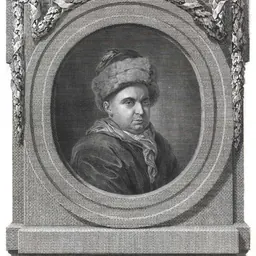
Lived 1744 – 1826 (aged 82). Jean-Baptiste Dumangin was a French physician, known for Louis XVII.
Jean-Baptiste Eugénie Dumangin (or Du Mangin) (7 March 1744 – 28 March 1826) was a French medical doctor known to have participated in the final treatment and autopsy of Louis XVII, the younger son of King Louis XVI and Queen Marie Antoinette. His two favourite fields were therapeutics and hygiene.
Biography He was born in Château-Thierry (Aisne), son of Jean Dumangin (1710–1769), directeur des Aides, and Jeanne Eugénie de La Haye de la Gonnière. He was received as a doctor in Paris on 15 September 1768 and made "acte de régence" on 17 September of the same year. In 1780, he was elected Professor of Pharmacy at the Faculty of Medicine and Doctor of the Hôpital de la Charité (renamed Hospice de l'Unité during the revolutionary period) in Paris. He worked there with Jean-Nicolas Corvisart (1755–1821), who became Napoleon's first physician and a member of the Académie Nationale de Médecine.
He was editor of the Journal de médecine, de chirurgie et de pharmacie from 1776.
On 18 May 1789, during the election of Abbé Sieyès, he wrote a protest against the election of a clergyman by the assembly of the Third State.
He was a member of the "Permanent Committee" set up on 13 July at the Town Hall to provide for the subsistence and organisation of the militia; then, three weeks later, he was a member of the "Provisional Committee for Police, Security and Tranquillity" of Paris. As a member of this committee, he signed a decree suspending the performances of Marie-Joseph Chénier's tragedy, Charles IX, or St. Bartholomew's day. He became a member of the Société des Amis de la Constitution and joined the Feuillants club on 18 July 1791. It represented the last and most vigorous attempt of the moderate constitutional monarchists to steer the course of the revolution away from the radical Jacobins.
The National Legislative Assembly (1 October 1791) did not include Dumangin in its ranks and he was sought during the Terror.
Buyer of Biens nationaux On January 8, 1791, Dumangin acquired the "Château de Rubelles" in Saint-Prix, a village of 515 inhabitants north-west of Paris in the Montmorency valley. He had it demolished to keep only the "Château des Vendôme" acquired in the same lot. This property belonged to André Louis Sulpice d'Albert who died on 22 December 1788, former president of the "Cour des monnaies".
Dumangin bought other property by dispossessing the former lord of Saint-Prix, François Nicolas Le Bas du Plessis (1740–1819). On 13 September 1797, Demangin denounced Mme du Plessis, wife of this lord of Saint-Prix, as an emigrant and liable to deportation. On 9 November he took the lot and reunited the two hectares adjoining his residence with the ten hectares of the seigniory: the "château" and the park of Saint-Prix. exchanged for prominent French prisoners (Pierre Riel de Beurnonville, Jean-Baptiste Drouet, Hugues-Bernard Maret, Armand-Gaston Camus, Nicolas Marie Quinette, and Charles-Louis Huguet de Sémonville) and taken to Vienna, the capital city of her cousin, the Holy Roman Emperor Francis II, and also her mother's birthplace. The young prince had pains in his knees and ankles and was bloated. On 9 June, four members of the General Security Committee visited the corpse and noted the death. He wrote:
Empire and Restoration In 1801, Dumangin was one of the twenty-four members of the General Council of the Department of the Seine, which served as Paris City Council.
On 27 January 1809, at the age of 64, he married his third wife, Anne de Coste de la Calprenède, aged 21, a distant descendant of Gauthier de Costes, seigneur de la Calprenède.
A final episode opposed Pelletan and Dumangin after the Bourbon Restoration of 1815. Following a tradition of preserving royal hearts, Louis XVII's heart was removed and smuggled out during the autopsy by Pelletan. Thus, Louis' heart was not interred with the rest of the body. Pelletan stored the smuggled heart in distilled wine in order to preserve it. However, after 8 to 10 years the distilled wine had evaporated, and the heart was from that time kept dry.
In 1817, Pelletan attempted to give the Louis XVII's heart to his uncle, Louis XVIII, because the king had expressed his intention to show some gratitude to those who had shown sympathy for his family in times of trouble. But Pelletan did not mention his colleague Dumangin: the latter expressed his displeasure and a discussion arose between the two doctors. Anyway, Louis XVIII refused the "gift" because he could not bring himself to believe that was the heart of his nephew. Pelletan then donated the heart to the Archbishop of Paris, Hyacinthe-Louis de Quélen.
After forty years of service in the hospital, Dumangin retired in 1820 at Saint-Prix, Val-d'Oise, near Montmorency, where he died on 28 March 1826 at the age of 82 without obtaining the Legion of Honour.
Don’t just read it —
keep it.
Full-length biographies made to live with: read them, listen on the way to work, watch them tonight.
- E-book
- Audio
- Video
Instant download · yours to keep · every purchase keeps this site free
Important facts
People in Jean-Baptiste Dumangin's life
Named in this biography and alive at the same time


Related people
Same field, nearest in time


Contemporaries
People whose lives overlapped Jean-Baptiste Dumangin's




Frequently asked questions
Who was Jean-Baptiste Dumangin?
French physician (1745-1826)
When was Jean-Baptiste Dumangin born?
Jean-Baptiste Dumangin was born on 7 March 1744 in Château-Thierry.
When did Jean-Baptiste Dumangin die?
Jean-Baptiste Dumangin died on 28 March 1826 in Saint-Prix.
What was Jean-Baptiste Dumangin's occupation?
Jean-Baptiste Dumangin was a physician.
What was Jean-Baptiste Dumangin known for?
Jean-Baptiste Dumangin was known for Louis XVII.
What nationality was Jean-Baptiste Dumangin?
Jean-Baptiste Dumangin was French.
Sources & further reading
· Wikipedia: Jean-Baptiste Dumangin
· DBpedia: Jean-Baptiste Dumangin
Cite this page
APA: Biography.guide. (2026). Jean-Baptiste Dumangin. https://biography.guide/jean-baptiste-dumangin/
MLA: "Jean-Baptiste Dumangin." Biography.guide, https://biography.guide/jean-baptiste-dumangin/.
Chicago: "Jean-Baptiste Dumangin." Biography.guide. https://biography.guide/jean-baptiste-dumangin/.
Data last updated: 2026-09-26 · Spot an error? Report a correction.
Page generated 2026-09-27 05:14 UTC