
About Jean-Baptiste Biaggi
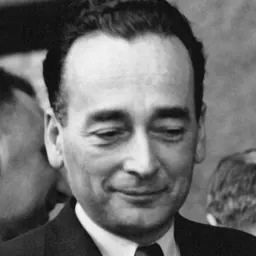
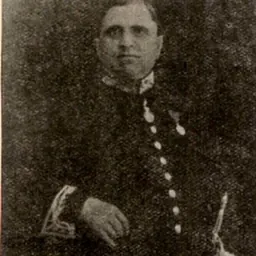
Lived 1918 – 2009 (aged 90). Jean-Baptiste Biaggi was a French and American politician, lawyer and french resistance fighter.
Jean-Baptiste Albert Antoine Biaggi (; 27 August 1918 – 29 July 2009), known to friends as "Bapt", was a French far-right activist, soldier, French Resistance leader, lawyer and politician. He sided with Charles de Gaulle during World War II, welcoming his return from retirement but rejected Gaullism when Algerian self-determination was granted. He retired from mainstream politics but supported the Front National thereafter.
Biography Early years He was born in Ponce, Puerto Rico, the son of Anita Agostini and Pierre-Paul Biaggi, an industrialist. The family moved to the village of Cagnano, Corsica. He studied at the Lycée de Bastia in Corsica, in mainland France at the École Lacordaire in Marseille and then law school, the Faculté de droit de Paris, gaining a Diplômé d’études supérieures de droit. While in Cagnano, he learnt of the extreme-right-wing royalist group Action française. He was influenced by a priest in Corsica, Ange Giudicelli, who was a Maurassien (in spite of the condemnation of Charles Maurras's statements by Pope Pius XI ), and by reading articles in L'Action française, the publication of the eponymous extremist royalist group (also condemned by the Pope), provided by a local retired sailor.
In metropolitain France He studied law in Paris, gaining first prize in civil law in his second year and the general competition prize at the end of his third. While working for his law degree met Jacques Maurras, nephew of Charles Maurras. He became a student delegate for Action Française and, at the Faculté de droit, gave a welcome speech for Maurras senior, who attended the group's student banquet each year. After a nurse saw him moving, he was operated on in the field, with further operations in Lille and Paris. Declared unfit for service, and with further medical intervention in Marseille, he convalesced between that city and Corsica. In 1941 in Marseille, shortly after an operation, he met Alain Griotteray, a resister and future leader of the Orion network who had been asked by its then leader, Henri d'Astier de la Vigerie, to establish a network base in Marseille for connexions with Algiers.
In 1943, Griotteray named the network after the village of Orion in Béarn where the network often operated. He went to Algiers when communication with d'Astier became poor; Biaggi became the leader of Orion in his absence along with fellow lawyers, Robert Le Balle, Xavier Escartin and Michel Alliot as co-leaders. On 13 December 1943, Biaggi and all other leading members were arrested, except Robert La Balle. Biaggi was arrested with naval officer cadet Henry-Jean Roulleaux Dugage and Charles-Louis de Frotté. They were interrogated by collaborator Pierre Bonny's department, passed through the Gestapo offices at 11 Rue des Saussaies - during which time Biaggi was tortured - transferred to Fresnes Prison, then to the camp at Compiègne before transportation by train towards Mauthausen on 4 June 1944.
Biaggi organised a largely successful escape with about 45 others, including Alliot, all jumping from the train. The same year, he founded the Volontaires pour l'Union française, a patriotic anti-communist group. In 1957, he participated with Alexandre Sanguinetti in the Gaullist Parti patriote révolutionnaire which rallied to Gaullism, but which was dissolved the following year. He welcomed the return of General de Gaulle from retirement in June 1958. On 30 November that year, he was elected as a deputy of Paris, representing the 14e circonscription de la Seine (Petit-Montrouge) in the Union pour la nouvelle République party; then, opposed to de Gaulle's support for Algerian independence, he left for the Unité de la République in 1959 (remaining until 1962). ), Roger Duchet and fellow Corsican Orion member, commando and lawyer Pascal Arrighi to create the Rally for French Algeria (RAF) 8 on November 20, 1959.
He was present in Algiers during the insurrection of January 1960 known as la semaine des barricades. He was arrested by police on his return to France but was released without charge soon after. The progression towards independence in Algeria made him a fervent opponent of General de Gaulle and he became associated with the Organisation armée secrète without becoming active in it. He supported Jean-Louis Tixier-Vignancour in the 1965 presidential elections, alongside Jean-Marie Le Pen who was Tixier-Vignacourt's campaign director (Tixier-Vignancourt and Le Pen were also deputies with Biaggi). Although he retired from mainstream French politics, he was mayor of his former home village, Cagnano, from 1965 to 1983 and a Conseiller régional à l’Assemblée de Corse from 1987. He stayed closely connected to Bernard Antony and his right-wing Catholic organisation, AGRIF, of which he was a member of the board of directors. He died aged 90 at his family home of Terre Rosse, Cagnano, on 29 July 2009. Ordre national de la Légion d'honneur, commandeur (Journal officiel, 4 May 2003); officier (14 January 1948) Médaille des evades
Don’t just read it —
keep it.
Full-length biographies made to live with: read them, listen on the way to work, watch them tonight.
- E-book
- Audio
- Video
Instant download · yours to keep · every purchase keeps this site free
Important facts
People in Jean-Baptiste Biaggi's life
Named in this biography and alive at the same time





Related people
Same field, nearest in time



Contemporaries
People whose lives overlapped Jean-Baptiste Biaggi's


Frequently asked questions
Who was Jean-Baptiste Biaggi?
French politician (1918-2009)
When was Jean-Baptiste Biaggi born?
Jean-Baptiste Biaggi was born on 27 August 1918 in Ponce.
When did Jean-Baptiste Biaggi die?
Jean-Baptiste Biaggi died on 29 July 2009 in Cagnano.
What was Jean-Baptiste Biaggi's occupation?
Jean-Baptiste Biaggi was a politician, lawyer and french resistance fighter.
What nationality was Jean-Baptiste Biaggi?
Jean-Baptiste Biaggi was French and American.
Sources & further reading
· Wikipedia: Jean-Baptiste Biaggi
· DBpedia: Jean-Baptiste Biaggi
Cite this page
APA: Biography.guide. (2026). Jean-Baptiste Biaggi. https://biography.guide/jean-baptiste-biaggi/
MLA: "Jean-Baptiste Biaggi." Biography.guide, https://biography.guide/jean-baptiste-biaggi/.
Chicago: "Jean-Baptiste Biaggi." Biography.guide. https://biography.guide/jean-baptiste-biaggi/.
Data last updated: 2026-09-20 · Spot an error? Report a correction.
Page generated 2026-09-27 05:06 UTC