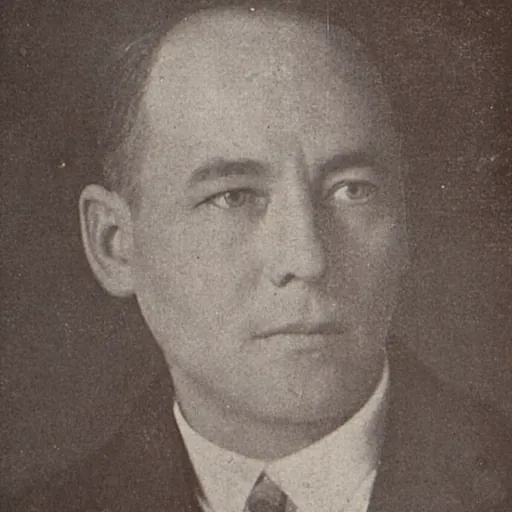
Jaroslav Křička
Czech conductor, music educator and composer
About Jaroslav Křička
Lived 1882 – 1969 (aged 86). Jaroslav Křička was an Austrian composer, music educator, conductor, university teacher, poet and choir director.
Jaroslav Křička (; 27 August 1882 – 23 January 1969) was a Czech composer, conductor and music teacher. He was the brother of poet .
Life Jaroslav Křička was born on 27 August 1882 in Kelč, Moravia, Austria-Hungary. He was born into the family of the Kelč village cantor and headmaster František Křička (1848–1891) as the oldest of three siblings. His mother was Františka Křičková (1861-1936). His brother Petr Křička (1884–1949) later became a well-known poet, and his sister Pavla Křičková (1886–1972) became a writer. Their father enthusiastically supported the musical education of his children; Jaroslav received violin, piano, and voice lessons as a child.
He attended high school in Havlíčkův Brod and graduated in 1900. As a high school student, he founded his own vocal quartet, string quartet, and student orchestra and began to compose. After graduating from high school, he moved to Prague and studied at the Prague Conservatory from 1902 to 1905. Under the tutelage of Josef Klička, he studied organ, orchestration, and harmony. He studied conducting with and composition with Karel Stecker[cs]. His musical role models were the famous Czech composers Antonín Dvořák, Bedřich Smetana, and Zdeněk Fibich, and later also the Czech modernists Vítězslav Novák and Josef Suk.
Křička moved to Prague in 1909, and from 1911 to 1920 he directed the Prague choir Hlahol[cs]. His tenure as director afforded him the opportunity to study numerous works by contemporary Czech composers such as Leoš Janáček, Vítězslav Novák, and Otakar Jeremiáš, in addition to premiering Novák's cantata Svatební košile (The Wedding Shirt), Op.48. During this period, he also began his first major work: the opera Hipolyta. From 1911 he championed his former teacher Karel Stecker at the Prague Conservatory, and after Stecker's death in 1919 he was appointed as a full professor of composition.
On 14 October 1918, he married Marie Krbová, a pianist and singer in the Hlahol choir who studied under Josef Bohuslav Foerster. Together with his student Jaroslav Řídký, Křička conducted the choir of the Czech Philharmonic from 1922 to 1930. During the critical years of World War II and the German occupation (1942–1945), he also served as rector of the Conservatory.
He was elected a member of the Czech Academy of Sciences and Arts in 1921, and in 1957 he received the esteemed title of Honored Artist (Zasloužilý umělec). The Křička Brothers Museum is located in his hometown of Kelč.
Works Jaroslav Křička's work encompasses almost all musical genres, in his words, “from passions to operetta,” in 1929, he wrote the music for the historical film Svatý Václav, which commemorated one thousand years since the death of the Bohemian ruler Wenceslaus I. He began composing operettas after 1945.
In addition to his musical compositions, Křička wrote many treatises on music and published regularly in the music periodicals Hudební revue and Hudební rozhledy.
Song cycles Severní noci (Northern Nights), Op. 14 (1909/1910), four songs based on poetry by Konstantin Balmont 1. Albatros (Albatross) 2. Labuť (Swan) 3. Ukolébavka (Lullaby) 4. U skandinávských skal (By the cliffs of Scandinavia) O lásce a smrti (On Love and Death), Op. 15 (1910), four songs on texts by Konstantin Balmont Písně rozchodu (Farewell Songs), Op. 19 (1916), four songs based on texts by Otakar Theer[cs] Tři bajky pro soprán a klavír (Three Fables for soprano and piano), (1917), based on fairytales by Božena Němcová and Alexander Afanasyev's fables Jaro pacholátko (Spring Child), Op. 29 (1919), three recitatives for high voice and piano Jiříčkovy písničky (Little Jiří's Songs), Op. 36 (1917, 1922-1923), collection of children's songs Daniny písničky a říkadla (Dana's Songs and Rhymes), Op. 49 (1928), children's songs and rhymes for toddlers Míšovy písničky (Míša's Songs) (1932), collection of children's songs Naše paní Božena Němcová (Our Lady Božena Němcová), Op. 112 (1954), five songs for mezzo-soprano and orchestra based on texts by František Halas.
Cantatas Pokušení na poušti (Temptation in the Desert), Op. 34 (1922), cantata for soli, choir, orchestra, and organ based on the Gospel of Matthew (text from the Kralice Bible) Studentské vzpomínky (Student Memories), cantata for soli, choir, and orchestra Tyrolské elegie (Tyrolean Elegies), Op. 52 (1930), cantata for soli, male choir, and orchestra based on a poem by Karel Havlíček Borovský Moravská kantáta (Moravian Cantata), Op. 65 (1935) for mixed choir, soli, and orchestra Valašská jitřní mše (Wallachian Morning Mass) (1941) for soli, mixed choir, and orchestra on a text by František Táborský Requiem in memoriam fratris dilectissimi, op. 96 (1949) in memory of his brother Petr Křička
Orchestral works 1. Symphony in D minor ("Jarní") (1905), "Spring Symphony" 2nd symphony in a minor ("Letní") (1907), "Summer Symphony" Modrý pták (Blue Bird), Op. 16 (1911), overture to the fairytale play by Maurice Maeterlinck. Adventus, Op. 33 (1921) Horácká suita (Horácko Suite a.k.a. Mountain Suite), Op. 63 (1936) won 3rd prize in the composition competition in the 1936 Summer Olympics
Chamber music 1st String Quartet in D major ("Ruský") (1907), "Russian String Quartet" Divertimento Novodvorico (1921), serenade for string quartet Sonata in E minor for violin and piano ("Památce Jana Štursy"), Op. 40 (1925), "In Memory of Jan Štursa" Piano Trio ("Malé domácí trio"), Op. 38 (1934), "Little domestic trio" 2nd String Quartet in E minor (1938) 3rd String Quartet ("Valašský") (1949), "Wallachian String Quartet"
Stage works Source:
Zmoudření Dona Quijota (Don Quixote Gains His Wisdom), Op. 18 (1914), music for the stage play by Viktor Dyk Hipolyta (Hippolyta), Op. 20 (1916), opera (premiered at the National Theatre in Prague on 10 October 1917) Ogaři (The Boys), Op. 27 (1918), children's opera based on texts by Ozef Kalda Bílý pán aneb Těžko se dnes duchům straší (The Gentleman in White, or It's Tough Scaring Ghosts Today), Op. 50 (1929), musical comedy based on Oscar Wilde's short story "The Canterville Ghost" Tlustý pradědeček, lupiči a detektývové aneb Dobře to dopadlo (The Fat Great-Grandpa, the Robbers, and the Detectives, or It Turned Out Well), Op. 56 (1932), children's Singspiel České jesličky (Czech Nativity), Op. 69 (1937), Christmas Singspiel Hra na květinky. A-o-i-e-u, jaro již je tu! (A Flower Play. A-E-I-O-U, Spring is upon us!), Op. 71 (1937), Singspiel for children's choirs Král Lávra (King Lávra), Op. 73 (1939), sung ballet based on a poem by Karel Havlíček Borovský Psaníčko na cestách aneb Pošťácká pohádka (A Letter on A Journey, or The Postman's Fairy Tale), Op. 79 (1941), children's Singspiel based on a fairy tale by Karel Čapek Jáchym a Juliana (Joachim and Julianna), Op. 90 (1948), opera Zahořanský hon (The Hunt of Zahořany), Op. 98a (1949), musical comedy based on a story by Alois Jirásek Český Paganini aneb Slavík a Chopin (Czech Paganini, or Slavík and Chopin) (1951), operetta Kolébka (The Cradle), Op. 101 (1950), musical comedy with songs and dances based on a story by Alois Jirásek Tichý dům (The Silent House), Op. 105 (1952), operetta based on a story by Jan Neruda Polka vítězí (The Polka Wins), Op. 111 (1954), operetta Cirkus Humberto (Circus Humberto), Op. 118 (1955), operetta Kalhoty (The Pants) (1962), Singspiel Pohádka o 12 měsíčkách (Fairy Tale of the 12 Months) (1962), Singspiel for school children based on a fairy tale by Božena Němcová Dvě komedie televizní: 1. Měsíc divů; 2. Šlechetný kasař aneb s poctivostí nejdál dojdeš (Two TV Comedies: 1. The Month of Marvels; 2. The Noble Safecracker, or Honesty is the Best Policy) (1963), two opera miniatures
Film music Source: Svatý Václav (1929) Naši furianti (1937) Cech panen kutnohorských (1938) Gabriela (1942) Jarní píseň (1944) Nikola Šuhaj (1947) Štika v rybníce (1951)
Don’t just read it —
keep it.
Full-length biographies made to live with: read them, listen on the way to work, watch them tonight.
- E-book
- Audio
- Video
Instant download · yours to keep · every purchase keeps this site free
Important facts
People in Jaroslav Křička's life
Named in this biography and alive at the same time


Related people
Same field, nearest in time



Contemporaries
People whose lives overlapped Jaroslav Křička's



Frequently asked questions
Who was Jaroslav Křička?
Czech conductor, music educator and composer (1882–1969)
When was Jaroslav Křička born?
Jaroslav Křička was born on 27 August 1882 in Kelč.
When did Jaroslav Křička die?
Jaroslav Křička died on 23 January 1969 in Prague, Červené Dvorce.
What was Jaroslav Křička's occupation?
Jaroslav Křička was a composer, music educator, conductor, university teacher, poet and choir director.
What nationality was Jaroslav Křička?
Jaroslav Křička was Austrian.
Sources & further reading
Cite this page
APA: Biography.guide. (2026). Jaroslav Křička. https://biography.guide/jaroslav-kricka/
MLA: "Jaroslav Křička." Biography.guide, https://biography.guide/jaroslav-kricka/.
Chicago: "Jaroslav Křička." Biography.guide. https://biography.guide/jaroslav-kricka/.
Data last updated: 2026-09-23 · Spot an error? Report a correction.
Portrait: Wikimedia Commons · author & licence
Page generated 2026-09-27 05:05 UTC