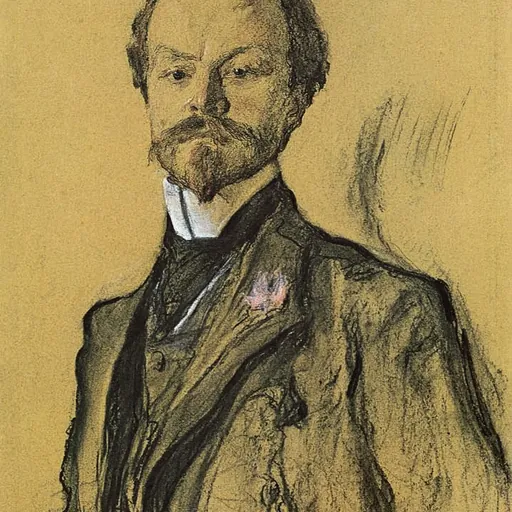
About Konstantin Balmont
Lived 1867 – 1942 (aged 75). Konstantin Balmont was a Russian and French linguist, poet, writer, translator, essayist and translator of Adam Mickiewicz.
Konstantin Dmitriyevich Balmont (; – 23 December 1942) was a Russian symbolist poet and translator who became one of the major figures of the Silver Age of Russian Poetry.
Balmont's early education came from his mother, who knew several foreign languages, valued literature and theater, and exerted a strong influence on her son. He then attended two gymnasiums, being expelled from the first for political activities and graduating from the second. He started studying law at the Imperial Moscow University in 1886 but was quickly expelled for taking part in student unrest. He tried again at the Demidov Law College from 1889 but dropped out in 1890.
In February 1889, Balmont married Larisa Mikhailovna Garelina. Unhappy in marriage, on 13 March 1890 he attempted suicide by jumping from a third-storey window, resulting in a limp and an injured writing hand for the rest of his life. He became involved in two other common-law marriages and attempted suicide a second time in 1909.
Balmont wrote poetry and prose prolifically and published his works to wide audiences in Imperial Russia. After the Bolshevik revolution he emigrated in 1920 and had a smaller following in exile. He translated the works of other writers, including Edgar Allan Poe. He was thought of among the pre-revolutionary Russian intellectual milieu as an innovative poet and enjoyed friendships with many of his fellow Russian emigrant poets. He died of pneumonia in France in 1942.
Biography Konstantin Balmont was born at his family's estate, Gumnishchi, in Shuya, then part of Vladimir Governorate, the third of seven sons of a Russian nobleman, lawyer, and senior state official, Dmitry Konstantinovich Balmont, and Vera Nikolayevna (née Lebedeva) who came from a military family. The latter knew several foreign languages, was enthusiastic about literature and theater, and exerted a strong influence on her son. Balmont learned to read at the age of five and cited Alexander Pushkin, Nikolay Nekrasov, Aleksey Koltsov, and Ivan Nikitin as his earliest influences. Later he remembered the first ten years of his life spent at Gumnishchi with great affection and referred to the place as 'a tiny kingdom of silent comfort'.
In 1876, the family moved to Shuya where Vera Nikolayevna owned a two-story house. It was there that he became interested in French and German poetry and started writing himself. His first two poems were criticized by his mother in such a way that for the next six years he made no further attempt at writing poetry. At the gymnasium Balmont became involved with a secret circle (formed by students and some teachers) which printed and distributed Narodnaya Volya proclamations. On 30 June 1886, he was expelled from the Shuya gymnasium for his political activities.
Vera Nikolayevna transferred her son to a Vladimir gymnasium, but here the boy had to board with a Greek language teacher who took upon himself the duty of a warden. In late 1885, Balmont made his publishing debut: three of his poems appeared in the popular Saint Petersburg magazine Zhivopisnoe obozrenie. This event (according to biographer Viktor Bannikov) "was noticed by nobody except for his [tor]mentor" (his mother) who forbade the young man to publish anything further.
In 1886, Balmont graduated from the much hated gymnasium ("It completely ruined my nervous system." he remembered in 1923). and enrolled in Moscow State University to study law. There he became involved with a group of leftist activists and was arrested for taking part in student unrest. In 1889, Balmont returned to the university but soon quit again after suffering a nervous breakdown. He joined the Demidov Law College in Yaroslavl but dropped out in September 1890, deciding he'd had enough formal education. In February 1889, he married Larisa Mikhailovna Garelina; unhappy in marriage, on 13 March 1890 Balmont attempted suicide by jumping from a third-story window, leaving him with a limp and an injured writing hand for the rest of his life. The year he spent recuperating from his suicide attempt became a turning point for Balmont, who, in his words, experienced 'extraordinary mental agitation' and envisaged his 'poetic mission.'
Debut
In 1890, Balmont released a self-financed book called Collection of Poems (Sbornik stikhotvoreny), which included some of the pieces published in 1885. Instrumental in helping the publication was Vladimir Korolenko, by then an established writer, who had received a handwritten notebook (sent to him by Konstantin's classmates) and sent back detailed and favorable critical analysis. He praised the schoolboy's eye for detail, warned against the occasional lapse of concentration, and advised him to "trust that unconscious part of the human soul which accumulates momentary impressions." "Should you learn to concentrate and work methodically, in due time we'll hear of your having developed into something quite extraordinary," were the last words of this remarkable letter. Disgusted with it, Balmont purchased and burnt all the remaining copies. meaning apparently Larisa, but also his university friends who considered the book 'reactionary' and scorned its author for 'betraying the ideals of social struggle'. Again, Korolenko came to Balmont's aid: "The poor guy is very shy; more editorial attention to his work would make great difference," he wrote to Mikhail Albov, one of the editors of Severny Vestnik, in September 1891.
In 1888–1891, Balmont published several poems he translated from German and French. All the while he continued to translate Shelley and Edgar Allan Poe. The lawyer and philanthropist, Prince Alexander Urusov, an expert in Western European literature, financed the publication of two of Poe's books, translated by Balmont.
1893–1899 In December 1893, Balmont informed Nikolai Minsky in a letter: "I've just written a series of my own poems and I am planning to start the publishing process in January. I anticipate my liberal friends will be outraged, for there's not much liberalism in this, while there are 'corrupting influences' aplenty." Under the Northern Sky came out in 1894 and marked the starting point in his literary career, several critics praising the young author's originality and versatility. He also became a close friend of Bryusov, who had a formative influence on the development of Balmont's poetic and critical voice. In 1896, Balmont married Ekaterina Alekseyevna Andreeva, and the couple went abroad that year to travel through Western Europe. "For the first time ever I've been given the opportunity to live my life totally in accord with my intellectual and aesthetic interests. I'll never get enough of this wealth of arts, poetry, and philosophical treasures", he wrote in a letter to critic Akim Volynsky. These European impressions formed the basis for Balmont's third collection Silence (, 1898).
The book in question, Burning Buildings (, 1900), a collection of innovative verse aimed at "inner liberation and self-understanding," came to be regarded as an apex of Balmont's legacy. Burning Buildings made Balmont the most popular poet in the Russian Symbolist movement. He introduced formal innovations that were widely emulated in Russian verse, including melodic rhythms, abundant rhymes, and the meticulous organization of short lyric poems into narrative poems, cycles, and other units of composition. "For a decade he was a towering presence in Russian poetry. Others either meekly followed or struggled painfully to free themselves from his overbearing influence," wrote Valery Bryusov later. He was also known for his prolific output, which became seen as a shortcoming over time. "I churn out one page after another, hastily... How unpredictable one's soul is! One more look inside, and you see the new horizons. I feel like I've struck a goldmine. Should I keep on this way, I'll make a book that will never die," he wrote to Ieronim Yasinsky in 1900.
In March 1901, Balmont took part in a student demonstration on the square in front of Kazan Cathedral which was violently disrupted by police and Cossack units. Alexander Blok called it "unique in its unfathomable richness." "Russia was passionately in love with him. Young men whispered his verses to their loved ones, schoolgirls scribbled them down to fill their notebooks," Teffi remembered. Established poets, like Mirra Lokhvitskaya, Valery Bryusov, Andrei Bely, Vyacheslav Ivanov, Maximilian Voloshin, and Sergey Gorodetsky, treated him (according to biographer Darya Makogonenko) as a "genius... destined to rise high above the world by submerging himself totally in the depths of his soul." A somewhat better reception awaited White Lightning (, 1908) and Luminous Sea (, 1910), collections of his essays on Russian and foreign authors. and Sergei Prokofiev, collaborating with the latter on musical works. His 1915 volume Poetry as Magic gave the most coherent and influential statement of his theoretical positions on poetry. White Architect (1914) confirmed Balmont's return as a lyric poet; Markov underscores its more classical qualities of "energy, viritlity, solidity, and finish." had also to support Andreyeva and their daughter Nina in Moscow. On May 25, 1920, Balmont and his family left Russia for good.
In Paris, Balmont found himself unpopular. Radical Russian émigrés took his safe and easy departure as a sign of his being a Communist sympathizer. For Balmont his European experience was a "life among aliens." "Emptiness, emptiness everywhere. Not a trace of spirituality here in Europe," he complained in a December 1921 letter to Andreyeva. Still, unlike his conservative friend Ivan Shmelyov, Balmont was a liberal: he detested fascism and right-wing nationalist ideas. All the while, he shied away from Russian Socialists (like Alexander Kerensky and Ilya Fondaminsky) and expressed horror at what he saw as France's general 'enchantment' with socialism. His views were in many ways similar to those of Ivan Bunin; the two disliked each other personally, but spoke in one voice on many occasions.
In emigration Balmont published several books of poetry, including A Gift to Earth , Lightened Hour (, both 1921), The Haze (, 1922), From Me to Her. Poems of Russia (, 1923), Beyond Stretched Horizons (, 1929), Northern Lights (, 1933), Blue Horseshoe and Serving the Light (, both 1937). He released autobiographies and memoirs: Under the New Sickle , The Airy Path (, both 1923) and Where Is My Home? (, Prague, 1924). Balmont's poetry in emigration was criticized by Vladimir Nabokov who called his verse "jarring" and "its new melodies false." Nina Berberova argued that Balmont had exhausted his muse while in Russia and that none of his later work was worthy of attention. Modern Russian critics assess Balmont's last books more favorably, seeing them as more accessible and insightful, even if less flamboyant than his best known work. The poet and biographer Nikolai Bannikov called the poems "Pines in Dunes" (Дюнные сосны) and "Russian Language" "little masterpieces". From the mid-1920s, Balmont turned his gaze to Eastern Europe, traveling to centers of the Russian emigration in Lithuania, Poland, Czechoslovakia and Bulgaria, translating poetry from their languages, and adapting their folklore in his own original work. In April 1936 a group of Russian writers and musicians abroad celebrated the 50th anniversary of Balmont's literary career by staging a charity event; among the organizers and contributors were Shmelyov, Bunin, Zaitsev, Sergei Rachmaninoff, and Mark Aldanov.
Personality Balmont and Sergey Gorodetsky with their respective wives (Andreyeva to the right), Saint Petersburg, 1907. Konstantin Balmont has been characterized variously as theatrical, pretentious, erratic and egotistical.
"Balmont was a poseur and the reasons for this were obvious. Always crowded by worshipers, he tried to behave in a manner he saw as befitting a great poet... It was laughter that gave him away... Just like a child, he was always moved by a momentary impulse," wrote Teffi.
Pyotr Pertsov who knew Balmont from teenage years, characterized him as "a very nice, friendly, and considerate young man." Marina Tsvetaeva insisted that he was "the kind of man who'd give a needy one his last piece of bread, his last log of wood." Mark Talov, a Soviet translator who in the 1920s found himself penniless in Paris, remembered how often, after having left Balmont's house, he would find money in a pocket; the poet (who was very poor himself) preferred this anonymous way of helping so as not to confuse a visitor. Balmont's paternal grand-grandfather Ivan Andreyevich Balamut (, the Ukrainian surname, translated literally as "trouble-maker") was a landowner in Kherson, Southern Ukraine, who served as a cavalry sergeant in Catherine the Great's Imperial Guard regiment (Andreyeva insisted she had seen the proof of it in an original parchment-written document kept in the family archives).
Dmitry Konstantinovich, Vera Nikolayevna and all of their relatives pronounced the surname Bál'mont. The poet changed its pronunciation to Bal'mónt, citing "a certain woman's whimsy" as his reason. then his March 13, 1890, suicide attempt. Balmont sent her letters or postcards almost daily; in all, 858 of them survived, mostly from 1920-1924. It was Elena Tsvetkovskaya, though, who remained with Balmont until his dying day. She died in 1943, surviving him by a year. Balmont's wife, Yekaterina died in 1954. Dagmar Shahovskaya died in 1967.
Mirra Tsvetkovskaya (in her first marriage Boychenko, in the second Ayutina) was a published poet, who used the pseudonym Aglaya Gamayun. She died in Paris in 1970.
In music Among the Russian composers who have set Balmont's poetry to music are Mikhail Gnessin, Nikolai Myaskovsky, Nikolai Obukhov, Sergei Prokofiev, Sergei Rachmaninoff, Maximilian Steinberg, Igor Stravinsky, and Sergei Taneyev. His free Russian translation of Edgar Allan Poe's "The Bells" formed the basis for Rachmaninoff's choral symphony of the same name, Op. 35. He surely influenced Aleksandr Scriabin for his Poème de l’extase.
Selected works
Poetry collections Collection of Poems (Сборник стихотворений, 1890) Under the Northern Sky (Под северным небом, 1894) In Boundlessness (В безбрежности, 1895) Silence (Тишина. Лирические поэмы, 1898) Burning Buildings. The Lyric of the Modern Soul (Горящие здания. Лирика современной души, 1900) Let Us Be Like the Sun. The Book of Symbols (Будем как солнце. Книга символов, 1903) Only Love (Только любовь. Семицветник, 1903) Liturgy of Beauty (Литургия красоты. Стихийные гимны, 1905) Fairy's Fairytales (Фейные сказки (детские песенки), 1905) Vile Charms (Злые чары, 1906) Poems (Стихотворения, 1906) Firebird. Slavic Svirel (Жар-птица. Свирель славянина, 1907) Songs of the Avenger (Песни мстителя, 1907) Three Blossoms. Theatre of Youth and Beauty (Три расцвета. Театр юности и красоты, 1907) Runaround of Times (Хоровод времён. Всегласность, 1909) Birds in the Air (Птицы в воздухе. Строки напевные, 1908) Green Vertograd (Зелёный вертоград. Слова поцелуйные, 1909) White Architect. Mystery of Four Lanterns (Белый Зодчий. Таинство четырёх светильников, 1914) Ash. Visions of a Tree (Ясень. Видение древа, 1916) Sonnets of Sun, Honey and Moon (Сонеты Солнца, Мёда и Луны, 1917; published in 1921 in Berlin)
Don’t just read it —
keep it.
Full-length biographies made to live with: read them, listen on the way to work, watch them tonight.
- E-book
- Audio
- Video
Instant download · yours to keep · every purchase keeps this site free
Important facts
People in Konstantin Balmont's life
Named in this biography and alive at the same time





Related people
Same field, nearest in time
Contemporaries
People whose lives overlapped Konstantin Balmont's



Frequently asked questions
Who was Konstantin Balmont?
Russian poet (1867–1942)
When was Konstantin Balmont born?
Konstantin Balmont was born on 3 June 1867 in Gumnischi.
When did Konstantin Balmont die?
Konstantin Balmont died on 23 December 1942 in Noisy-le-Grand.
What was Konstantin Balmont's occupation?
Konstantin Balmont was a linguist, poet, writer, translator, essayist and translator of Adam Mickiewicz.
What nationality was Konstantin Balmont?
Konstantin Balmont was Russian and French.
Sources & further reading
· Wikipedia: Konstantin Balmont
Cite this page
APA: Biography.guide. (2026). Konstantin Balmont. https://biography.guide/konstantin-balmont/
MLA: "Konstantin Balmont." Biography.guide, https://biography.guide/konstantin-balmont/.
Chicago: "Konstantin Balmont." Biography.guide. https://biography.guide/konstantin-balmont/.
Data last updated: 2026-09-22 · Spot an error? Report a correction.
Portrait: Wikimedia Commons · author & licence
Page generated 2026-09-27 05:03 UTC