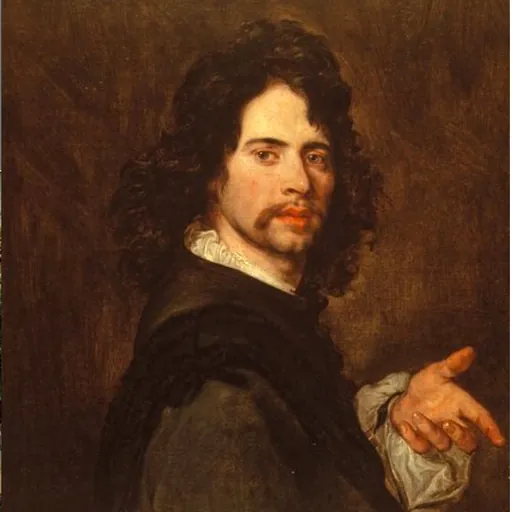
About Jan van den Hoecke
Lived 1611 – 1651 (aged 39–40). Jan van den Hoecke was a Belgian painter.
Jan van den Hoecke (baptised on 4 August 1611 – 1651) was a Flemish painter, draughtsman and designer of wall tapestries. He was one of the principal assistants in Rubens' studio in the 1630s. He later traveled to Italy where he resided for a decade in Rome. He subsequently worked as a court painter in Vienna and Brussels. Jan van den Hoecke was a versatile artist who created portraits as well as history and allegorical paintings.
Life
Jan van den Hoecke was born in Antwerp in July or August 1611 and was baptized on 4 August 1611. He then worked in the studio of Peter Paul Rubens in the 1630s. Together with his father, Jan contributed to the decorations for the Joyous Entry of Cardinal-infant Ferdinand in Antwerp on 17 April 1635, the overall artistic design of which was under the direction of Rubens. Jan painted monumental representations for this occasion after designs by Rubens.
Jan van den Hoecke travelled to Italy where he resided likely from 1635 to 1644 although some extend the period of his stay to 1646. In 1644, the artist was accepted in Rome as a member of a select club, the Virtuosi al Pantheon. He was at the same time a court painter and the conservator of the art collection of the Archduke, which was reported to be one of the largest in Northern Europe and comprised about 1,400 paintings and other artworks.
Style His early style with its precise draughtsmanship and closeness to Rubens can be found in his oil sketch of The Triumph of David (Kimbell Art Museum) (1635) that was for a long time regarded as a work by Rubens. His Hercules between Vice and Virtue (Uffizi Gallery) shows the influence from both Rubens (particularly Rubens' style between 1610 and 1620) and Anthony van Dyck. The closeness of his style to that of Rubens may have led to the attribution in 1780 to van den Hoecke of the Massacre of the Innocents (now attributed to Rubens) when it was in the Liechtenstein Collection. Van den Hoecke painted a series of Sibyls which have been attributed to his earlier period from 1630 to 1637.
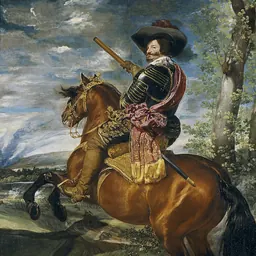
The influence of Reni's idealized figure types as well as of Domenichino and Poussin (see the Virtue Overcoming Avarice of 1637) are visible in the allegorical paintings he produced in Vienna. An example is the Virtue Overcoming Avarice in the Kunsthistorisches Museum. His familiarity with the work of Andrea Sacchi is reflected in his portraits of Emperor Ferdinand III and Archduke Leopold William. His style retained a certain reticence and a stiffness of composition as reflected in his Equestrian portrait of Archduke Leopold Wilhelm the static composition of which is clearly different from the lively equestrian portraits by Rubens and Anthony van Dyck.
Collaborations As was common in the Flemish art scene at the time, van den Hoecke collaborated with other painters who were specialised in a particular genre. An example is the Amor vincit omnia (Kunsthistorisches Museum), in which the figure of Cupid was painted by van den Hoecke and the still life elements by Paul de Vos. It is not clear whether the composition is an allegory of peace, as suggested by the figure of Cupid and the traditional title, or rather an allegory of transience (vanities), as indicated by the motifs of the money bag, the armour and the musical instruments. An example of a collaboration by van den Hoecke on a garland painting is the Flower garland surrounding a portrait of Archduke Leopold Wilhelm (Uffizi Gallery). In this work Daniel Seghers painted the flowers and van den Hoecke the illusionistic bust of the Archduke.
Tapestry designs
For Archduke Leopold Wilhelm, van den Hoecke further designed the pattern boards for a series of 12 wall tapestries on the motif of vanitas and a series of ten tapestries under the title 'Allegory of Time' (c. 1650): Day and Night, six pictures of The Months, the Four Seasons, the Four Elements and the Triumph of Time. The series of the Allegory of Time was woven between 1647 and 1650 in the Brussels tapestry workshop of Everaert Leyniers III. Several other artists such as Pieter Thijs and Adriaen van Utrecht also worked on the series. Ten preparatory oil sketches ("modelli") that van den Hoecke made for the series have survived (four in the Kunsthistorisches Museum, Vienna), as have eight tapestries based on the designs for Day and Night and The Months. Four of the modelli for The Months are now in the Miramare Castle in Trieste.
The cartoons of van Hoecke for the Allegory of Time series were innovative in that they dispensed with the traditional borders of the tapestries, which he replaced by elements of the picture such as piers, entablature and foreground step of the architecture as well as with sumptuous festoons of game, fowl, fish, flowers and fruit. He was also able to create an illusion of three-dimensional space by extending the architectural elements behind and around the figures. The muted palette of the modelli shows that van den Hoecke was more interested in line and composition than in colour.
Don’t just read it —
keep it.
Full-length biographies made to live with: read them, listen on the way to work, watch them tonight.
- E-book
- Audio
- Video
Instant download · yours to keep · every purchase keeps this site free
Important facts
more
Van Houk, Jean van Hoek, Hoeck, J. van Hoecke, Jean Vanhoeck, Van Hocke, Vanhook, Van Hoecke, J. van Hoek, jan van den hoeck, J.V. Hoeck, Giovanni Horch, Ioh. van Hoock, Vanhock, Van Hoeck, Hucke, J. Van-Houck, Vau Oek, I. Vanhoek, Jean Vanhonck, J. Van Oeck, Johannes van Hoeck, Van-Ouck, Van-Hook, Vanhooke, Jean Van Hoeck, Van Hoock, J. van Hoeck, J.v. Höck, Jean Vanhoek, VanhoeckPeople in Jan van den Hoecke's life
Named in this biography and alive at the same time



Related people
Same field, nearest in time
Contemporaries
People whose lives overlapped Jan van den Hoecke's




Frequently asked questions
Who was Jan van den Hoecke?
Flemish painter (1611-1651)
When was Jan van den Hoecke born?
Jan van den Hoecke was born on 4 August 1611 in Antwerp.
When did Jan van den Hoecke die?
Jan van den Hoecke died in 1651 in Antwerp.
What was Jan van den Hoecke's occupation?
Jan van den Hoecke was a painter.
What nationality was Jan van den Hoecke?
Jan van den Hoecke was Belgian.
Sources & further reading
· Wikipedia: Jan van den Hoecke
Cite this page
APA: Biography.guide. (2026). Jan van den Hoecke. https://biography.guide/jan-van-den-hoecke/
MLA: "Jan van den Hoecke." Biography.guide, https://biography.guide/jan-van-den-hoecke/.
Chicago: "Jan van den Hoecke." Biography.guide. https://biography.guide/jan-van-den-hoecke/.
Data last updated: 2026-09-23 · Spot an error? Report a correction.
Portrait: Wikimedia Commons · author & licence
Page generated 2026-09-27 05:05 UTC