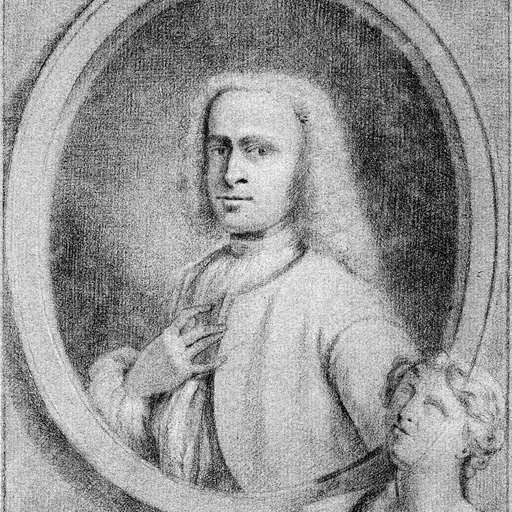
About Jan Baptist Xavery
Lived 1697 – 1742 (aged 45). Jan Baptist Xavery was a sculptor.
Jan Baptist Xavery (30 March 1697, in Antwerp – 19 July 1742, in Antwerp) was a Flemish sculptor principally active in the Dutch Republic. He produced portrait busts, large scale statues for residences and gardens, church furniture, wall decorations, tomb monuments as well as small scale statuettes in boxwood, lime wood, ivory and terracotta. The latter were made for elite collectors who liked to admire such objects in the privacy of their homes. He worked on various projects for William IV of Orange-Nassau, the Prince of Orange who later became the Stadtholder. He is regarded as the leading sculptor active in the Dutch Republic in the first half if the 18th century.
Life He was the son of the sculptor Albert Xavery and Catharina Maria Herry (Herri). He had a younger brother called Gerardus Josephus who became a painter. His father probably taught him before he entered the studio of Michiel van der Voort the Elder. He stayed in the van der Voort workshop until moving to Vienna in 1719. Allegories of Music and Poetry St. Bavochurch, Haarlem, 1739
From there he went to Italy where he was in Rome. Instead of returning to his home country he settled in The Hague in the Dutch Republic. He likely arrived in The Hague in 1721 where he is recorded as paying in June 1721 his half master's money as a sculptor to the local artists' guild, the Confrerie Pictura. His decision to settle in this city may have to do with the activities of the French architect Daniel Marot. Marot was at that time leading many construction and decorative projects in The Hague for which he hired many artists from abroad. There were no sculptors of quality in the city which meant Xavery had hardly any competition. In November 1725 he became a full member of the Confrerie Pictura in The Hague. In 1633, he was one of the artists who worked under the direction of Daniel Marot on the refurbishment of Huis ten Bosch, the residence in The Hague of William IV of Orange-Nassau, the Prince of Orange who later became the Stadtholder. In that project he was responsible, among other things, for the wood carvings in the White Dining Room. One of these, representing Apollo and the Cumaean Sibyl was later removed by the French occupiers and later moved to the Trippenhuis in Amsterdam. He also interceded on behalf of Jacob de Wit for a commission to paint a chimney piece, the frame for which was carved by Xavery.
In addition, he was able to obtain commissions from the civil authorities. He was involved in the decoration of the Old City Hall of The Hague for which he created allegorical figures of Prudentia and Justitia. In the same city hall he made the marble overdoor pieces of the alderman's and justice rooms.
There is some evidence, too, that he worked briefly around 1737 for Frederick I, Landgrave of Hesse-Kassel. Willem Hendrik van der Wall and Olof Arenius were his pupils.
While working early in his career on projects of Daniel Marot, his style shows similarities with that of Marot. Even in his early career he showed an interest in developing his own style as shown in the Group of three children, allegory of Summer of 1726 (Rijksmuseum, Amsterdam). It shows a lively group of two nude girls and a boy children holding symbols of summer (corn stalks, ears of corn, a sickle) who are connected through scanty draperies. The group shows his interest in achieving a lively interaction between the children and a nice distribution of their attributes. Xavery also made a portrait bust of François Fagel, an important personality who served as servant of the States General for more than sixty years. His various funeral monuments also include busts or full-length portraits of the deceased persons. These include the funeral monuments of Johannes Graaf von Lilljenstedt (1732) in the Marienkirche in Stralsund, Johan Theodorus baron von Friesheim (1733) in the Grote of Sint-Catharinakerk in Heusden, Sicco van Goslinga (1737) in the Hervormde kerk in Dongjum and Count Oswald III van den Bergh (1741) in the Sint Petrusbasiliek in Boxmeer. Some of the funeral monuments such as that of Reinhart Vincent von Hompesch in Linnich have been lost while of that of Johan van Welderen only the bust portrait has survived.
Xavery was also known for his small-scale ivory sculptures. His ivory Medallion portrait of Maria Louise van Hessen-Kassel, the mother of Prince William IV of Orange, made in 1731 was likely the first contact between the artist and the Prince.
Don’t just read it —
keep it.
Full-length biographies made to live with: read them, listen on the way to work, watch them tonight.
- E-book
- Audio
- Video
Instant download · yours to keep · every purchase keeps this site free
Important facts
People in Jan Baptist Xavery's life
Named in this biography and alive at the same time




Related people
Same field, nearest in time


Contemporaries
People whose lives overlapped Jan Baptist Xavery's



Frequently asked questions
Who was Jan Baptist Xavery?
Flemish sculptor (1697–1742)
When was Jan Baptist Xavery born?
Jan Baptist Xavery was born on 30 March 1697 in Antwerp.
When did Jan Baptist Xavery die?
Jan Baptist Xavery died on 19 July 1742 in The Hague.
What was Jan Baptist Xavery's occupation?
Jan Baptist Xavery was a sculptor.
What nationality was Jan Baptist Xavery?
Jan Baptist Xavery's recorded nationality: Habsburg Netherlands.
Sources & further reading
· Wikipedia: Jan Baptist Xavery
Cite this page
APA: Biography.guide. (2026). Jan Baptist Xavery. https://biography.guide/jan-baptist-xavery/
MLA: "Jan Baptist Xavery." Biography.guide, https://biography.guide/jan-baptist-xavery/.
Chicago: "Jan Baptist Xavery." Biography.guide. https://biography.guide/jan-baptist-xavery/.
Data last updated: 2026-09-21 · Spot an error? Report a correction.
Portrait: Wikimedia Commons · author & licence
Page generated 2026-09-27 05:00 UTC