
About James Rainwater
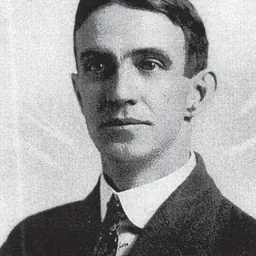
Lived 1917 – 1986 (aged 68). James Rainwater was an American physicist, nuclear physicist and university teacher.
Leo James Rainwater (December 9, 1917 – May 31, 1986) was an American physicist who shared the Nobel Prize in Physics in 1975 for his part in determining the asymmetrical shapes of certain atomic nuclei.
During World War II, he worked on the Manhattan Project that developed the first atomic bombs. In 1949, he began developing his theory that, contrary to what was then believed, not all atomic nuclei are spherical. His ideas were later tested and confirmed by Aage Bohr's and Ben Mottelson's experiments. He also contributed to the scientific understanding of X-rays and participated in the United States Atomic Energy Commission and naval research projects.
Rainwater joined the physics faculty at Columbia in 1946, where he reached the rank of full professor in 1952 and was named Pupin Professor of Physics in 1982. He received the Ernest Orlando Lawrence Award for Physics in 1963 and in 1975 was awarded the Nobel Prize in Physics, "for the discovery of the connection between collective motion and particle motion in atomic nuclei and the development of the theory of the structure of the atomic nucleus based on this connection".
Early life Leo James Rainwater was born on December 9, 1917, in Council, Idaho, the son of a former civil engineer who ran the local general store, Leo Jaspar Rainwater and his wife Edna Eliza née Teague. He never used his first name and was always referred to as James or Jim. His father died in the great influenza epidemic of 1918 and Rainwater and his mother moved to Hanford, California, where she married George Fowler, a widower with two sons, Freeman and John. In time he also acquired a half-brother, George Fowler Jr., who became naval officer. At high school he excelled in mathematics, chemistry and physics and was admitted to the California Institute of Technology on the strength of a chemistry competition.
Manhattan Project Rainwater then chose to undertake postgraduate studies at Columbia University. At the time this was an unusual move for a scholar from California, as Columbia was not then renowned for its physics; but this had recently changed. George B. Pegram had recently built up the physics department, and hired scientists like Enrico Fermi. At Columbia Rainwater studied under Isidor Isaac Rabi, Enrico Fermi, Edward Teller and John R. Dunning. written under Dunning's supervision, he built a neutron spectrometer and developed techniques for its use. Rainwater married Emma Louise Smith in March 1942. and he was awarded his doctorate in 1946. This was superseded in 1949 by Maria Goeppert Mayer's nuclear shell model, which could explain more about the structure of heavy elements than the older theory but it still had limits. At a colloquium at Columbia in 1949, Charles H. Townes reported experimental results that indicated quadrupole moments greater than those indicated by the shell model. It occurred to Rainwater that this could be explained and the differences between the liquid drop and nuclear shell models could be reconciled, if the atomic nucleus were not spherical, as had been assumed but could assume other shapes. Rainwater published his theoretical paper in 1950. By chance, that year he was sharing an office with Aage Bohr, Rainwater felt that his model was overlooked. He later recalled that:
With funding from the Office of Naval Research, After 1965, he worked on turning the Nevis synchrocyclotron into a meson facility. When a reporter rang in 1975 to inform him that he had won the Nobel Prize in Physics, he initially thought that it was for his work on muonic atoms. Several hours passed before he discovered that it was for his work on nuclear structure, the Nobel Prize being shared with Bohr and Mottelson.
He was a fellow of the American Physical Society, the New York Academy of Sciences and the Institute of Electrical and Electronics Engineers, and was a member of the National Academy of Sciences, the American Institute of Physics, the American Association of Physics Teachers and the Optical Society of America.
Rainwater succeeded Robert R. Wilson as Michael I. Pupin Professor of Physics in 1983.
Don’t just read it —
keep it.
Full-length biographies made to live with: read them, listen on the way to work, watch them tonight.
- E-book
- Audio
- Video
Instant download · yours to keep · every purchase keeps this site free
Important facts
People in James Rainwater's life
Named in this biography and alive at the same time






Related people
Same field, nearest in time

Contemporaries
People whose lives overlapped James Rainwater's

Frequently asked questions
Who was James Rainwater?
American physicist
When was James Rainwater born?
James Rainwater was born on 9 December 1917 in Council.
When did James Rainwater die?
James Rainwater died on 31 May 1986 in New York City.
What was James Rainwater's occupation?
James Rainwater was a physicist, nuclear physicist and university teacher.
What nationality was James Rainwater?
James Rainwater was American.
Sources & further reading
Cite this page
APA: Biography.guide. (2026). James Rainwater. https://biography.guide/james-rainwater/
MLA: "James Rainwater." Biography.guide, https://biography.guide/james-rainwater/.
Chicago: "James Rainwater." Biography.guide. https://biography.guide/james-rainwater/.
Data last updated: 2026-09-26 · Spot an error? Report a correction.
Page generated 2026-09-27 05:16 UTC