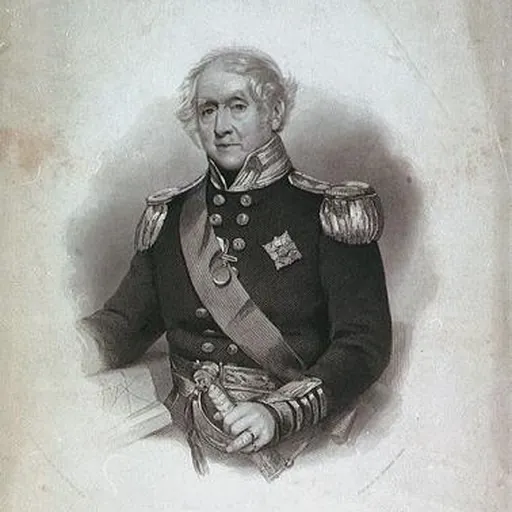
About James Hawkins-Whitshed
Lived 1762 – 1849 (aged 86–87). James Hawkins-Whitshed was a naval officer.
Admiral of the Fleet Sir James Hawkins-Whitshed, 1st Baronet, (1762 – 28 October 1849) was a Royal Navy officer. He saw action in command of a sloop at the Battle of Martinique during the American Revolutionary War. He went on to serve under Sir John Jervis in the Mediterranean and took part in the battle of Cape St. Vincent during the French Revolutionary Wars.
After promotion to flag-officer rank Hawkins-Whitshed became Commander-in-Chief of the Sea Fencibles in Ireland and then Commander-in-Chief of the Cork Station during the Napoleonic Wars. After the War with France was won he served as Commander-in-Chief, Portsmouth.
Early life Hawkins was born simply James Hawkins in Raphoe, County Donegal, in Ulster, the third son of The Rt Rev. Dr James Hawkins, Church of Ireland Lord Bishop of Raphoe, and his wife, Catherine Keene Hawkins. His name was carried on the muster roll of the sloop on the Irish Station in 1773, and on that of , the guard ship at Plymouth, the next year.
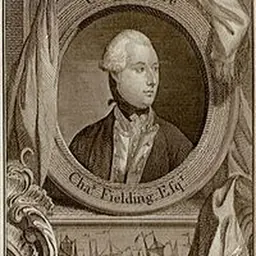
American War The first ship in which Hawkins actually served at sea was the 20-gun sixth-rate , commanded by Captain William Bennett, whom he accompanied to Newfoundland in 1775. He afterwards served under Sampson Edwards in the schooner Canada, and after the loss of that vessel, returned to England with Admiral Robert Duff in . He was then assigned to the frigate , under Captain Charles Fielding. In May 1776, Diamond escorted a convoy carrying a large detachment of British and foreign troops to America. In 1778, Hawkins served for a time as a lieutenant in , under Captain Sir George Collier, and after being confirmed in his rank by Lord Howe on 4 September 1778. On his arrival back in England he was appointed to the frigate , where he remained until the end of 1779. He then served aboard the 90-gun ship , the flagship of Admiral Sir George Rodney. Hawkins consequently saw action in the capture of the Caracas Company convoy on 8 January 1780, and the "Moonlight Battle" on 16 January, when Rodney defeated a Spanish squadron under Don Juan de Lángara off the southern coast of Portugal.
Hawkins was appointed to command of the newly built 32-gun fifth-rate at Liverpool in July 1781. Ceres returned to America in May 1782, conveying Sir Guy Carleton, the new Commander-in-Chief, North America to his command. Ceres remained in America until its final evacuation in December 1783, when Hawkins returned to England, where in February 1784, Ceres was paid off.
Senior command Upon the death of Sir Charles Thompson in March 1799, Hawkins-Whitshed hoisted his flag on board the 110-gun first-rate ship and sailed for the Mediterranean. He soon returned to England, with his flag in the second-rate , and joined the Channel Fleet in November 1799. He remained there until the temporary peace occasioned by the Treaty of Amiens in March 1802. Hawkins-Whitshed was present at the funeral of Lord Nelson in January 1806. In early 1807 he replaced Lord Gardner as Commander-in-Chief on the Cork Station, remaining there until late 1810. He was promoted to the rank of admiral on 31 July 1810.
On 2 January 1815 Hawkins-Whitshed was made a Knight Commander of the Order of the Bath (KCB), receiving the award from the Prince Regent at Carlton House, on 11 April 1815. In February 1821, following the sudden death of Sir George Campbell, he was appointed Commander-in-Chief, Portsmouth On 17 November 1830 he was advanced to Knight Grand Cross of the Order of the Bath (GCB), receiving the award on 1 December 1830.
On 1 May 1834 Hawkins-Whitshed was made a baronet of the United Kingdom of Great Britain and Ireland, of Killincarrick, in the county of Wicklow, and of Jobstown, in the county of Dublin, and the heirs "male of his body lawfully begotten." He received promotion by seniority to the highest rank in the navy, Admiral of the Fleet, on 8 January 1844. Hawkins-Whitshed died at his home in Cavendish Square, London, on 28 October 1849.
Family Hawkins-Whitshed and his wife, Sophia, had two sons and four daughters. Their eldest son, James Hawkins-Whitshed (ca. 1795–1813) followed his father into the Royal Navy, but was killed while serving as a midshipman in . Their second son, St. Vincent Keene Hawkins-Whitshed (1801–1870), succeeded his father as baronet.
Don’t just read it —
keep it.
Full-length biographies made to live with: read them, listen on the way to work, watch them tonight.
- E-book
- Audio
- Video
Instant download · yours to keep · every purchase keeps this site free
Important facts
People in James Hawkins-Whitshed's life
Named in this biography and alive at the same time



Related people
Same field, nearest in time




Contemporaries
People whose lives overlapped James Hawkins-Whitshed's




Frequently asked questions
Who was James Hawkins-Whitshed?
British admiral
When was James Hawkins-Whitshed born?
James Hawkins-Whitshed was born in 1762 in Raphoe.
When did James Hawkins-Whitshed die?
James Hawkins-Whitshed died on 28 October 1849 in London.
What was James Hawkins-Whitshed's occupation?
James Hawkins-Whitshed was a naval officer.
Sources & further reading
· Wikipedia: James Hawkins-Whitshed
· DBpedia: James Hawkins-Whitshed
Cite this page
APA: Biography.guide. (2026). James Hawkins-Whitshed. https://biography.guide/james-hawkins-whitshed/
MLA: "James Hawkins-Whitshed." Biography.guide, https://biography.guide/james-hawkins-whitshed/.
Chicago: "James Hawkins-Whitshed." Biography.guide. https://biography.guide/james-hawkins-whitshed/.
Data last updated: 2026-09-23 · Spot an error? Report a correction.
Portrait: Wikimedia Commons · author & licence
Page generated 2026-09-27 05:06 UTC