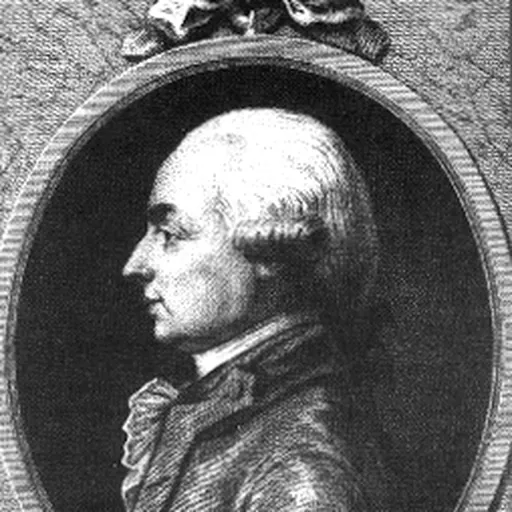
About J. Hector St. John de Crèvecœur
Lived 1735 – 1813 (aged 78). J. Hector St. John de Crèvecœur was a French and American writer, military personnel and diplomat, known for American Revolution.
Michel Guillaume Jean de Crèvecœur (; December 31, 1735 – November 12, 1813), naturalized in New York as John Hector St. John, was a French-American writer, diplomat, and farmer.
Biography Crèvecœur was born on December 31, 1735, in Caen, Province of Normandy, France, to the Count and Countess of Crèvecœur. He was educated by Jesuits at Caen's Collège Royal-Bourbon, and was sent to live with relatives in Salisbury around 1751. In 1755 he migrated to New France, in North America. There, he served in the French and Indian War under Montcalm in the La Sarre Regiment, where he was a cartographer and rose to the rank of lieutenant. After the French defeat at the Battle of the Plains of Abraham of in 1759, he moved to the Province of New York, where he acquired British citizenship and adopted the anglicized name of John Hector St. John; in 1770 he married an American woman, Mehitable Tippet, the daughter of a New York merchant. He bought a sizable farm in the Greycourt area of Chester, New York, a small town in Orange County. He named his farm "Pine Hill" and prospered as a farmer. He also traveled about, working as a surveyor. He started writing about life in the American colonies and the emergence of an American society.
In 1779, during the American Revolutionary War, Crèvecœur tried to leave the country to return to France because of the faltering health of his father. Accompanied by his son, he entered British-occupied New York City, where he was imprisoned as a suspected American spy for three months. Eventually, he was released and sailed for England, but was shipwrecked off the coast of Ireland.
Author In 1782 in London, he published a volume of narrative essays entitled Letters from an American Farmer. The book quickly became the first literary success by an American author in Europe and turned Crèvecœur into a celebrated figure. He was the first writer to describe to Europeans the life on the American frontier and to explore the concept of the American Dream. He used many American English terms portraying American society as characterized by the principles of equal opportunity and self-determination. His work provided useful information and understanding of the "New World" that helped create an American identity in the minds of Europeans by describing an entire country, rather than another regional colony. His writing celebrated American ingenuity and the uncomplicated lifestyle. It described the acceptance of religious diversity in a society being created from a variety of ethnic and cultural backgrounds. He applied the Latin maxim "Ubi panis ibi patria" (Where there is bread, there is my country) to early American settlers. He once praised the middle colonies for "fair cities, substantial villages, extensive fields... decent houses, good roads, orchards, meadows, and bridges, where an hundred years ago all was wild, woody, and uncultivated."
The original edition, published near the end of the American Revolutionary War, was rather selective in the letters that were included, omitting those that were negative or critical. Norman A. Plotkin argues that "it was intended to serve the English Whig cause by fostering an atmosphere conducive to reconciliation." The book excluded all but one of the letters that were written after the beginning of the war, as well as earlier ones that were more critical. Crèvecœur himself sympathized with the Whig cause. His wife's family remained loyal to the Crown and later fled to Nova Scotia. With regard to French politics, Crèvecœur was a liberal and a follower of the philosophes and dedicated his book to Abbé Raynal, who he said "viewed these provinces of North America in their true light, as the asylum of freedom; as the cradle of future nations, and the refuge of distressed Europeans." Plotkin notes that "extremists in the American colonies who violated this principle, incurred Crèvecœur's harshest criticism, although the severest of these criticisms were considered unsuitable for publication at the time."
In 1883, his great-grandson, Robert de Crèvecœur, published a biography for which he used previously unpublished letters and manuscripts passed down by the family. Although it received little notice in France, its existence came to the attention of W. P. Trent of Columbia University, who in 1904 published a reprint of Letters of an American Farmer. In 1916, Crèvecœur's first American biographer, Julia Post Mitchell, who had access to all the manuscripts, made a more balanced assessment and wrote that Crèvecœur addressed "problems in political economy which European governments were trying in vain to solve." He was "illustrating his theories from American conditions" and was not just "a garruluous apologist of American life." The additional manuscripts were published in 1925.
Diplomat
The success of his book in France had led to his being taken up by an influential circle, and he was appointed the French consul for New York, including the areas of New Jersey and Connecticut. Crèvecœur returned to New York City as the newly appointed French consul in November 1783. Anxious to be reunited with his family, he learned that his farm had been destroyed in an Indian raid, his wife was dead, and his two younger children missing. He stayed in the house of his friend William Seton, who, as the last royal public notary for the City and Province of New York, had helped to secure his release in 1780 from the prison he was kept in. Principal of the import-export mercantile firm the William Seton Company, Seton helped Crèvecœur locate his children, who were safe and living with a family in Boston. The following spring, Crèvecœur reunited with his children. For most of the 1780s, he lived in New York City.
St. Peter's, New York At that time, New York City was the national capital, and most of the resident Catholics were connected to the diplomatic corps. Initially, they met for services at the home of the Spanish consul. Their numbers increased with seafaring people, merchants, emigrants from the Spanish West Indies, and a few Acadians. They then rented space at Vauxhall Gardens, a garden and entertainment venue located along the North River on Greenwich Street between Warren and Chambers Streets. In 1785, Portuguese Consul Jose Roiz Silva, Spanish Consul Tomas Stoughton and others sought to rent the vacant Exchange Building and deemed Crèvecœur the best one to make the approach.
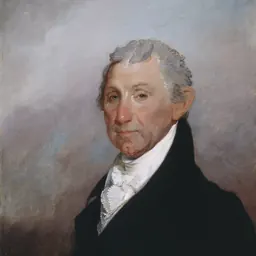
Although Crèvecœur was relatively indifferent to religion, he was sympathetic to the idea of liberty of conscience and a friend of Lafayette. When the proposal was rejected, Crèvecœur was insulted and became very active in working for the establishment of the first Catholic church in the city. He later served as president of the first Board of Trustees of St. Peter's Church, on Barclay Street. In 1789, during a stay in France, he was trapped by the political upheaval that was quickly turning into the French Revolution. At risk as an aristocrat, he went into hiding and secretly tried to gain passage to the United States. The necessary papers were finally delivered to him by the new American ambassador to France, James Monroe, at the end of his life. Crèvecœur returned to France and settled permanently on land that he inherited from his father. On November 12, 1813, he died in Sarcelles, Île-de-France, France. The town of St. Johnsbury, Vermont, is named after him, as suggested by Ethan Allen.
Primary works Letters from an American Farmer: Describing Certain Provincial Situations, Manners, and Customs, Not Generally Known; and Conveying Some Idea of the Late and Present Interior Circumstances of the British Colonies of North America, 1782. Letters from an American Farmer, written to W.S. (William Seton), squire, from the year 1770 to 1781, translated from English by *** (Lettres d'un cultivateur américain : écrites à W. S. (William Seton), écuyer, depuis l'année 1770 jusqu'à 1781, traduites de l'anglois par ***), 1784. Memoire sur le Commerce Entre la France et les États-Unis D'Amerique, 1784 (manuscript rests in the U.S. Embassy, Paris). Eighteenth-Century Travels in Pennsylvania and New York (Voyage dans la Haute-Pensylvanie et dans l'état de New-York), 1801. Sketches of the Eighteenth Century America: More "Letters From an American Farmer", probably written between 1770 and 1774, first published 1925.
Don’t just read it —
keep it.
Full-length biographies made to live with: read them, listen on the way to work, watch them tonight.
- E-book
- Audio
- Video
Instant download · yours to keep · every purchase keeps this site free
Important facts
People in J. Hector St. John de Crèvecœur's life
Named in this biography and alive at the same time
Related people
Same field, nearest in time
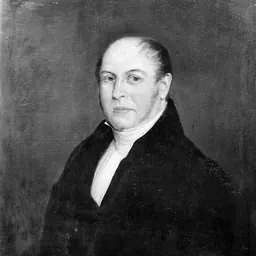
Contemporaries
People whose lives overlapped J. Hector St. John de Crèvecœur's
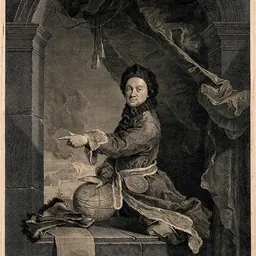
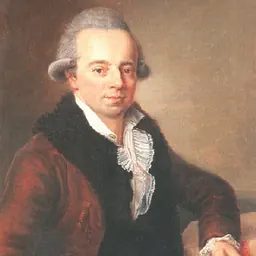




Frequently asked questions
Who was J. Hector St. John de Crèvecœur?
French writer (1735-1813)
When was J. Hector St. John de Crèvecœur born?
J. Hector St. John de Crèvecœur was born on 31 January 1735 in Caen.
When did J. Hector St. John de Crèvecœur die?
J. Hector St. John de Crèvecœur died on 12 November 1813 in Sarcelles.
What was J. Hector St. John de Crèvecœur's occupation?
J. Hector St. John de Crèvecœur was a writer, military personnel and diplomat.
What was J. Hector St. John de Crèvecœur known for?
J. Hector St. John de Crèvecœur was known for American Revolution.
What nationality was J. Hector St. John de Crèvecœur?
J. Hector St. John de Crèvecœur was French and American.
Sources & further reading
· Wikipedia: J. Hector St. John de Crèvecœur
· DBpedia: J. Hector St. John de Crèvecœur
Cite this page
APA: Biography.guide. (2026). J. Hector St. John de Crèvecœur. https://biography.guide/j-hector-st-john-de-crevecoeur/
MLA: "J. Hector St. John de Crèvecœur." Biography.guide, https://biography.guide/j-hector-st-john-de-crevecoeur/.
Chicago: "J. Hector St. John de Crèvecœur." Biography.guide. https://biography.guide/j-hector-st-john-de-crevecoeur/.
Data last updated: 2026-09-24 · Spot an error? Report a correction.
Portrait: Wikimedia Commons · author & licence
Page generated 2026-10-03 09:35 UTC