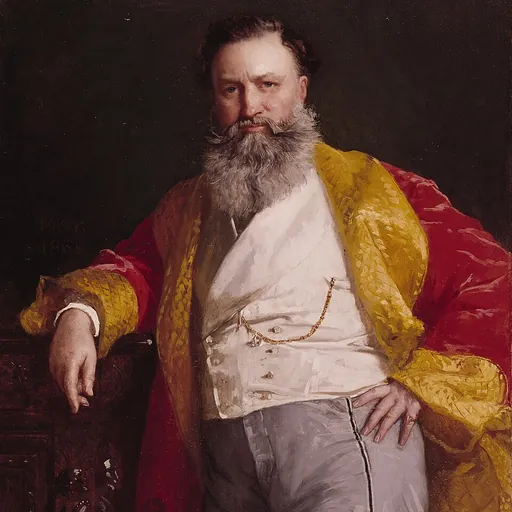
Isaac Singer
American businessman; inventor of the Singer sewing machine
About Isaac Singer
Lived 1811 – 1875 (aged 63). Isaac Singer was an American inventor, stage actor, businessperson, entrepreneur and mechanic, known for Singer Corporation.
Isaac Merritt Singer (October 27, 1811 – July 23, 1875) was an American inventor, actor, and businessman. He made important improvements in the design of the sewing machine and was the founder of what became one of the first American multi-national businesses, the Singer Sewing Machine Company.
Many others, including Walter Hunt and Elias Howe, had patented sewing machines before Singer, but his success was based on the practicality of his machine, the ease with which it could be adapted to home use and its availability on an installments payment basis.
Singer died in 1875, dividing his $13 million fortune unequally among 20 of his living children by his wives and various mistresses, although one son, who had supported his mother in her divorce case against Singer, received only $500. and his American wife Ruth (née Benson). His siblings were John Valentine Singer, Alexander Singer, Elizabeth (née Singer) Colby, Christiana (née Singer) Cleveland, and Elijah Singer. In 1821, his parents divorced and his mother abandoned Isaac. which were difficult to use and produce. Singer concluded that the sewing machine would be more reliable if the shuttle moved in a straight line rather than a circle, with a straight rather than a curved needle. Singer was able to obtain US Patent number 8294 for his improvements on August 12, 1851.
I. M. Singer & Co In 1856, manufacturers Grover & Baker, Singer, Wheeler & Wilson, all accusing each other of patent infringement, met in Albany, New York to pursue their suits. Orlando B. Potter, a lawyer and president of the Grover and Baker Company, proposed that, rather than squander their profits on litigation, they pool their patents. This was the first patent pool, a process which enables the production of complicated machines without legal battles over patent rights. They agreed to form the Sewing Machine Combination, but for this to be of any use, they had to secure the cooperation of Elias Howe, who still held certain vital uncontested patents. Terms were arranged; Howe received a royalty on every sewing machine manufactured.
Sewing machines began to be mass-produced. I. M. Singer & Co manufactured 2,564 machines in 1856, and 13,000 in 1860 at a new plant on Mott Street in New York. Later, a massive plant was built near Elizabeth, New Jersey.
Up to then, sewing machines had been industrial machines, made for garments, shoes, bridles and for tailors, but in 1856, smaller machines began to be marketed for home use. However, at the then enormous price of over $100 ($4,094.82 in 2024 USD), few sold. Singer invested heavily in mass production utilizing the concept of interchangeable parts developed by Samuel Colt and Eli Whitney for their firearms. He was able to cut the price in half, while at the same time increasing his profit margin by 530%. By the 1900s, this factory, controlled by the parent company, made 1.5 million machines sold around the world,
Consequence on global garment industry Singer's prototype sewing machine became the first to work in a practical way. It could sew 900 stitches per minute, far better than the 40 of an accomplished seamstress on simple work. was one of the key actions leading to protests known as Red Clydeside.
In the 1960s, Japanese production efficiency brought aluminum body machines and products at lower pricing which outsold the cast iron Singer machines. The symbolic tower was knocked down as the Singer Clydebank factory was modernized, but it closed in 1980 and was demolished in the late 1990s. In 1860, Singer divorced Catherine on the basis of her adultery with Stephen Kent. Their son William spoke up for his mother in the divorce case and was snubbed by Singer, including in his will where William received just $500 of Singer's $13,000,000 fortune. William Adam Singer (1834–1914), who in 1872 married Sarah Augusta Webb (1851–1909), a twin sister of William Seward Webb (who married Eliza Osgood Vanderbilt). John Albert Singer (1842–1911), who married Jennie C. Belinski. Fanny Elizabeth Singer (1844–1909), who married William S. Archer. Jasper Hamlet Singer (1846–1922), who married Jane Collier Cook. Mary Olivia Singer (1848–1900), who married Sturges Selleck Whitlock, a Connecticut state senator. Julia Ann Singer (1855–1923), who married Martin J. Herz. Caroline Virginia Singer (1857–1896), who married Augustus C. Foster. Margaret Matthews (1858–1939), who married Granville Henry Jackson Alexander, Esq., the High Sheriff of Armagh. Charles Alexander Matthews (1859–1883), who married Minnie Mathews. Florence Adelaide Matthews (–1932), who married Harry Ruthven Pratt.
Upon the discovery of his infidelity, Singer beat Mary Ann senseless. Mary Ann, still calling herself Mrs. I. M. Singer, had her husband arrested for bigamy. Singer was let out on bond and, disgraced, fled to London in 1862, taking Mary McGonigal with him. In the aftermath, another of Isaac's families was discovered: he had a "wife", Mary Eastwood Walters, a machine demonstrator, and had had a daughter in Lower Manhattan: Winnaretta Eugenie Singer (1865–1943), a patron of 20th-century music who married Prince Louis de Scey-Montbéliard in 1887. They divorced in 1892 and she married Prince Edmond de Polignac. Washington Merritt Grant Singer (1866–1934), who married Blanche Emmeline Hale and Ellen Mary Allen. Paris Eugene Singer (1867–1932), who married Cecilia Henrietta Augusta "Lillie" Graham (1867–1951). Paris was a close friend of the Palm Beach architect Addison Mizner. Isabelle-Blanche Singer (1869–1896), who married the French aristocrat Jean, Duc Decazes et de Glücksbierg in 1888. Franklin Merritt Morse Singer (1870–1939),
Isaac Singer died in 1875, shortly after the wedding of his daughter by Mary Eastwood Walters, Alice, whose dress had cost as much as a London apartment. His funeral was an elaborate affair with eighty horse-drawn carriages, and around 2,000 mourners, to see him buried locally in Torquay Cemetery, at his request in three layers of coffin (cedar lined with satin, lead, English oak with silver decoration) and a marble tomb.
Legacy and honors The World War II Liberty Ship was named in his honor. Singer Island, Florida was named for his son Paris Singer
Don’t just read it —
keep it.
Full-length biographies made to live with: read them, listen on the way to work, watch them tonight.
- E-book
- Audio
- Video
Instant download · yours to keep · every purchase keeps this site free
Important facts
Family & relationships
People in Isaac Singer's life
Named in this biography and alive at the same time





Related people
Same field, nearest in time

Contemporaries
People whose lives overlapped Isaac Singer's





Frequently asked questions
Who was Isaac Singer?
American businessman; inventor of the Singer sewing machine (1811-1875)
When was Isaac Singer born?
Isaac Singer was born on 27 October 1811 in Pittstown.
When did Isaac Singer die?
Isaac Singer died on 23 July 1875 in Paignton.
What was Isaac Singer's occupation?
Isaac Singer was an inventor, stage actor, businessperson, entrepreneur and mechanic.
What was Isaac Singer known for?
Isaac Singer was known for Singer Corporation.
What nationality was Isaac Singer?
Isaac Singer was American.
Sources & further reading
Cite this page
APA: Biography.guide. (2026). Isaac Singer. https://biography.guide/isaac-singer/
MLA: "Isaac Singer." Biography.guide, https://biography.guide/isaac-singer/.
Chicago: "Isaac Singer." Biography.guide. https://biography.guide/isaac-singer/.
Data last updated: 2026-09-20 · Spot an error? Report a correction.
Page generated 2026-09-27 05:09 UTC