About Iolo Morganwg
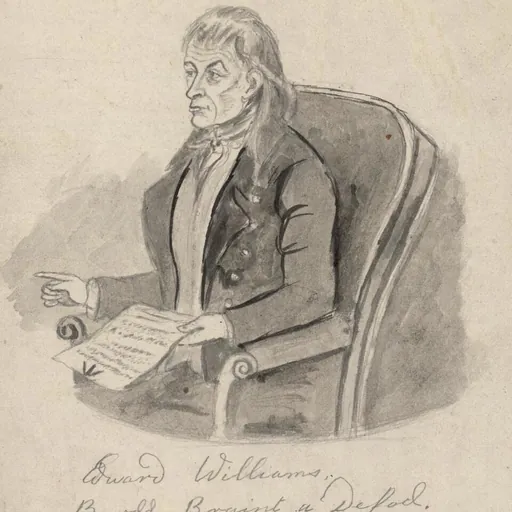
Lived 1747 – 1826 (aged 79). Iolo Morganwg was a British and Welsh poet, antiquarian seller, writer, antiquarian, farmer and counterfeiter.
Edward Williams, better known by his bardic name Iolo Morganwg (; 10March 174718December 1826), was a Welsh antiquarian, poet and collector. He was seen as an expert collector of Medieval Welsh literature, but it emerged after his death that he had forged several manuscripts, notably some of the Third Series of Welsh Triads. Even so, he had a lasting impact on Welsh culture, notably in founding the secret society known as the Gorsedd, through which Iolo Morganwg successfully co-opted the 18th-century Eisteddfod revival. The philosophy he spread in his forgeries has had an enormous impact upon neo-Druidism. His bardic name is Welsh for "Iolo of Glamorgan".
Early life Edward Williams was born in Pen-onn, near Llancarfan, Vale of Glamorgan, and raised in the village of Flemingston (or Flimston; Trefflemin in Welsh). He followed his father as a stonemason. In Glamorgan, he took an interest in manuscript collection, and learnt to compose Welsh poetry from poets such as Lewis Hopkin, Rhys Morgan, and especially Siôn Bradford. a selection being published as the Iolo Manuscripts by the Welsh Manuscripts Society in 1848.
Literary career From an early date Williams was concerned with preserving and maintaining the literary and cultural traditions of Wales. He produced a large number of manuscripts as evidence for his claims that ancient Druidic tradition had survived the Roman conquest, the conversion of the populace to Christianity, the persecution of bards under King Edward I, and other adversities. His forgeries develop an elaborate mystical philosophy, which he claimed as a direct continuation of ancient Druidic practice. Williams's reportedly heavy use of laudanum may have been a contributing factor. This work, published in two volumes in 1862 and 1874, was claimed to be a translation of works by Llywelyn Siôn, detailing the history of the Welsh bardic system from its ancient origins to the present day. Though it contains nothing of authentic Druidic lore, it is the fullest account of the mystical cosmology Williams developed.
By 1799 he had become a Unitarian, and was a leading spirit when a Unitarian Association was formed in South Wales in 1802. It was he who drew up its Rheolau a Threfniadau (Rules and Procedures), published in 1803. These symbols were to be represented in a wooden frame, known as peithynen.
Exposure Towards the end of the 19th century, the grammarian Sir John Morris-Jones was involved in exposing Morganwg as a forger, which led to the bard being labelled a charlatan. Morris-Jones called Morganwg "hateful" and said it would be an age "before our history and literature are clean of the traces of his dirty fingers."
After the First World War, the scholar Griffith John Williams (1892–1963) was the first to make a full study of Morganwg's work, consulting original documents donated to the National Library of Wales by Iolo's descendants in 1917. Williams aimed to find out exactly how much of Morganwg's output was based on imagination rather than fact. He established that the poems Morganwg attributed to Dafydd ap Gwilym were forgeries. His researches led him to become a defender of Iolo's reputation as well as a critic.
It has been suggested that some of Iolo's claims were supported by oral tradition: recent research has revealed that the tale of Ieuan Gethin, a soldier in the Glyndŵr revolt, might have basis in fact.
Legacy
In 1926, in honor of the hundredth anniversary of Morganwg's death, a plaque was mounted at the location of his old shop. It reads:
A memorial plaque was erected in 2009, on the approximate site of the first Gorsedd ceremony, held on London's Primrose Hill in 1792, and another memorial stone on Stalling Down near Cowbridge, where the first Gorsedd ceremony in Wales took place in 1795.
Such was the extent of his forgery that, even into the 21st century, some of his tampered versions of medieval Welsh texts are better known than the original versions.
A Welsh-language school in Cowbridge, Ysgol Iolo Morganwg, is named after him, and Super Furry Animals vocalist Gruff Rhys dedicated a song to him on his 2014 album, American Interior.
Family tree
Don’t just read it —
keep it.
Full-length biographies made to live with: read them, listen on the way to work, watch them tonight.
- E-book
- Audio
- Video
Instant download · yours to keep · every purchase keeps this site free
Important facts
People in Iolo Morganwg's life
Named in this biography and alive at the same time



Related people
Same field, nearest in time


Contemporaries
People whose lives overlapped Iolo Morganwg's




Frequently asked questions
Who was Iolo Morganwg?
Welsh antiquarian and poet (1747–1826)
When was Iolo Morganwg born?
Iolo Morganwg was born on 10 March 1747 in Llancarfan.
When did Iolo Morganwg die?
Iolo Morganwg died on 18 December 1826 in Flemingston.
What was Iolo Morganwg's occupation?
Iolo Morganwg was a poet, antiquarian seller, writer, antiquarian, farmer and counterfeiter.
What nationality was Iolo Morganwg?
Iolo Morganwg was British and Welsh.
Sources & further reading
Cite this page
APA: Biography.guide. (2026). Iolo Morganwg. https://biography.guide/iolo-morganwg/
MLA: "Iolo Morganwg." Biography.guide, https://biography.guide/iolo-morganwg/.
Chicago: "Iolo Morganwg." Biography.guide. https://biography.guide/iolo-morganwg/.
Data last updated: 2026-09-20 · Spot an error? Report a correction.
Portrait: Wikimedia Commons · author & licence
Page generated 2026-09-27 04:58 UTC