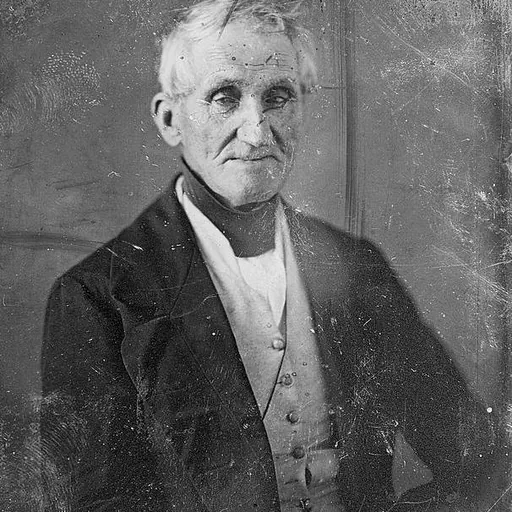
About Hugh Brady
Lived 1768 – 1851 (aged 82). Hugh Brady was an American military officer.
Hugh Brady (July 29, 1768 – April 15, 1851) was an American general from Pennsylvania. He served in the Northwest Indian War under General Anthony Wayne, and during the War of 1812. Following the War of 1812, Brady remained in the military, eventually rising to the rank of major general and taking command of the garrison at Detroit. He also marginally participated in the 1832 Black Hawk War. Hugh Brady died an accidental death in 1851 when he was thrown from a horse-drawn carriage.
Early life
Hugh Brady was born July 29, 1768, one of six sons and four daughters by John and Mary Brady, in Standing Stone, Huntingdon County, Pennsylvania. Brady's father, Captain John Brady, was killed in 1779, during the American Revolution in a battle with Native Americans. In May 1779, the family moved to Brady's maternal grandfather's home in Cumberland County and stayed there until October 1779. After a harsh winter, Brady spent the ensuing few years working the fields in the area with his brothers, often armed in case of conflict with Native Americans. Brady's mother died in 1783, and his oldest siblings began to marry. Hugh Brady moved with his brother Samuel Brady to Washington County, Pennsylvania. Samuel married and Hugh stayed with his brother until 1792, when he began his military career.
The Quigleys
Hugh's Irish maternal grandfather, James Quigley, was born in about 1710 and came to America from Ireland in 1730. He settled on of frontier land, in what is today, Hopewell township, Cumberland County, Pennsylvania, close to present day Shippensburg, Pennsylvania. He built his wilderness home of logs close to the banks of Conodoguinet Creek.
The Irish were the earliest settlers on the Pennsylvania frontier of the early 18th century. As one author puts it.
The Cumberland Valley was dotted with Irish settlements throughout its entire area, a district which had become almost exclusively the possession of this racial group, with whom were mingled small numbers of English and German settlers constituting perhaps ten percent of the population. It was well adapted to farming, and the Irish, in this early period, were mostly farmers, but later they developed a marked aptitude for trade and the professions.
As pioneers, they were the advance guard blazing the trail through the wilderness far out on the frontier. They were the first line of defense against the savages, bearing the brunt of the Indian wars, and courageously enduring the hardships of pioneer life as the typical frontiersmen of provincial Pennsylvania. Step by step they had advanced along a perilous path, surmounting whatever difficulties arose, moving ever farther into the wilderness and reclaiming it to the new civilization.
Little is known of James' wife, Jeanette, except that she was likely of Scottish descent and probably was born in Hopewell Township in 1725. However, according to Brady family historian, Belle Swope, "We are assured she was a devoted wife, a loving mother, and a wise counselor, or she would not have given to the world such brave and illustrious children." In 1738 the log Middle Spring Presbyterian Church was erected three miles (5 km) from their homestead, of which James and Jeanette Quigley became faithful members and in which they along with some of their children came to be buried in its old graveyard. James Quigley had to be and was ever vigilant to keep hostile Indians from killing his family and burning his home–a fate that befell many of his neighbors in those early days on the Pennsylvania frontier. In addition to successfully keeping his home and family safe, on March 25, 1756, James Quigley was commissioned ensign in the Cumberland County Colonial Rangers. He served as a private in the Revolutionary War. He died in 1782. They had six children, who were all born on their Hopewell Township homestead, namely, John Quigley, born in August 1731, Samuel Quigley, born in June 1733, Mary Quigley (who was the wife of Major John Brady, Hugh's mother), born August 16, 1735, Agnes Quigley, born in March 1737 or 1738, Martha Quigley, born in July 1741 and Robert Quigley, born in 1744, who married Mary Jacob. Robert Quigley eventually ended up living on the Quigley Homestead, at Quigley Bridge, Hopewell Township, Cumberland County, Pennsylvania. Robert Quigley and Mary Quigley Brady remained very close throughout their lives.
The Bradys As to the Brady grandparents of General Hugh Brady, Belle Swope states, "No family of pioneers was more conspicuous in the early history and settlement of the country than the Bradys." Hugh Brady was born in 1709 in County Cork, Ireland. Hannah's maiden name was McCormick. She was born on January 3, 1709, in Dublin, Ireland. After immigrating from Ireland, the Bradys first lived in the American colony of Delaware where they were married in 1733. They are said to have moved to frontier Pennsylvania on the urging of prosperous friends who told them that good land was readily available. Hugh and Hannah Brady moved to the Scottish-Irish Presbyterian community on the banks of Conodoguinet creek around 1733, where they established a homestead close to where the Quigleys had already settled. They thereby became near neighbors of and fellow church members with James and Jeanette Quigley. They had nine children, Major John Brady (General Hugh Brady's father), born in 1733 in Delaware, Samuel T. Brady, born in 1734, Joseph Brady, born in 1735, Hugh Brady, born in 1738, William Robert Brady, born in 1740 in Cumberland County, Pennsylvania, Margaret Brady, born in 1742, Mary Brady, born in 1745, Ebenezer Brady, born in 1750 and James Brady, born in 1753. All of their children, except Major John Brady, were likely born in Hopewell Township, Cumberland County, Pennsylvania. Hannah Brady died in 1776 in Cumberland County, Pennsylvania. Hugh Brady died on May 26, 1787, also in Cumberland County, Pennsylvania. As are the Quigleys, they are also buried in the Middle Spring Presbyterian Church Cemetery, Cumberland County, Pennsylvania.
Military career
Early career
Brady was first inducted into the military with a commission from George Washington as an ensign in General "Mad" Anthony Wayne's Legion of the United States in March 1792 and placed in a rifle company under the command of Captain John Crawford. In October 1795 he left the military, albeit temporarily, and returned to Virginia to visit the widow of his brother, Captain Samuel Brady.
His brother had settled in Ohio County, Virginia and after visiting his widow there, Hugh Brady decided to return home to see his family in Sunbury, Pennsylvania. He arrived there, after further stops in Virginia and Kentucky, in 1797. He remained in Sunbury until, during the winter of 1798–99, he was appointed a captain in the army raised by the administration of President John Adams during the Quasi-War. Brady would remain in the military after the war, until his death in 1851. Brady rose in rank to brevet brigadier general later that same year, after ten years service. The next morning Dodge set out for Dixon's Ferry, where he camped with General Brady. On June 11, Dodge escorted Brady to the mouth of the Fox River to confer with Atkinson.
Late life and death Five years after the Black Hawk War, in 1837, Brady was given command of Military Department No. 7, headquartered in Detroit. He remained in the position for seven years, during which time he was in command over the removal of several Native American tribes as well as an incident known as the "Patriot War". When the U.S.-Mexican War broke out, Brady was too old to join the troops in the field but he assisted by helping to raise troops and equipment and shipping it to the war zone. In 1848, three years before his death, Brady was brevetted to the rank of major general.
Hugh Brady died, an accidental death, in Detroit on April 15, 1851. Brady was at the helm of a horse-drawn carriage, when the vehicle became entangled in telegraph wires. The wires, lowered for repairs, caused the horses to panic. In the panic, Brady was thrown from the carriage and fatally injured. He died in the presence of his pastor, Dr. (Rev.) George Duffield.
Don’t just read it —
keep it.
Full-length biographies made to live with: read them, listen on the way to work, watch them tonight.
- E-book
- Audio
- Video
Instant download · yours to keep · every purchase keeps this site free
Important facts
People in Hugh Brady's life
Named in this biography and alive at the same time






Related people
Same field, nearest in time


Contemporaries
People whose lives overlapped Hugh Brady's




Frequently asked questions
Who was Hugh Brady?
American general
When was Hugh Brady born?
Hugh Brady was born on 29 July 1768 in Huntingdon.
When did Hugh Brady die?
Hugh Brady died on 15 April 1851 in Detroit.
What was Hugh Brady's occupation?
Hugh Brady was a military officer.
What nationality was Hugh Brady?
Hugh Brady was American.
Sources & further reading
· DBpedia: Hugh Brady (general)
Cite this page
APA: Biography.guide. (2026). Hugh Brady. https://biography.guide/hugh-brady/
MLA: "Hugh Brady." Biography.guide, https://biography.guide/hugh-brady/.
Chicago: "Hugh Brady." Biography.guide. https://biography.guide/hugh-brady/.
Data last updated: 2026-09-20 · Spot an error? Report a correction.
Portrait: Wikimedia Commons · author & licence
Page generated 2026-09-27 04:57 UTC