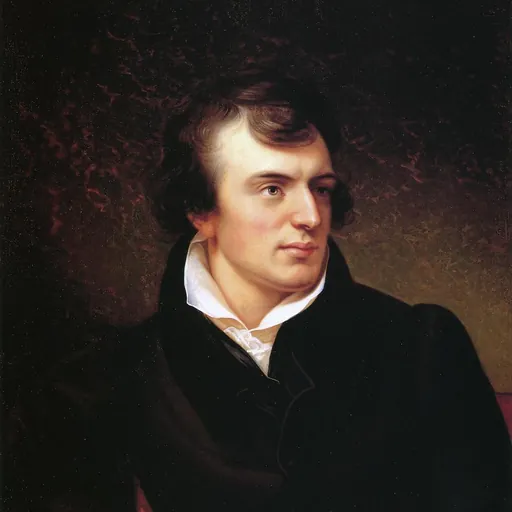
About Horatio Greenough
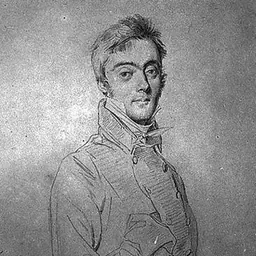
Lived 1805 – 1852 (aged 47). Horatio Greenough was an American architect, sculptor, landscape architect and artist.
Horatio Greenough (September 6, 1805 – December 18, 1852) was an American sculptor best known for his United States government commissions The Rescue (1837–1850) and George Washington.
Biography The son of Elizabeth (née Bender) and David Greenough, he was born in Boston on September 6, 1805, into a home with ethics for honesty and emphasis on good education. Horatio showed an early interest in artistic and mechanical hobbies. Particularly attracted to chalk, around the age of 12 he made a chalk statue of William Penn, known as his earliest work of record. Horatio also experimented with clay, which medium he learned from Solomon Willard. He also learned how to carve with marble under instruction from Alpheus Cary. Horatio seemed to have a natural talent for art, yet his father wasn't fond of the idea of this as a career for Horatio.
In 1814 Horatio Greenough enrolled at Phillips Academy, Andover, and in 1821 he entered Harvard University. There he found a passion in works of antiquity and devoted much of his time to reading literature and works of art. With a plan to study abroad, he learned Italian and French, but also still studied anatomy and kept modeling sculptures. While attending Harvard he came across his first crucial influence. Washington Allston was more than a mentor, but a close friend who enlightened and inspired Horatio. He even molded a bust of Washington. In 1825, he submitted the winning obelisk plan in a design contest for the Bunker Hill Monument. Before graduating from Harvard, he sailed to Rome to study art where he met the painter Robert W. Weir, while living on Via Gregoriana.
These two became close friends and studied together the Renaissance and works of antiquity. Favorites of theirs were the Laocoon group of the Vatican structure galleries and the Apollo Belvedere. During Horatio's time spent in Rome, he created many busts, such as a full-size statue of the Dead Abel, a Dead John Cranch, and a portrait of himself. He returned to Boston in May 1827 with Weir, after recovering an attack of malaria. He modeled busts such as Josiah Quincy, president of Harvard, Samuel Appleton and John Jacob Astor. In an attempt to establish a greater reputation he sought out to make a portrait of President John Quincy Adams. His plan worked as he displayed a style of naturalism in this piece as he did in many other works. In 1828 he established a studio in Florence.
Although Greenough was generally healthy, in December 1852 he contracted a severe fever. On December 18, after two weeks of this high fever he died at the age of 47 in Somerville, near Boston.
He was elected a Fellow of the American Academy of Arts and Sciences in 1843. His sketchbook is held in the Archives of American Art. In 1828 he was elected into the National Academy of Design as an Honorary Academician.
His younger brother was the sculptor Richard Saltonstall Greenough.
Horatio's son, biologist Horatio S. Greenough, proposed a stereo microscope design to Ernst Abbe of Carl Zeiss AG in Paris that led to the first commercial stereomicroscope. The younger Greenough's design, originally intended for dissection, is still widely used in the optics industry.
Works
His sculptures reflected truth and reality, but also ancient classical aesthetic ideals learned from Washington Allston. Many of Greenough's works were done in Florence, Italy where he spent most of his professional life. His sculpture The Rescue (1837–1850) and his over-life-size George Washington (1840) both derived from United States government commissions. Some of his other most famous and important sculptures include James Fenimore Cooper (1831), Castor and Pollux (1847), and Marquis de Lafayette (1831–32). A prolific draftsman, a selection of his drawings were displayed in 1999 in the exhibition Horatio Greenough: An American Sculptor's Drawings, at the Middlebury College Museum of Art.
His works are in the Art Institute of Chicago, Metropolitan Museum of Art, Museum of Fine Arts, and the Smithsonian American Art Museum.
In 1939, a joint resolution introduced in Congress condemned The Rescue and recommended that it should be "ground into dust." In 1941, another resolution said it was "an atrocious distortion of the facts of American history and a gratuitous insult" to Native Americans. In 1958, the statue had fallen into disrepair and was removed during renovation and put into storage. In 1976, it was damaged while being moved. He was, however, a Protestant. Greenough's writings were for a long time largely forgotten, and were rediscovered only in the 1930s; in 1947 a selection of his essays was published under the title Form and Function: Remarks on Art by Horatio Greenough.
In a letter to Emerson, Greenough wrote:"Here is my theory of structure: A scientific arrangement of spaces and forms to functions and to site; an emphasis of features proportioned to their gradated importance in function; color and ornament to be decided and arranged and varied by strictly organic laws, having a distinct reason for each decision; the entire and immediate banishment of all makeshift and make-believe."
Gallery
Don’t just read it —
keep it.
Full-length biographies made to live with: read them, listen on the way to work, watch them tonight.
- E-book
- Audio
- Video
Instant download · yours to keep · every purchase keeps this site free
Important facts
People in Horatio Greenough's life
Named in this biography and alive at the same time





Related people
Same field, nearest in time



Contemporaries
People whose lives overlapped Horatio Greenough's





Frequently asked questions
Who was Horatio Greenough?
American artist (1805-1852)
When was Horatio Greenough born?
Horatio Greenough was born on 6 September 1805 in Boston.
When did Horatio Greenough die?
Horatio Greenough died on 18 December 1852 in Somerville.
What was Horatio Greenough's occupation?
Horatio Greenough was an architect, sculptor, landscape architect and artist.
What nationality was Horatio Greenough?
Horatio Greenough was American.
Sources & further reading
· Wikipedia: Horatio Greenough
Cite this page
APA: Biography.guide. (2026). Horatio Greenough. https://biography.guide/horatio-greenough/
MLA: "Horatio Greenough." Biography.guide, https://biography.guide/horatio-greenough/.
Chicago: "Horatio Greenough." Biography.guide. https://biography.guide/horatio-greenough/.
Data last updated: 2026-09-20 · Spot an error? Report a correction.
Portrait: Wikimedia Commons · author & licence
Page generated 2026-09-27 04:57 UTC