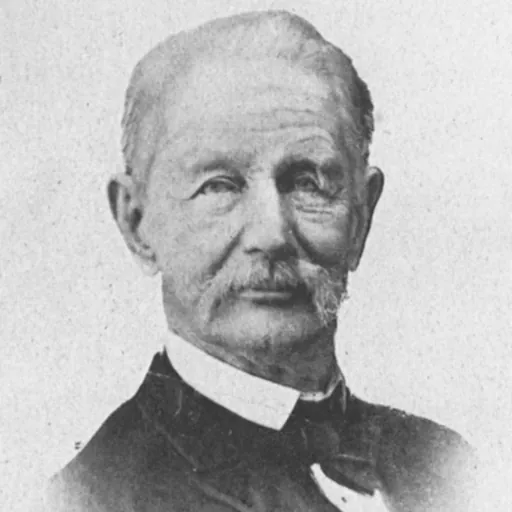
Hermann Burmeister
German Argentine zoologist, entomologist, herpetologist, and botanist
About Hermann Burmeister
Lived 1807 – 1892 (aged 85). Hermann Burmeister was an Argentine and German curator, ornithologist, geographer, geologist, botanist and marine biologist.
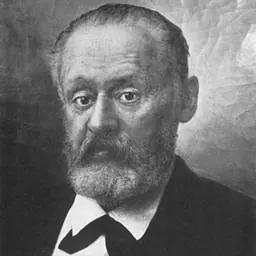
Karl Hermann Konrad Burmeister (also known as Carlos Germán Conrado Burmeister) (15 January 1807 – 2 May 1892) was a German Argentine zoologist, entomologist, herpetologist, botanist, and coleopterologist. He served as a professor at the University of Halle, headed the museum there and published the Handbuch der Entomologie (1832–1855) before moving to Argentina where he worked until his death.
Career Burmeister was born in Stralsund, where his father was a customs officer. He studied medicine at Greifswald (1825–1827) and Halle (1827–1829), and in 1830 went to Berlin to qualify himself to be a teacher of natural history. His dissertation was titled De insectorum systemate naturali and graduated as a doctor of medicine on November 4, 1829 and then received a doctor of philosophy on December 19 in the same year. He then joined for military service in Berlin and Grünberg (Silesia). He was soon after appointed an instructor in the gymnasium at Cologne. He later became a professor of zoology at the Martin Luther University of Halle-Wittenberg serving there from 1837 to 1861. During this period he published several major works on insects which also involved the examination of insect collections around Europe and those of wealthy collectors. He married Marie Elise, the daughter of shipowner and insect collector M.C. Sommer of Altona, in 1836.
In 1848, during the revolutionary excitement, he was sent by the city of Halle as deputy to the national assembly, and subsequently by the town of Leibnitz to the first Prussian chamber. Around 1848 he became a socialist and still later opposed slavery. He traveled to Brazil from 1850 to 1852 — partly supported through the efforts of Alexander von Humboldt — was cut short by a leg injury. He then visited Argentina from 1857 to 1860, returning to Germany with zoological collections. He was elected to the American Philosophical Society in 1856. In 1861, he divorced his wife and went to live in Argentina, founding the Institute at the Museo Nacional in Buenos Aires. He married an Argentine woman and they had two sons, Carlos and Federico. Carlos also became a scientist. Burmeister headed the Academy of Sciences, formed from the scientific faculty of Argentina's National University of Córdoba.
In the field of herpetology he described many new species of amphibians and reptiles. He also mistakenly described a bovid atlas as belonging to Macrauchenia patachonica. Burmeister was said to be harsh and did not have any close circle of friends. While working at the Argentine museum, he had a fall from a ladder and landed on a glass case and injured himself seriously on 8 February 1892. He resigned from work on 18 April and died on 2 May. A state funeral was held on the 4 May and the president of Argentina, Carlos Pellegrini was present. A monument was placed on the bank of the Rio de La Plata in the Parque 3 Febrero on October 7, 1900 and later moved to the Parque Centenario.
Evolution
Burmeister was a critic of Darwinism, he rejected common descent. However, he changed his views slightly on common descent in the late 1870s. In 1879 he commented that:
I am wholly convinced that the beings found in the older formations of our globe are the prototypes of contemporary beings, and in this respect, I declare myself a partisan of the hypothesis recently developed in detail, and as a natural law, by Darwin and his followers. But I must confess that their experiments have not provided me with any proof that any fundamental change in type is possible.
Florentino Ameghino described Burmeister as a "Biblical creationist", although this remains unconfirmed.
Don’t just read it —
keep it.
Full-length biographies made to live with: read them, listen on the way to work, watch them tonight.
- E-book
- Audio
- Video
Instant download · yours to keep · every purchase keeps this site free
Important facts
more
Carl Hermann Conrad BurmeisterPeople in Hermann Burmeister's life
Named in this biography and alive at the same time

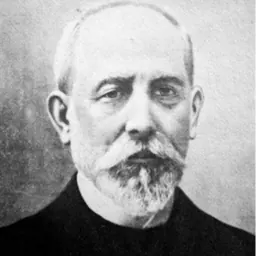

Related people
Same field, nearest in time
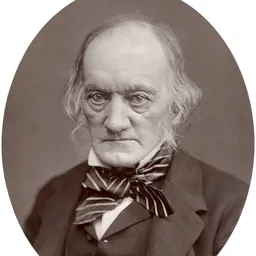
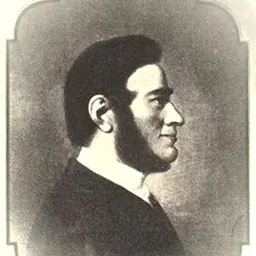

Contemporaries
People whose lives overlapped Hermann Burmeister's





Frequently asked questions
Who was Hermann Burmeister?
German Argentine zoologist, entomologist, herpetologist, and botanist (1807–1892)
When was Hermann Burmeister born?
Hermann Burmeister was born on 15 January 1807 in Stralsund.
When did Hermann Burmeister die?
Hermann Burmeister died on 2 May 1892 in Buenos Aires.
What was Hermann Burmeister's occupation?
Hermann Burmeister was a curator, ornithologist, geographer, geologist, botanist and marine biologist.
What nationality was Hermann Burmeister?
Hermann Burmeister was Argentine and German.
Sources & further reading
· Wikipedia: Hermann Burmeister
Cite this page
APA: Biography.guide. (2026). Hermann Burmeister. https://biography.guide/hermann-burmeister/
MLA: "Hermann Burmeister." Biography.guide, https://biography.guide/hermann-burmeister/.
Chicago: "Hermann Burmeister." Biography.guide. https://biography.guide/hermann-burmeister/.
Data last updated: 2026-09-23 · Spot an error? Report a correction.
Portrait: Wikimedia Commons · author & licence
Page generated 2026-09-27 05:05 UTC