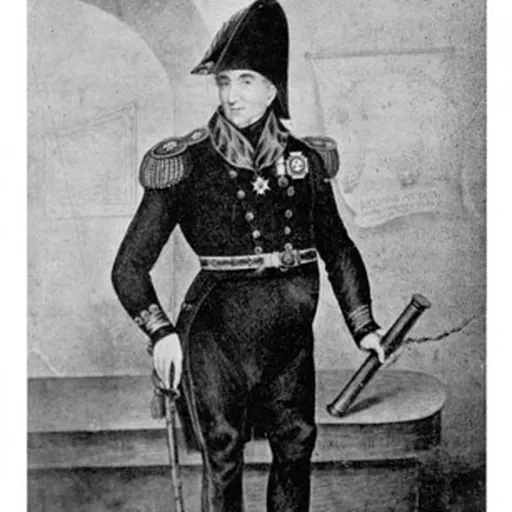
About Henry Digby
Lived 1770 – 1842 (aged 72). Henry Digby was a British naval officer.
Admiral Sir Henry Digby GCB (20 January 1770 – 19 August 1842) was a Royal Navy officer who served in the French Revolutionary and Napoleonic Wars. Born into a long-established naval family, his uncle was Admiral Robert Digby. Digby went to sea at the end of the American Revolutionary War at the age fourteen.
As a lieutenant aboard HMS Pallas, he received a commendation for rescuing the crew of the burning HMS Boyne. Promoted to commander in August 1795 and captain in December 1796, Digby established a reputation as an aggressive prize taker, capturing 57 ships in less than twenty months. His richest capture came in the action of 16 October 1799 when he assisted in the taking of the Spanish frigate Santa Brigida. Digby commanded HMS Africa at the Battle of Trafalgar, manoeuvring her into the Franco-Spanish fleet against orders, having been instructed by Horatio Nelson to avoid battle, fearing Digby's small ship of the line would be overwhelmed.
In 1806, Digby married Lady Jane Elizabeth Coke, the daughter of Thomas Coke, 1st Earl of Leicester, with whom he had three children. They moved to the estate in Dorset inherited from his uncle where the prize money amassed by Digby paid for a comfortable life. He continued to serve in the navy, was appointed Commander in Chief, Sheerness and attained the rank of admiral in 1841.
Early life The nephew of Robert Digby, Henry was born in Bath on 20 January 1770. His father, the Hon. Rev. William Digby, was the younger brother of Edward Digby, 6th Baron Digby and later became Dean of Durham and Chaplain Ordinary to King George III. The younger, Joseph, later becoming a vice-admiral. After a short probationary period aboard HMS Bellerophon, he was confirmed as fourth lieutenant of the Lion in October 1790. In these first two commands, Digby took 57 enemy vessels before transferring to HMS Leviathan under Commodore John Duckworth and was present at the capture of Minorca in November 1798. In 1799 he was given a lucrative independent cruise in the frigate HMS Alcmene. Patrolling the waters in and around Portugal and the Azores, Digby captured dozens of small merchant ships and a 28 gun French privateer, Courageux. One particular capture, that of the Santa Brigida, contained such wealth that even an Ordinary Seaman received £182. Triton, the fastest of the three British frigates, led the chase of the second frigate. The next morning Triton struck some rocks off Muros as she tried to prevent her quarry from reaching port. Triton got off the rocks and resumed the chase despite taking on water. She and Alcmene then exchanged fire with the Spanish frigate, which surrendered before Naiad could catch up.
The Santa Brigida and Thetis cargoes included around 2.7 million Pieces of Eight. The two ships' cargoes totalled around £618,000 (£56million in 2018 values) and Digby's share of the prize fund came to £40,731, not including the ships themselves. Digby spent the next three years on half pay, though in February 1805 he was in temporary command of . He was next given command of HMS Africa in July 1805. An old, small battleship, Africa possessed just 64 guns and was considered by many as much too small to serve in the line of battle in a major fleet engagement. Ordered to join Nelson's fleet off Cadiz, Digby arrived just days before the Battle of Trafalgar on 21 October.
Digby indignantly received the order and then deliberately misinterpreted it as an instruction to close with the British fleet to the south, engaging each in turn with port broadsides before reaching the melee surrounding the enormous Spanish flagship, the 130 gun Santissima Trinidad.
Later life
On 17 April 1806, he married Lady Jane Elizabeth Coke, a renowned beauty, and daughter of Thomas Coke, 1st Earl of Leicester. Their youngest child, Rev. Hon. Kenelm Henry Digby, held the office of rector of Tittleshall, and Honorary Canon of Norwich. In 1815 his uncle, Admiral Robert Digby, died leaving Henry the estate in Minterne Magna to which he retired with his family. Digby did not leave the Royal Navy, however, and continued to serve for many years, advancing by seniority through the ranks, making rear admiral in 1819 and vice admiral in 1830. He received the Order of the Bath in 1815 and served as High Sheriff of Dorset in 1835. Digby was appointed Commander-in-Chief, The Nore, in 1840.
He suffered from bouts of gout in his final years and died in 1842 and was buried in the local churchyard with many of his family, where his tombstone can still be seen. At the time of his death he was a full admiral of the Blue and had become a Knight Grand Cross of the Order of the Bath
Henry's great-great-granddaughter was the 20th-century socialite and diplomat Pamela Harriman, who grew up on the family estate in Dorset.
Don’t just read it —
keep it.
Full-length biographies made to live with: read them, listen on the way to work, watch them tonight.
- E-book
- Audio
- Video
Instant download · yours to keep · every purchase keeps this site free
Important facts
People in Henry Digby's life
Named in this biography and alive at the same time
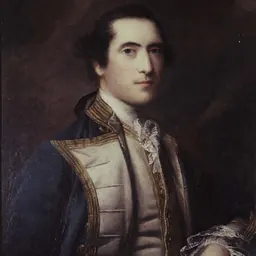



Related people
Same field, nearest in time




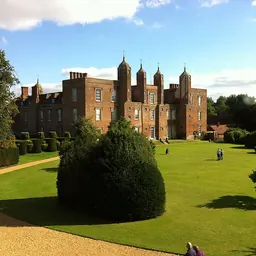
Contemporaries
People whose lives overlapped Henry Digby's





Frequently asked questions
Who was Henry Digby?
Royal Navy admiral
When was Henry Digby born?
Henry Digby was born on 20 January 1770 in Bath.
When did Henry Digby die?
Henry Digby died on 19 August 1842 in Sheerness.
What was Henry Digby's occupation?
Henry Digby was a naval officer.
What nationality was Henry Digby?
Henry Digby was British.
Sources & further reading
· DBpedia: Henry Digby (Royal Navy officer)
Cite this page
APA: Biography.guide. (2026). Henry Digby. https://biography.guide/henry-digby/
MLA: "Henry Digby." Biography.guide, https://biography.guide/henry-digby/.
Chicago: "Henry Digby." Biography.guide. https://biography.guide/henry-digby/.
Data last updated: 2026-09-20 · Spot an error? Report a correction.
Page generated 2026-09-27 05:09 UTC