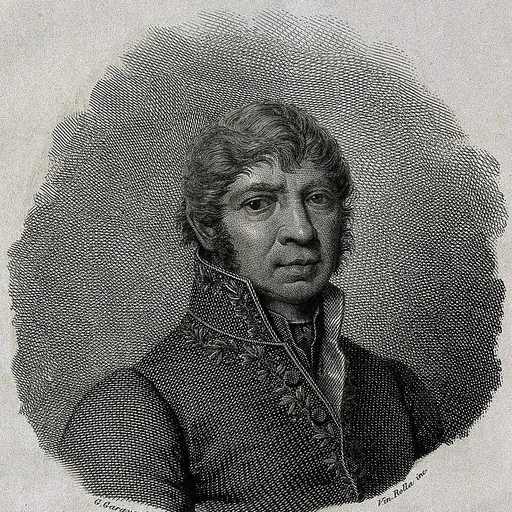
About Giuseppe Mangili
Lived 1767 – 1829 (aged 62). Giuseppe Mangili was an Austrian and Italian entomologist, naturalist and physician.
Giuseppe Mangili (7 March 1767 – 15 November 1829) was an Italian physician and naturalist who studied animal physiology through experimental means. He examined the nervous systems of invertebrates, the onset of hibernation in mammals and the action of viper venom. He was a professor of natural history at the University of Pavia from 1799 to 1819.
Life and work Mangili was born in Molini della Sonna, Caprino Bergamasco, the son of Giambattista and Angela Magoni. After studying at the Bergamo seminary, he taught at the Marian college from 1786. Invited by his friend Lorenzo Mascheroni, he moved to Pavia in 1790 and later to the University of Ticino where he attended the lectures of Lazarro Spallanzani, Antonio Scarpa, Alessandro Volta, and others. In 1791, he joined Mascheroni, Gregorio Fontana and Carlo Baldinotti, on an excursion to southern Italy and he visited the crater of Vesuvius. On his way back he visited the natural history collection in Florence. He received a degree in physiology and anatomy in 1793. In 1797 he became a member of the municipal council of Bergamo. After the death of Spallanzani, he became chair of natural history at the University of Pavia. His interests were on animal physiology and his studies included the nervous system of invertebrates, hibernation of mammals, and on the effects of viper venom. He examined the nervous system of leeches and earthworms and wrote about it in 1795, disproving the claims of Giuseppe Saverio Poli. Around 1807 he worked on mammal hibernation and noted that cold weather alone was not enough to induce hibernation. He suggested that good was a major factor and that fasting led to the torpid state while feeding prevented hibernation. He conducted experiments on hedgehogs and dormice in captivity and also observed marmots in the wild. He studied viper venom and noted that it was effective only in the bloodstream and was ineffective when ingested. He also dried venom and noted that it remained potent after 14 months. He conducted his tests on pigeons. He noted that ammonia reduced the venom action and considered it as a remedy.
Mangili was a member of the Medical Society of Bologna. Apart from his scientific work, he also wrote some poems and essays. He suffered from a paralysis of his legs in 1815 and was forced to retire in 1819.
Don’t just read it —
keep it.
Full-length biographies made to live with: read them, listen on the way to work, watch them tonight.
- E-book
- Audio
- Video
Instant download · yours to keep · every purchase keeps this site free
Important facts
People in Giuseppe Mangili's life
Named in this biography and alive at the same time


Related people
Same field, nearest in time


Contemporaries
People whose lives overlapped Giuseppe Mangili's





Frequently asked questions
Who was Giuseppe Mangili?
Italian entomologist (1767-1829),
When was Giuseppe Mangili born?
Giuseppe Mangili was born on 7 March 1767 in Caprino Bergamasco.
When did Giuseppe Mangili die?
Giuseppe Mangili died on 15 November 1829 in Caprino Bergamasco, Bergamo.
What was Giuseppe Mangili's occupation?
Giuseppe Mangili was an entomologist, naturalist and physician.
What nationality was Giuseppe Mangili?
Giuseppe Mangili was Austrian and Italian.
Sources & further reading
Cite this page
APA: Biography.guide. (2026). Giuseppe Mangili. https://biography.guide/giuseppe-mangili/
MLA: "Giuseppe Mangili." Biography.guide, https://biography.guide/giuseppe-mangili/.
Chicago: "Giuseppe Mangili." Biography.guide. https://biography.guide/giuseppe-mangili/.
Data last updated: 2026-09-22 · Spot an error? Report a correction.
Portrait: Wikimedia Commons · author & licence
Page generated 2026-09-27 05:02 UTC