
About Gershon Iskowitz
Lived 1921 – 1988 (aged 66). Gershon Iskowitz was a Polish painter and graphic artist.
Gershon Iskowitz (November 24, 1919 – January 26, 1988) His early figurative images represent his tragic observed and remembered experiences while his later luminous abstract works represent his own unique vision of the world.
Early life Iskowitz was born in Kielce, in the Second Polish Republic. His father was Shmiel Yankl, generally referred to as Jankel; his mother was Zisla Lewis. Gershon was the third of four children; he had two brothers, Itchen and Yosl, and a younger sister, Devorah. At the age of four he was sent to a yeshiva in Lublin.
World War II He was accepted at the Academy of Fine Arts in Warsaw in 1939 and arranged to live with an uncle in the city, but a few days later, the German Army invaded the city and Iskowitz returned to Kielce. The Nazi persecution of the country's Jewish population began almost immediately. On March 31, 1941, the occupying forces established the Kielce Ghetto, a few square blocks surrounded by barbed-wire-topped walls and locked gates. The Iskowitz family and all the other Jews in the city were forced to live there. They were soon joined by Jews transported from elsewhere in Poland for "containment," and by August 1942, more than 25,000 people were jammed into this squalid area.
Gershon painted or drew at night only after every one else was asleep. He said "Why did I do it? I think it kept me alive. There was nothing to do. I had to do something in order to forget the hunger. It's very hard to explain, but in the camp painting was a necessity for survival." He was transferred to Buchenwald in the fall of 1944. Near the end of the war he tried to escape but was seriously wounded. After the April 11 liberation of Buchenwald he was sent to recuperate in hospitals for about nine months.
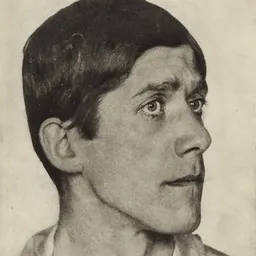
From January to May 1947, he attended the Academy of Fine Arts Munich and had private study with Oskar Kokoschka who painted in an intense expressionistic style.
Life in Canada Gershon's first application to move to Canada was rejected because he had a limp. "Always when my life was in danger," Iskowitz found "I did a drawing and pulled through." He reapplied and drew a picture for the bureaucrat in immigration. The fellow declared Gershon a genius, predicted a great future for him in Canada, approved his emigration application and said that Gershon would have special privileges on the voyage to his new home. Thus in 1949 he emigrated to Canada to stay with relatives living in Toronto.
Early career In 1952, he attended the Artist's Workshop, Toronto (until 1959–1960) and began sketching trips to Markham and Uxbridge. He had his first exhibition with the Canadian Society of Graphic Art (CSGA) in 1954, submitting two works for $300 CAD each.
Abstraction and Northern Canada There is no definitive date at which Iskowitz evolved into abstract and non-representational painting, but by the mid-1960s his work had taken on a largely different character. A subset of the exhibition was put on display in London, England. Gershon said [painting] "... is just an extension of myself. It's a plastic interpretation of the way I think. You reflect your own vision. That's what it's all about. Art is like evolution and life, and you've got to search for life, stand on your own feet and continue. The only fear I have is before starting to paint. When I paint, I'm great, I feel great."
In gratitude for the value that artistic grants had given to his career he established the charitable not-for-profit Gershon Iskowitz Foundation in 1985. Its mandate was to award the annual Gershon Iskowitz Prize, in association with the Canada Council in 1986 and 1987, of $25,000 to mature artists. The Foundation awarded the prize on its own from 1988 to 2006. It then partnered with the AGO in 2007 to award this prize as the winner would then receive an exhibition at the AGO.
He was made a member of the Royal Canadian Academy of Arts. On January 26, 1988, Gershon Iskowitz died in Toronto, Ontario.
Works in public collections in Canada Over the years, many public art galleries have acquired, through purchase and donation, works by Gershon Iskowitz. Beginning in the mid-1960s, his work received critical attention and was shown in solo and group exhibitions nationally and internationally. In addition, in 1995 in celebration of the Prize's 10th Anniversary the Foundation donated over one hundred and forty paintings and works on paper to many of these same institutions. The works have been included in major exhibitions and many are exhibited as part of the Permanent Collections of these institutions. Queen's Silver Jubilee Medal (1977)
Winners of the Gershon Iskowitz Prize In 2007, the Gershon Iskowitz Foundation in partnership with the Art Gallery of Ontario (AGO) established the annual Gershon Iskowitz Prize presented by AGO in order to raise awareness of the visual arts in Canada. Year Artist City 2024 Rita McKeough Calgary 2023 Allison Katz Toronto 2022 Tim Whiten Toronto 2021 Faye HeavyShield Blood Reserve, Alberta 2019 Ken Lum Vancouver 2018 Shuvinai Ashoona Kinngait 2017 Valérie Blass Montreal 2016 Rebecca Belmore Montreal 2015 Sandra Meigs Victoria 2014 Liz Magor Vancouver 2013 Geoffrey Farmer Vancouver 2012 Kim Adams Toronto 2011 Michael Snow Toronto 2010 Brian Jungen Vancouver 2009 Shary Boyle Toronto 2008 Françoise Sullivan Montreal 2007 Mark Lewis London, England 2006 Iain Baxter& Windsor 2005 Max Dean Toronto 2004 Rodney Graham Vancouver 2003 Janet Cardiff and George Bures Miller Guelph 2002 Geoffrey James Toronto 2001 John Massey Toronto 2000 Paterson Ewen London 1999 Stan Douglas Vancouver 1998 Shirley Wiitasalo Toronto 1997 Ron Moppett Calgary 1996 Murray Favro London 1995 Betty Goodwin Montreal 1994 Eric Cameron Calgary 1993 Vera Frenkel Toronto 1992 Irene F. Whittome Montreal 1991 Arnaud Maggs Toronto 1990 Jack Shadbolt Vancouver 1989 Gathie Falk Vancouver 1988 General Idea Toronto and New York 1987 Louis Comtois Montreal 1986 Denis Juneau Montreal
Don’t just read it —
keep it.
Full-length biographies made to live with: read them, listen on the way to work, watch them tonight.
- E-book
- Audio
- Video
Instant download · yours to keep · every purchase keeps this site free
Important facts
People in Gershon Iskowitz's life
Named in this biography and alive at the same time





Related people
Same field, nearest in time

Contemporaries
People whose lives overlapped Gershon Iskowitz's




Frequently asked questions
Who was Gershon Iskowitz?
Canadian artist (1921-1988)
When was Gershon Iskowitz born?
Gershon Iskowitz was born on 21 November 1921 in Kielce.
When did Gershon Iskowitz die?
Gershon Iskowitz died on 26 January 1988 in Toronto.
What was Gershon Iskowitz's occupation?
Gershon Iskowitz was a painter and graphic artist.
What nationality was Gershon Iskowitz?
Gershon Iskowitz was Polish.
Sources & further reading
Cite this page
APA: Biography.guide. (2026). Gershon Iskowitz. https://biography.guide/gershon-iskowitz/
MLA: "Gershon Iskowitz." Biography.guide, https://biography.guide/gershon-iskowitz/.
Chicago: "Gershon Iskowitz." Biography.guide. https://biography.guide/gershon-iskowitz/.
Data last updated: 2026-09-20 · Spot an error? Report a correction.
Page generated 2026-09-27 05:01 UTC