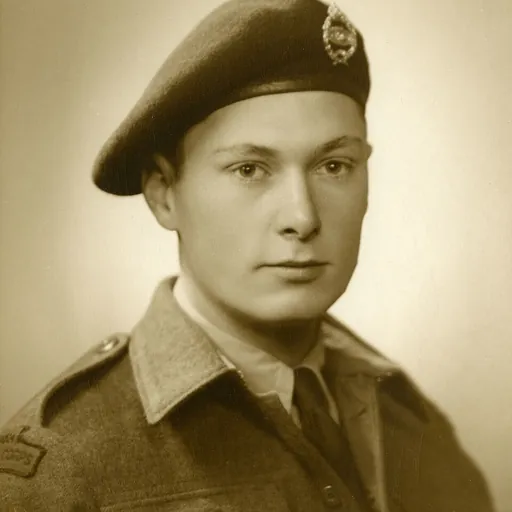
About Paterson Ewen
Lived 1925 – 2002 (aged 76). Paterson Ewen was a Canadian painter.
Paterson Ewen (April 7, 1925 – February 17, 2002) was a Canadian painter. He was a founding member of The Non-Figurative Artists' Association of Montreal, along with Claude Tousignant, Jean-Paul Mousseau, Guido Molinari, and Marcel Barbeau. He moved to London, Ontario in the late 1960s where London Regionalism was championed by Jack Chambers and Greg Curnoe. It was in London that Ewen developed the gouged-plywood style that would become his hallmark.
Biography William Paterson Ewen was born in 1925 in Montreal, Quebec. Interested in art from a young age, he began by sculpting small figures in wax, and at thirteen petitioned his mother to hang art on the previously unadorned walls of the Ewen residence. Beginning in 1944, Ewen served in a reconnaissance regiment on the Western Front (World War II), but was not involved in active combat. Upon his return to Canada, he enrolled in McGill University. He studied geology, but after his first year he began to struggle with depression, and sought relief in copying magazine covers and sketching the landscape around Canadian Officers' Training Corps at Saint-Gabriel-de-Valcartier where he had re-enlisted for the summer. When he returned to school in the fall, Ewen signed up for a figure-drawing course taught by John Goodwin Lyman. The experience was, as Ewen recalls it, unpleasant.
In 1949, he married dancer Françoise Sullivan, with whom he had four sons. Sullivan was a member of Les Automatistes, and Ewen would often attend Automatiste events and take part in the conversations which were enriching for him. though he continued to struggle with his mental health and his relationship to alcohol. He went on to teach at H. B. Beal Secondary School until he was awarded a Canada Council grant in 1971. The grant allowed him to take a studio in Toronto, and this is where he developed his signature style, gouging landscapes out of massive plywood sheets with an electric router. When Ewen returned to Toronto, his Beal Secondary job had gone to someone else, but there was an opening at the University of Western Ontario. Ewen became a full professor at UWO. This is where he met Mary Alison Handford in 1979. They married in 1995. During this period Ewen was, in his own words, "a pretty straightforward figurative painter influenced by the Post-Impressionists." This began to change around 1949, when Françoise Sullivan's influence and the Automatiste milieu pushed Ewen towards abstraction.
This tension between surface and figurative form can be seen in paintings like Interior, Fort Street, Montréal [#1] (1951). Ewen showed very little until 1955, when he began exhibiting abstract works. This new way of painting balanced the psychic automatism of les Automatistes with the rising star of hard-edged geometric Plasticiens like Molinari and Tousignant, both of whom Ewen shared a studio with in the mid-1960s. During this period, Ewen was also influenced by Camilla Gray's work on Russian Constructivism, the monochromes of Paul-Émile Borduas, and the work of Northwest Coast artists on display at the Royal Ontario Museum.
In 1971, Ewen moved to London, and there found inspiration in the growing London Regionalism movement, which emphasized specificity of place and time. Once again, Ewen's methods changed dramatically, rejecting abstraction in favour of dynamic, figurative "phenomscapes." This way of looking at landscape allowed Ewen to revisit his boyhood interests in geology and space. The new pieces were physically large, often using two or three 4' x 8' sheets of plywood scarfed together. Ewen used a router to tear into the surface, sometimes re-attaching objects to the plane with hardware. These shallow topographies were then painted with huge, rolling forces, gestures towards what Roald Nasgaard called "a strategy to make landscape painting vital again." Ewen described this way of working as cathartic: I enjoyed the physicality of it, particularly after the meticulousness of the hard-edge painting. It was like a kind of therapy. I may not have felt the tension and anger pouring out of me when I did it, but it felt awfully good afterwards. These were the works that solidified Ewen's place in the annals of Canadian art. He worked on many series in this mode, returning again, and again to the ever-changing natural world. No subject is more integral to an understanding Ewen's work, and perhaps Ewen himself, than the moon, whose phases he painted endlessly.
Selected exhibitions 1969: four group exhibitions and first solo at the Carmen Lamanna Gallery, Toronto 1976: Retrospective, Museum London, London, Ontario 1982: Venice Biennale curated by Jessica Bradley 1996: Art Gallery of Ontario, Toronto: Ewen: Earthly Weathers, Heavenly Skies (major retrospective) 2000: Palazzo Grassi, Venice: Cosmos: From Goya to De Chirico, From Friedrich to Kiefer
Selected collections National Gallery of Canada, Ottawa Art Gallery of Ontario, Toronto Musée d'art contemporain de Montréal Montreal Museum of Fine Arts Museum of Contemporary Canadian Art, Toronto MIT List Visual Artistiiscis centres of the west . Jackson-Triggs Winery, Niagara On The Lake.
Selected publications Hatch, John G. Paterson Ewen: Life & Work. Toronto: Art Canada Institute, 2018. Paterson Ewen: Biennale di Venezia [exhibition catalogue]. 1982. Teitelbaum, Matthew. Paterson Ewen: The Montreal Years. Saskatoon: Mendel Art Gallery, 1988. Teitelbaum, Matthew (ed.). Paterson Ewen. Toronto: Art Gallery of Ontario, 1996.
Honours Prix des Laurentides, 1957 numerous Canada Council awards and fellowships Victor Martyn Lynch-Staunton Award, 1987 Banff Centre School of Fine Arts National Award, 1987
Don’t just read it —
keep it.
Full-length biographies made to live with: read them, listen on the way to work, watch them tonight.
- E-book
- Audio
- Video
Instant download · yours to keep · every purchase keeps this site free
Important facts
Family & relationships
People in Paterson Ewen's life
Named in this biography and alive at the same time




Related people
Same field, nearest in time

Contemporaries
People whose lives overlapped Paterson Ewen's



Frequently asked questions
Who was Paterson Ewen?
Canadian artist (1925-2002)
When was Paterson Ewen born?
Paterson Ewen was born on 7 April 1925 in Montreal.
When did Paterson Ewen die?
Paterson Ewen died on 17 February 2002 in London.
What was Paterson Ewen's occupation?
Paterson Ewen was a painter.
What nationality was Paterson Ewen?
Paterson Ewen was Canadian.
Sources & further reading
Cite this page
APA: Biography.guide. (2026). Paterson Ewen. https://biography.guide/paterson-ewen/
MLA: "Paterson Ewen." Biography.guide, https://biography.guide/paterson-ewen/.
Chicago: "Paterson Ewen." Biography.guide. https://biography.guide/paterson-ewen/.
Data last updated: 2026-09-23 · Spot an error? Report a correction.
Portrait: Wikimedia Commons · author & licence
Page generated 2026-09-27 05:07 UTC