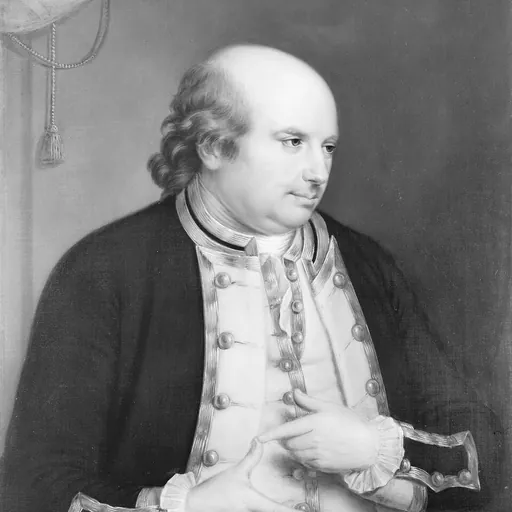
About George Johnstone
Lived 1730 – 1787 (aged 56–57). George Johnstone was a British politician, plantation owner and property manager.
Captain George Johnstone (1730 – 24 May 1787) was a Royal Navy officer, politician and colonial administrator who served in the War of the Austrian Succession, the Seven Years' War and the American War of Independence. In a multifaceted career he was also a member of parliament, a director of the East India Company, a member of the Carlisle Peace Commission and the governor of West Florida from 1763 until 1767.
Johnstone was born into a Scottish gentry family in 1730, and embarked on a naval career. Early in his service there occurred several incidents which revealed both positive and negative aspects of his character. In several naval engagements Johnstone was praised for his bravery, and incidents where he was censured for disobedience. He rose through the ranks to his own commands and had some success with small cruisers against French merchantmen and privateers. After the end of the Seven Years' War he had made friends with several powerful figures, and was appointed governor of West Florida. He achieved a measure of success in the delicate operations of running a new colony, but ultimately clashed with his political masters and failed to cultivate support amongst the wider sections of colonial society. Returning to Britain he became active in politics, supporting conciliatory measures for the Americans, and the removal of government interference from the affairs of the East India Company. His stance on the former led to his appointment as a member of the Carlisle Peace Commission, but he was accused of offering bribes and the Americans would have nothing to do with him.
Returning to active naval service with a lucrative posting as commodore, he cruised with success off Portugal, and was then entrusted with a secret mission to capture the Dutch Cape Colony. While en route to the colony, he was surprised by a French fleet sent to thwart his goal, and though he fought it off at the Battle of Porto Praya, he allowed the French to push on and reinforce the Cape Colony. Thwarted in his mission, he had some consolation in discovering a valuable fleet of Dutch East Indiamen, and capturing most of them. Returning to politics in England after the war he spoke on a number of issues, but was not asked to join an administration. He became a director of the East India Company towards the end of his life, before illness forced him to retire from business and politics shortly before his death in 1787.
Family and early life
George Johnstone was born in 1730 in Dumfriesshire the fourth son of Sir James Johnstone, 3rd Baronet of Westerhall, Dumfries, and his wife Barbara Murray, the oldest sister of the literary patron Patrick Murray, 5th Lord Elibank. He was a younger brother of William Johnstone (later Sir William Pulteney)
War of the Austrian Succession and Seven Years' War
He began his career at sea in the Merchant Navy, then entered the Royal Navy in 1746. He served in the War of the Austrian Succession, spending some time aboard , where he gained a reputation for bravery for an instance when he boarded a French fire ship so that it could be towed away from a British squadron off Port Louis, Hispaniola. For reasons unknown Crookshanks refused to grant Johnstone his certificate, upon which Johnstone challenged him to a duel. The challenge being accepted, the two duelled and Crookshanks was wounded in the neck. Despite these incidents, Johnstone was briefly made acting captain of the 70-gun in June 1759.
By 1759 Johnstone, by now in poor health, found himself without a ship. After a period of delays, the first Lord of the Admiralty George Anson, 1st Baron Anson gave him his first command, the 14-gun sloop . He was then sent to inform Admiral George Rodney in January 1762 of the British declaration of war against Spain. Rodney was able to use this early notice to capture a number of valuable prizes, before the Spanish in the region became aware that they were at war. Johnstone was promoted to post-captain in May 1762, shortly before the end of the Seven Years' War. He was appointed to the 24-gun before the end of the year, but received a new commission before he could take it up.
The Carlisle Peace Commission
Johnstone's stance on conciliation probably led to his selection by North to form part of the peace commission sent to America in 1778 under Frederick Howard, 5th Earl of Carlisle. The following year his ships captured the 38-gun Artois on 3 July 1780, and the 18-gun Perle on 6 July 1780, both off Cape Finisterre. Immediately Dutch possessions around the world became valuable targets for the British, and taking advantage of Johnstone's expedition, it was quickly reinforced with more warships, transports and East Indiamen, and assigned to carry out a secret expedition to capture the Dutch Cape Colony. The expedition at first went well, with the cutter capturing a Dutch merchant ship on the fourth day out of port. On 16 April strange sails were seen approaching the harbour. These were the ships of Suffren's squadron, who also intended to take on water and was equally as surprised to discover the British fleet. Taking advantage of the situation he quickly ran up to HMS Isis with his 74-gun ships and , and the 64-gun , fired broadsides into her, and raised the French colours. Moored as he was Johnstone could not easily bring his remaining warships to engage the French, while his smaller ships were useless against the large French warships. In the smoke and confusion several of the transports fired into the East Indiamen. After two hours of heavy cannonading the French found themselves in a dangerous position, as Annibal lost her mizzen mast, followed shortly afterwards by her main and foremasts. She had by now sustained casualties of two hundred dead or wounded, and with the British preparing to board her, Suffren decided to retreat. From her Johnstone learnt that Suffren's forces had already reinforced the Cape Colony, and that an attack would be futile. However he also learnt that a small convoy of richly laden Dutch merchants had been moved to the safety of Saldanha Bay. Johnstone decided to capture them, and on the morning of 21 July, arrived off the entrance to the bay. The Dutch squadron consisted of Dankbaarheid, Perel, Schoonkop, Hoogscarspel and Middleburg, under the command of Captain Gerrit Harmeyer of Hoogscarspel. Their stores and equipment had been stored on the packets Zon and Snelheid, which were sent further into the bay, near to Schapen Island. They had been given orders to burn their ships if attacked, while even if they were captured, the loss of their equipment on Zon and Snelheid would make them useless. However the Dutch were largely unprepared, and only on Middleburg had stores of combustible material been prepared. They cut their anchor cables and ran onshore, where their crews set fire to them, but the British were able to board them in their boats and extinguished the fires on all but Middleburg, to which Johnstone personally attached a line to, repeating the success of his youth, and had towed away from the remaining Dutch ships.
Having failed in his objective to capture the Cape Colony, Johnstone decided to send the troops and supplies on to the East Indies station, detaching his best warships under Captain James Alms of HMS Monmouth to escort them, while he returned to Britain with the ships Romney, Jupiter, Diana, Jason, Terror, Infernal, one light cruiser, two victuallers, and the Dutch prizes. In response Sutton brought a suit against his former commander.
John later succeeded his uncle, Sir William Pulteney Johnstone, as 6th Baronet of Westerhall. George Johnstone had achieved small-scale success as a naval officer, serving with undoubted courage, but had not been able to succeed when given a major command.
Don’t just read it —
keep it.
Full-length biographies made to live with: read them, listen on the way to work, watch them tonight.
- E-book
- Audio
- Video
Instant download · yours to keep · every purchase keeps this site free
Important facts
People in George Johnstone's life
Named in this biography and alive at the same time



Related people
Same field, nearest in time




Contemporaries
People whose lives overlapped George Johnstone's





Frequently asked questions
Who was George Johnstone?
Royal Navy officer (1730-1787)
When was George Johnstone born?
George Johnstone was born in 1730 in Dumfriesshire.
When did George Johnstone die?
George Johnstone died on 24 May 1787 in Hotwells.
What was George Johnstone's occupation?
George Johnstone was a politician, plantation owner and property manager.
What nationality was George Johnstone?
George Johnstone was British.
Sources & further reading
· DBpedia: George Johnstone (Royal Navy officer)
Cite this page
APA: Biography.guide. (2026). George Johnstone. https://biography.guide/george-johnstone-politician-1730/
MLA: "George Johnstone." Biography.guide, https://biography.guide/george-johnstone-politician-1730/.
Chicago: "George Johnstone." Biography.guide. https://biography.guide/george-johnstone-politician-1730/.
Data last updated: 2026-09-22 · Spot an error? Report a correction.
Portrait: Wikimedia Commons · author & licence
Page generated 2026-09-27 05:03 UTC