
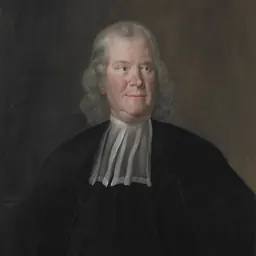
George Berkeley
Irish idealist philosopher and Anglican bishop
About George Berkeley
Lived 1685 – 1753 (aged 67). George Berkeley was a philosopher, anglican priest, writer, epistemologist, philosopher of science and metaphysician.
Biography Ireland
Berkeley was born at his family home, Dysart Castle, near Thomastown, County Kilkenny, Ireland, the eldest son of William Berkeley, a cadet of the noble family of Berkeley whose ancestry can be traced back to the Anglo-Saxon period and who had served as feudal lords and landowners in Gloucestershire, England. Little is known of his mother. He was the oldest of six brothers.
He was educated at Kilkenny College and attended Trinity College Dublin. He was elected a Scholar in 1702. He was awarded BA in 1704 and MA and a Junior Fellowship in 1707. This publication had great success and gave him a lasting reputation, though few accepted his theory that nothing exists outside the mind. This was followed in 1713 by Three Dialogues Between Hylas and Philonous. This publication propound his system of philosophy, the leading principle of which is that the world, as represented by our senses, depends for its existence on being perceived.
For this theory, the Principles gives the exposition and the Dialogues the defence. One of his main objectives was to combat the prevailing materialism of his time. The theory was largely received with ridicule, while even those such as Samuel Clarke and William Whiston, who did acknowledge his "extraordinary genius," were nevertheless convinced that his first principles were false.
England and Europe Shortly afterwards, Berkeley visited England and was received into the circle of Addison, Pope and Steele. In 1721, he took Holy orders in the Church of Ireland, earning his doctorate in divinity, and once again chose to remain at Trinity College Dublin, lecturing this time in Divinity and in Hebrew. In 1721/2 he was made Dean of Dromore and, in 1724, Dean of Derry.
In 1723, Berkeley was named co-heir of Esther Vanhomrigh, along with the barrister Robert Marshall. This naming followed Vanhomrigh's violent quarrel with Jonathan Swift, who had been her intimate friend for many years. Vanhomrigh's choice of legatees caused a good deal of surprise since she did not know either of them well, although Berkeley as a very young man had known her father. Swift said that he did not grudge Berkeley his inheritance, much of which vanished in a lawsuit in any event. A story that Berkeley and Marshall disregarded a condition of the inheritance that they must publish the correspondence between Swift and Vanessa is probably untrue.
In 1725, Berkeley began the project of founding a college in Bermuda for training ministers and missionaries in the colony, in pursuit of which he gave up his deanery with its income of £1,100.
Marriage and America
On 1 August 1728 at St Mary le Strand, London, Berkeley married Anne Forster, daughter of John Forster, Chief Justice of the Irish Common Pleas, and Forster's first wife Rebecca Monck. He then went to America on a salary of £100 per annum. He landed near Newport, Rhode Island, where he bought a plantation at Middletownthe famous "Whitehall". Berkeley purchased several enslaved Africans to work on the plantation. In 2023, Trinity College Dublin removed Berkeley's name from one of its libraries because of his slave ownership and his active defence of slavery.
It has been claimed that "he introduced Palladianism into America by borrowing a design from [William] Kent's Designs of Inigo Jones for the door-case of his house in Rhode Island, Whitehall". He also brought to New England John Smibert, the Scottish artist he "discovered" in Italy, who is generally regarded as the founding father of American portrait painting. Meanwhile, he drew up plans for the ideal city he planned to build on Bermuda. He lived at the plantation while he waited for funds for his college to arrive. The funds, however, were not forthcoming. "With the withdrawal from London of his own persuasive energies, opposition gathered force; and the Prime Minister, Walpole grew steadily more sceptical and lukewarm. At last it became clear that the essential Parliamentary grant would be not forthcoming", and in 1732 he left America and returned to London.
He and Anne had four children who survived infancyHenry, George, William and Juliaand at least two others who did not. William's death in 1751 was a great cause of grief for his father.
Episcopate in Ireland Berkeley was nominated to be the Bishop of Cloyne in the Church of Ireland on 18 January 1734. He was consecrated as such on 19 May 1734. He was the Bishop of Cloyne until his death on 14 January 1753, although he died at Oxford (see below).
Humanitarian work While living in London's Saville Street, he took part in efforts to create a home for the city's abandoned children. The Foundling Hospital was founded by royal charter in 1739, and Berkeley is listed as one of its original governors.
Last works His last two publications were Siris: A Chain of Philosophical Reflexions and Inquiries Concerning the Virtues of Tarwater, And divers other Subjects connected together and arising one from another (1744) and Further Thoughts on Tar-water (1752). Pine tar is an effective antiseptic and disinfectant when applied to cuts on the skin, but Berkeley argued for the use of pine tar as a broad panacea for diseases. His 1744 work on tar-water sold more copies than any of his other books during Berkeley's lifetime. He died soon afterwards and was buried in Christ Church Cathedral, Oxford. His affectionate disposition and genial manners made him much loved and held in warm regard by many of his contemporaries. Anne outlived her husband by many years, and died in 1786.
Contributions to philosophy
The use of the concepts of "spirit" and "idea" is central in Berkeley's philosophy. As used by him, these concepts are difficult to translate into modern terminology. His concept of "spirit" is close to the concept of "conscious subject" or of "mind", and the concept of "idea" is close to the concept of "sensation" or "state of mind" or "conscious experience".
Thus Berkeley denied the existence of matter as a metaphysical substance, but did not deny the existence of physical objects such as apples or mountains ("I do not argue against the existence of any one thing that we can apprehend, either by sense or reflection. That the things I see with mine eyes and touch with my hands do exist, really exist, I make not the least question. The only thing whose existence we deny, is that which philosophers call matter or corporeal substance. And in doing of this, there is no damage done to the rest of mankind, who, I dare say, will never miss it.", Principles #35). This basic claim of Berkeley's thought, his "idealism", is sometimes and somewhat derisively called "immaterialism" or, occasionally, subjective idealism. In Principles #3, he wrote, using a combination of Latin and English, esse is percipi (to be is to be perceived), most often if slightly inaccurately attributed to Berkeley as the pure Latin phrase esse est percipi . The phrase appears associated with him in authoritative philosophical sources, e.g., "Berkeley holds that there are no such mind-independent things, that, in the famous phrase, esse est percipi (aut percipere)—to be is to be perceived (or to perceive)."
Hence, human knowledge is reduced to two elements: that of spirits and of ideas (Principles #86). In contrast to ideas, a spirit cannot be perceived. A person's spirit, which perceives ideas, is to be comprehended intuitively by inward feeling or reflection (Principles #89). For Berkeley, we have no direct 'idea' of spirits, albeit we have good reason to believe in the existence of other spirits, for their existence explains the purposeful regularities we find in experience ("It is plain that we cannot know the existence of other spirits otherwise than by their operations, or the ideas by them excited in us", Dialogues #145). This is the solution that Berkeley offers to the problem of other minds. Finally, the order and purposefulness of the whole of our experience of the world and especially of nature overwhelms us into believing in the existence of an extremely powerful and intelligent spirit that causes that order. According to Berkeley, reflection on the attributes of that external spirit leads us to identify it with God. Thus a material thing such as an apple consists of a collection of ideas (shape, colour, taste, physical properties, etc.) which are caused in the spirits of humans by the spirit of God.
Theology A convinced adherent of Christianity, Berkeley believed God to be present as an immediate cause of all our experiences.
Here is Berkeley's proof of the existence of God:
As T. I. Oizerman explained:
Berkeley also attempted to prove the existence of God throughout his beliefs in immaterialism. However, there seemed to have been no influence or communication between the two writers.
German philosopher Arthur Schopenhauer once wrote of him: "Berkeley was, therefore, the first to treat the subjective starting-point really seriously and to demonstrate irrefutably its absolute necessity. He is the father of idealism...".
Berkeley is considered one of the originators of British empiricism. A linear development is often traced from three great "British Empiricists", leading from Locke through Berkeley to Hume.
Berkeley influenced many modern philosophers, especially David Hume. Thomas Reid admitted that he put forward a drastic criticism of Berkeleianism after he had been an admirer of Berkeley's philosophical system for a long time. Berkeley's "thought made possible the work of Hume and thus Kant, notes Alfred North Whitehead". Some authors draw a parallel between Berkeley and Edmund Husserl.
When Berkeley visited America, the American educator Samuel Johnson visited him, and the two later corresponded. Johnson convinced Berkeley to establish a scholarship program at Yale and to donate a large number of books, as well as his plantation, to the college when the philosopher returned to England. It was one of Yale's largest and most important donations; it doubled its library holdings, improved the college's financial position and brought Anglican religious ideas and English culture into New England. Johnson also took Berkeley's philosophy and used parts of it as a framework for his own American Practical Idealism school of philosophy. As Johnson's philosophy was taught to about half the graduates of American colleges between 1743 and 1776, and over half of the contributors to the Declaration of Independence were connected to it, Berkeley's ideas were indirectly a foundation of the American Mind.
Outside of America, during Berkeley's lifetime, his philosophical ideas were comparatively uninfluential. But interest in his doctrine grew from the 1870s when Alexander Campbell Fraser, "the leading Berkeley scholar of the nineteenth century", published The Works of George Berkeley. A powerful impulse to serious studies in Berkeley's philosophy was given by A. A. Luce and Thomas Edmund Jessop, "two of the twentieth century's foremost Berkeley scholars", thanks to whom Berkeley scholarship was raised to the rank of a special area of historico-philosophical science. In addition, the philosopher Colin Murray Turbayne wrote extensively on Berkeley's use of language as a model for visual, physiological, natural and metaphysical relationships.
The proportion of Berkeley scholarship, in literature on the history of philosophy, is increasing. This can be judged from the most comprehensive bibliographies on George Berkeley. During the period of 1709–1932, about 300 writings on Berkeley were published. That amounted to 1.5 publications per year. During the course of 1932–1979, over one thousand works were brought out, i.e., 20 works per year. Since then, the number of publications has reached 30 per annum. In 1977 publication began in Ireland of a special journal on Berkeley's life and thought (Berkeley Studies). In 1988, the Australian philosopher Colin Murray Turbayne established the International Berkeley Essay Prize Competition at the University of Rochester in an effort to advance scholarship and research on the works of Berkeley.
Other than philosophy, Berkeley also influenced modern psychology with his work on John Locke's theory of association and how it could be used to explain how humans gain knowledge in the physical world. He also used the theory to explain perception, stating that all qualities were, as Locke would call them, "secondary qualities", therefore perception laid entirely in the perceiver and not in the object. These are both topics today studied in modern psychology.
Appearances in literature
Lord Byron's Don Juan references immaterialism in the Eleventh Canto:
When Bishop Berkeley said 'there was no matter,' And proved it—'t was no matter what he said: They say his system 't is in vain to batter, Too subtle for the airiest human head; And yet who can believe it? I would shatter Gladly all matters down to stone or lead, Or adamant, to find the world a spirit, And wear my head, denying that I wear it.
Herman Melville humorously references Berkeley in Chapter 20 of Mardi (1849), when outlining a character's belief of being on board a ghostship:
And here be it said, that for all his superstitious misgivings about the brigantine; his imputing to her something equivalent to a purely phantom-like nature, honest Jarl was nevertheless exceedingly downright and practical in all hints and proceedings concerning her. Wherein, he resembled my Right Reverend friend, Bishop Berkeley–truly, one of your lords spiritual—who, metaphysically speaking, holding all objects to be mere optical delusions, was, notwithstanding, extremely matter-of-fact in all matters touching matter itself. Besides being pervious to the points of pins, and possessing a palate capable of appreciating plum-puddings:—which sentence reads off like a pattering of hailstones.
James Joyce references Berkeley's philosophy in the third episode of Ulysses (1922):
Who watches me here? Who ever anywhere will read these written words? Signs on a white field. Somewhere to someone in your flutiest voice. The good bishop of Cloyne took the veil of the temple out of his shovel hat: veil of space with coloured emblems hatched on its field. Hold hard. Coloured on a flat: yes, that's right. Flat I see, then think distance, near, far, flat I see, east, back. Ah, see now!
In commenting on a review of Ada or Ardor, author Vladimir Nabokov alludes to Berkeley's philosophy as informing his novel:
And finally I owe no debt whatsoever (as Mr. Leonard seems to think) to the famous Argentine essayist and his rather confused compilation "A New Refutation of Time." Mr. Leonard would have lost less of it had he gone straight to Berkeley and Bergson. (Strong Opinions, pp. 2892–90)
James Boswell, in the part of his Life of Samuel Johnson covering the year 1763, recorded Johnson's opinion of one aspect of Berkeley's philosophy:
After we came out of the church, we stood talking for some time together of Bishop Berkeley's ingenious sophistry to prove the non-existence of matter, and that every thing in the universe is merely ideal. I observed, that though we are satisfied his doctrine is untrue, it is impossible to refute it. I shall never forget the alacrity with which Johnson answered, striking his foot with mighty force against a large stone, till he rebounded from it,– "I refute it thus."
Commemoration
Both the University of California, Berkeley, and the city of Berkeley, California, were named after him, although both school and city are pronounced . The naming was suggested in 1866 by Frederick H. Billings, a trustee of what was then called the College of California. Billings was inspired by Berkeley's Verses on the Prospect of Planting Arts and Learning in America, particularly the final stanza: "Westward the course of empire takes its way; the first four Acts already past, a fifth shall close the Drama with the day; time's noblest offspring is the last".
The Town of Berkley, currently the least populated town in Bristol County, Massachusetts, was founded on 18 April 1735 and named for George Berkeley.
A residential college and an Episcopal seminary at Yale University also bear Berkeley's name.
"Bishop Berkeley's Gold Medals" were two awards given annually at Trinity College Dublin, "provided outstanding merit is shown", to candidates answering a special examination in Greek. The awards were founded in 1752 by Berkeley. However, they have not been awarded since 2011. Other elements of Berkeley's legacy at Trinity are currently under review due to his support of slavery. For example, the library at Trinity that was named after him in 1978 was "de-named" in April 2023 and renamed in October 2024 after Irish poet Eavan Boland. Another memorialization of him in the form of a stained glass window will remain, but used as part of "a retain-and-explain approach" where his legacy will be given further context.
An Ulster History Circle blue plaque commemorating him is located in Bishop Street Within, the city of Derry.
Berkeley's farmhouse in Middletown, Rhode Island, is preserved as Whitehall Museum House, also known as Berkeley House, and was listed on the National Register of Historic Places in 1970. St. Columba's Chapel, located in the same town, was formerly named "The Berkeley Memorial Chapel", and the appellation still survives at the end of the formal name of the parish, "St. Columba's, the Berkeley Memorial Chapel".
Writings Original publications Arithmetica (1707) Miscellanea Mathematica (1707) Philosophical Commentaries or Common-Place Book (1707–08, notebooks) An Essay Towards a New Theory of Vision (1709) A Treatise Concerning the Principles of Human Knowledge, Part I (1710) Passive Obedience, or the Christian doctrine of not resisting the Supreme Power (1712) Three Dialogues Between Hylas and Philonous (1713) An Essay Towards Preventing the Ruin of Great Britain (1721) De Motu (1721) A Proposal for Better Supplying Churches in our Foreign Plantations, and for converting the Savage Americans to Christianity by a College to be erected in the Summer Islands (1725) A Sermon preached before the incorporated Society for the Propagation of the Gospel in Foreign Parts (1732) Alciphron, or the Minute Philosopher (1732)
The Theory of Vision, or Visual Language, shewing the immediate presence and providence of a Deity, vindicated and explained (1733) The Analyst: A Discourse Addressed to an Infidel Mathematician (1734) A Defence of Free-thinking in Mathematics, with Appendix concerning Mr. Walton's vindication of Sir Isaac Newton's Principle of Fluxions (1735) Reasons for not replying to Mr. Walton's Full Answer (1735) The Querist, containing several queries proposed to the consideration of the public (three parts, 1735–37). A Discourse addressed to Magistrates and Men of Authority (1736) Siris: A Chain of Philosophical Reflections and Inquiries, Concerning the Virtues of Tar Water (1744). A Letter to the Roman Catholics of the Diocese of Cloyne (1745) A Word to the Wise, or an exhortation to the Roman Catholic clergy of Ireland (1749) Maxims concerning Patriotism (1750) Farther Thoughts on Tar-water (1752) Miscellany (1752)
Collections The Works of George Berkeley, D.D. Late Bishop of Cloyne in Ireland. To which is added, an account of his life, and several of his letters to Thomas Prior, Esq. Dean Gervais, and Mr. Pope, &c. &c. Printed for George Robinson, Pater Noster Row, 1784. Two volumes. The Works of George Berkeley, D.D., formerly Bishop of Cloyne: Including Many of His Writings Hitherto Unpublished; With Prefaces, Annotations, His Life and Letters, and an Account of His Philosophy. Ed. by Alexander Campbell Fraser. In 4 Volumes. Oxford: Clarendon Press, 1901. Vol. 1 Vol. 2 Vol. 3 Vol. 4 The Works of George Berkeley. Ed. by A. A. Luce and T. E. Jessop. Nine volumes. Edinburgh and London, 1948–1957. Ewald, William B., ed., 1996. From Kant to Hilbert: A Source Book in the Foundations of Mathematics, 2 vols. Oxford Uni. Press. 1707. Of Infinites, 16–19. 1709. Letter to Samuel Molyneaux, 19–21. 1721. De Motu, 37–54. 1734. The Analyst, 60–92.
Don’t just read it —
keep it.
Full-length biographies made to live with: read them, listen on the way to work, watch them tonight.
- E-book
- Audio
- Video
Instant download · yours to keep · every purchase keeps this site free
Important facts
People in George Berkeley's life
Named in this biography and alive at the same time




Related people
Same field, nearest in time


Contemporaries
People whose lives overlapped George Berkeley's



Frequently asked questions
Who was George Berkeley?
Irish idealist philosopher and Anglican bishop (1685–1753)
When was George Berkeley born?
George Berkeley was born on 12 March 1685 in Kilkenny, Dysart Castle.
When did George Berkeley die?
George Berkeley died on 14 January 1753 in Oxford.
What was George Berkeley's occupation?
George Berkeley was a philosopher, anglican priest, writer, epistemologist, philosopher of science and metaphysician.
What nationality was George Berkeley?
George Berkeley's recorded nationality: Kingdom of Ireland.
Sources & further reading
Cite this page
APA: Biography.guide. (2026). George Berkeley. https://biography.guide/george-berkeley/
MLA: "George Berkeley." Biography.guide, https://biography.guide/george-berkeley/.
Chicago: "George Berkeley." Biography.guide. https://biography.guide/george-berkeley/.
Data last updated: 2026-09-20 · Spot an error? Report a correction.
Page generated 2026-09-27 05:17 UTC