About Fukuda Chiyo-ni
Lived 1703 – 1775 (aged 71–72). Fukuda Chiyo-ni was a Japanese writer, haiku poet and painter.
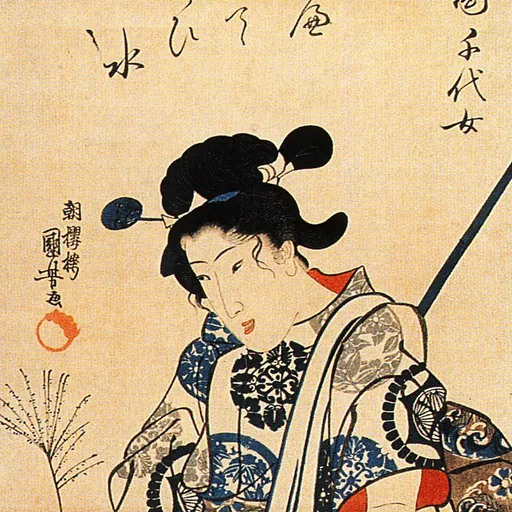
Chiyo-ni standing beside a well. This woodcut by Utagawa Kuniyoshi illustrates her most famous haiku: finding a bucket entangled in the vines of a morning glory, she will go ask for water rather than disturb the flower. , also known as , was a Japanese poet of the Edo period and a Buddhist nun. She is widely regarded as one of the greatest poets of haiku (then called hokku). Some of Chiyo's most notable works include "The Morning Glory", "Putting up my hair", and "Again the women".
Being one of the few women haiku poets in pre-modern Japanese literature, Chiyo-ni has been seen an influential figure. Before her time, haiku by women were often dismissed and ignored. She began writing haiku at seven years old, and by age seventeen she had become very popular all over Japan. Chiyo-ni continued writing throughout her life. Influenced by the renowned poet Matsuo Bashō but emerging and as independent figure with a unique voice in her own right, Chiyo-ni's dedication not only paved a way for her career but also opened a path for other women to follow. Chiyo-ni is known as a "forerunner, who played the role of encouraging cultural exchange with Korea".
She is perhaps best known for this haiku:
Today, the morning glory is a favorite flower for the people of her home town, because she left a number of poems on that flower. Shokouji temple in Hakusan contains a display of her personal effects.
Biography Chiyo-ni was born in Matto, Kaga Province (now Hakusan, Ishikawa Prefecture), in February 1703, the eldest daughter of a scroll mounter. At an early age, Chiyo-ni was introduced to art and poetry, and she began writing haiku poetry at the age of seven. By the age of seventeen, she had become very popular all over Japan for her poetry.
Her poems, although mostly dealing with nature, work for a unity of nature with humanity. Her own life was that of the haikai poets who made their lives and the world they lived in one with themselves through living a simple and humble life. She was able to make connections by being observant and studying her surroundings, then writing them down.
She appears to say that while she did listen to him, she also did not copy him, "not to listen, fine too."
In around 1720 she married a servant of the Fukuoka family of Kanazawa, and had one child with him, a son, who died in infancy. Her husband died of disease not long after in 1722. She valued her independence too much, and despite her loneliness, she did not remarry, so she returned home to her parents.
It may be that after her husband's death Chiyo-ni lived with and cared for her elderly parents and worked in the family’s scroll mounting business. She wrote:
After her parents died, she adopted a married couple to carry on the family business and in 1754, at the age of fifty-two (by East Asian age reckoning), Chiyo-ni chose to become a Buddhist nun. "Not", she said, "in order to renounce the world, but as a way 'to teach her heart to be like the clear water which flows night and day." Chiyo-ni shaved her head and started to live in a temple with other nuns and took the Buddhist name Soen. She continued her writing and lived the rest of her simple yet peaceful life in the manner of haikai.
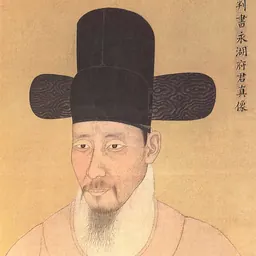
In 1764, she was chosen to prepare the official gift for Maeda Shigemichi, the daimyō of her region, to the Korean Delegation led by civil minister Jo Eom. Chiyo-ni crafted and delivered 21 artworks based on her twenty-one haiku.
Chiyo-ni died in 1775.
In popular culture The American rock band Red House Painters adapted one of Chiyo's haiku for the chorus of their song "Dragonflies".
Don’t just read it —
keep it.
Full-length biographies made to live with: read them, listen on the way to work, watch them tonight.
- E-book
- Audio
- Video
Instant download · yours to keep · every purchase keeps this site free
Important facts
People in Fukuda Chiyo-ni's life
Named in this biography and alive at the same time
Related people
Same field, nearest in time




Contemporaries
People whose lives overlapped Fukuda Chiyo-ni's



Frequently asked questions
Who was Fukuda Chiyo-ni?
Japanese writer (1703-1775)
When was Fukuda Chiyo-ni born?
Fukuda Chiyo-ni was born in 1703 in Mattō.
When did Fukuda Chiyo-ni die?
Fukuda Chiyo-ni died on 2 October 1775 in Mattō.
What was Fukuda Chiyo-ni's occupation?
Fukuda Chiyo-ni was a writer, haiku poet and painter.
What nationality was Fukuda Chiyo-ni?
Fukuda Chiyo-ni was Japanese.
Sources & further reading
Cite this page
APA: Biography.guide. (2026). Fukuda Chiyo-ni. https://biography.guide/fukuda-chiyo-ni/
MLA: "Fukuda Chiyo-ni." Biography.guide, https://biography.guide/fukuda-chiyo-ni/.
Chicago: "Fukuda Chiyo-ni." Biography.guide. https://biography.guide/fukuda-chiyo-ni/.
Data last updated: 2026-09-24 · Spot an error? Report a correction.
Portrait: Wikimedia Commons · author & licence
Page generated 2026-09-27 05:08 UTC