
About Friedrich Ritter von Röth
Lived 1893 – 1918 (aged 25). Friedrich Ritter von Röth was a fighter pilot, military officer and oberleutnant.
Oberleutnant Friedrich Ritter von Röth (29 September 1893 – 31 December 1918) was a German World War I fighter ace with 28 victories. He was the most successful German pilot at the extremely hazardous practice of shooting down enemy observation balloons, and destroyed 20 of them. Röth concentrated on observation balloons because they were large enough targets for him to see and hit with machine gun fire.
Distressed by his nation's loss of the war, and by his religious compunctions against killing, he shot himself to death on 31 December 1918.
Early life
Friedrich Röth was born in Nuremberg, Germany on 29 September 1893. He was the son of a factory owner. He became known by the nickname of "Fritz". He was just graduating college when World War I broke out.
Early service
Friedrich Röth served originally in the 8th Bavarian Field Artillery Regiment. He was seriously wounded early in the war. Once he was again fit for duty, he was commissioned as a Leutnant on 29 May 1915. He transferred to the aerial service, only to be severely injured in a crash and spend nearly another year in hospital. Because of his extended recuperation, he did not qualify as a pilot until early 1917. His initial assignment was to a Bavarian artillery spotting unit, Flieger-Abteilung (Artillerie) 296. While with them, he was granted the Bavarian Military Merit Order with Swords on 11 June. Beginning 17 September 1917, he served in a fighter squadron, Jagdstaffel 34, but did not down any enemies until he was assigned to Jagdstaffel 23 on 4 October. On 1 November, he was awarded the German Iron Cross, First Class. His decision meant he took upon himself one of the most hazardous duties of World War I fighter aviation. Because balloons flew at a known altitude, antiaircraft guns ringing them were extremely accurate. The balloons were low enough that an attacker was exposed to small arms fire as well. Protective fighters also lurked in the vicinity. The balloons were so well defended because they were an important part of the artillery fire direction systems of World War I. Aerial observers in the balloons' gondolas called down accurate artillery fire on enemy soldiers.
On 25 January 1918, as a member of Jagdstaffel 23, Röth scored his first victories, downing three balloons in eight minutes. He shot down a British observation plane on 26 February and downed another pair of balloons on 21 March. On 1 April, he single-handedly shot down four balloons in ten minutes. By this time, he had begun scrupulous planning of his raids on balloons, spending hours studying potential target balloons through a telescope. He also loaded his guns to maximize effectiveness against balloons; his left-hand machine gun would be loaded with 80 percent incendiaries and 20 percent armor-piercing, and the right-hand gun vice versa. As his new unit used Pfalz D.IIIa fighters, Röth may have used one occasionally.
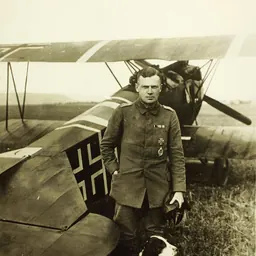
At this time, Röth was known to fly an Albatros D.V marked with his personal livery overlaying the standard markings. It bore a white propeller spinner, yellow fuselage, and gray engine cowling, and wheel covers. Painted on the fuselage's side even with the trailing edge of the cockpit was a large disk divided into white and black halves.
On 29 May 1918, Röth attacked the balloons he had been spying upon. Picking a time when there were no enemy fighters in sight and the wind was in his favor, Röth set five balloons afire in 15 minutes without assistance. Five other balloons were rapidly winched to ground to protect them. Röth had expended 220 rounds to burn the balloons, shooting down each in a single pass. He dodged enemy fighters and heavy antiaircraft fire to do it. He went on to destroy three balloons each on 13 August and 10 October, along with seven enemy airplanes on various dates. On 30 July 1918 he shot down 16-victory Irish ace Sergeant John Cowell's 20 Squadron Bristol F.2b.
Röth awarded Germany's highest decoration for valor, the Pour le Mérite, on 8 September 1918. Röth's last victory was on 14 October 1918; Röth's final victory list credited him with destroying 20 enemy observation balloons and eight enemy airplanes.
Inline citations
Don’t just read it —
keep it.
Full-length biographies made to live with: read them, listen on the way to work, watch them tonight.
- E-book
- Audio
- Video
Instant download · yours to keep · every purchase keeps this site free
Important facts
People in Friedrich Ritter von Röth's life
Named in this biography and alive at the same time



Related people
Same field, nearest in time



Contemporaries
People whose lives overlapped Friedrich Ritter von Röth's


Frequently asked questions
Who was Friedrich Ritter von Röth?
German flying ace (1893-1918)
When was Friedrich Ritter von Röth born?
Friedrich Ritter von Röth was born on 29 September 1893 in Nuremberg.
When did Friedrich Ritter von Röth die?
Friedrich Ritter von Röth died on 31 December 1918 in Nuremberg.
What was Friedrich Ritter von Röth's occupation?
Friedrich Ritter von Röth was a fighter pilot, military officer and oberleutnant.
What nationality was Friedrich Ritter von Röth?
Friedrich Ritter von Röth's recorded nationality: German Reich.
Sources & further reading
· Wikipedia: Friedrich Ritter von Röth
· DBpedia: Friedrich Ritter von Röth
Cite this page
APA: Biography.guide. (2026). Friedrich Ritter von Röth. https://biography.guide/friedrich-ritter-von-roth/
MLA: "Friedrich Ritter von Röth." Biography.guide, https://biography.guide/friedrich-ritter-von-roth/.
Chicago: "Friedrich Ritter von Röth." Biography.guide. https://biography.guide/friedrich-ritter-von-roth/.
Data last updated: 2026-09-20 · Spot an error? Report a correction.
Page generated 2026-09-27 05:29 UTC