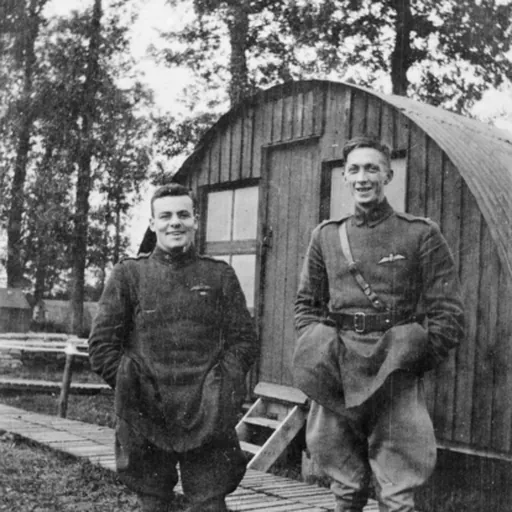
Cedric Howell
Australian flying ace of the First World War
About Cedric Howell
Lived 1896 – 1919 (aged 23). Cedric Howell was an Australian fighter pilot.
Cedric Ernest Howell (17 June 1896 – 10 December 1919) was an Australian fighter pilot and flying ace of the First World War. Born in Adelaide, South Australia, he enlisted in the Australian Imperial Force in 1916 for service in the First World War and was posted to the 46th Battalion on the Western Front. In November 1916, he was accepted for a transfer to the Royal Flying Corps and was shipped to the United Kingdom for flight training. Graduating as a pilot, he was commissioned as a second lieutenant and posted to No. 45 Squadron RFC in France during October 1917; two months later the unit sailed to the Italian theatre.
Howell spent eight months flying operations over Italy, conducting attacks against ground targets and engaging in sorties against aerial forces. While in Italy, he was credited with shooting down a total of nineteen aircraft. In one particular sortie on 12 July 1918, Howell attacked, in conjunction with one other aircraft, a formation of between ten and fifteen German machines; he personally shot down five of these planes and was awarded the Distinguished Service Order. He had previously been awarded the Military Cross and Distinguished Flying Cross for his gallantry in operations over the front. He was posted back to the United Kingdom in July 1918.
Howell died in December 1919 while taking part in the England to Australia air race. Piloting a Martinsyde A1 aircraft, he attempted to make an emergency landing on Corfu but the plane fell short, crashing into the sea just off the island's coast. Both Howell and his navigator subsequently drowned. Howell's body later washed ashore and was returned to Australia, where he was buried with full military honours.
Early life Cedric Ernest Howell was born on 17 June 1896 in Adelaide, South Australia, to Ernest Howell, an accountant, and his wife Ida Caroline (née Hasch). He was educated at the Melbourne Church of England Grammar School from 1909, and was active in the school's Cadet unit. On completing his secondary studies in 1913, Howell gained employment as a draughtsman. By 1914, he held a commission in the 49th (Prahran) Cadet Battalion, Citizen Military Forces, as a second lieutenant. The following year, he resigned his commission in the Citizen Military Forces and re-applied to join the Australian Imperial Force for active service in the war; he was accepted on 1 January 1916. Due to his age, Howell was ineligible for a commission in the force and was instead granted the rank of private. Allotted to the 16th Reinforcements of the 14th Battalion, he embarked aboard HMAT Anchises in Melbourne, Victoria, on 14 March. Considered an expert shot, Howell was trained as a sniper during his service with the 46th Battalion. Howell was posted to No. 17 Reserve Squadron in April, he was attached to the Central Flying School for duties. On 1 April 1918, the Royal Flying Corps and Royal Naval Air Service were combined to form the Royal Air Force, with personnel from the former services transferred to the new branch; Howell thus became a lieutenant in the new service from this date.
Throughout the first half of 1918, Howell conducted several raids on ground targets,
Howell was out on patrol on 15 June 1918 when German and Austrian forces initiated the Battle of the Piave River by striking Allied lines on the opposite bank. After landing back at base at 11:40, he was the first to bring news of the attack. With the aircraft refuelled and loaded with bombs, he—in company with the rest of the squadron—then led his flight on a total of four sorties against the enemy insurgents. No. 45 Squadron succeeded in destroying with its bombs a pontoon bridge, a boat, and a trench filled with soldiers, before inflicting at least a hundred casualties with machine gun fire. Heavy rain washed other bridges away, and by 18 June the stranded Austrian forces on the Allied bank of the river were routed by a counterattack. The pair were soon confronted by a formation of between ten and fifteen Central aircraft. As the consequent dogfight raged, Howell destroyed four of the aircraft and sent a fifth down out of control. Two days later, Howell was credited with bringing down another plane, forcing the machine to crash down in Allied-held territory. On 15 July, he led a trio of Camels in an assault on sixteen scout planes; he destroyed two of the machines. His total made him No. 45 Squadron's second highest-scoring ace after Matthew Frew, Late in July, following ten months of active service in the cockpit, Howell was posted back to the United Kingdom where he spent the remainder of the war attached to training units as a flight instructor. For his efforts in destroying eight aircraft over a four-day period in July, Howell was awarded the Distinguished Service Order. A supplement of the London Gazette carried the announcement on 2 November 1918, reading: That year, the Australian Government offered a prize of £10,000 to the first aviator to pilot a British or Empire-built aircraft from England to Australia within a period of 30 days. On 15 August, Howell was approached by the British aircraft manufacturer Martinsyde to take part in the race flying their Type A Mk.I aircraft, powered by a Rolls-Royce engine; he accepted the offer.
Howell and Fraser took off in their Martinsyde from Hounslow Heath Aerodrome on 4 December 1919. However, the pair soon ran into poor weather, and were forced to land the aircraft in Dijon, France later that day. Airborne again, they reached Pisa, Italy the following day, where a replacement tail skid was fitted to the A1; by 6 December, the duo were in Naples. On 10 December, Howell and Fraser took off in their fully fuelled plane from Taranto in the afternoon. Citizens in the area later reported that they heard cries for help coming from the sea that night, but a rescue was not possible in the rough conditions. On 12 February 1923, a stained-glass window dedicated to the memory of Howell was unveiled by General Sir Harry Chauvel at St. Anselm's Church of England in Middle Park, Victoria; Howell had been a member of the congregation there in his youth.
Don’t just read it —
keep it.
Full-length biographies made to live with: read them, listen on the way to work, watch them tonight.
- E-book
- Audio
- Video
Instant download · yours to keep · every purchase keeps this site free
Important facts
People in Cedric Howell's life
Named in this biography and alive at the same time


Related people
Same field, nearest in time


Contemporaries
People whose lives overlapped Cedric Howell's




Frequently asked questions
Who was Cedric Howell?
Australian flying ace of the First World War
When was Cedric Howell born?
Cedric Howell was born on 17 June 1896 in Adelaide.
When did Cedric Howell die?
Cedric Howell died on 10 December 1919 in Corfu.
What was Cedric Howell's occupation?
Cedric Howell was a fighter pilot.
What nationality was Cedric Howell?
Cedric Howell was Australian.
Sources & further reading
Cite this page
APA: Biography.guide. (2026). Cedric Howell. https://biography.guide/cedric-howell/
MLA: "Cedric Howell." Biography.guide, https://biography.guide/cedric-howell/.
Chicago: "Cedric Howell." Biography.guide. https://biography.guide/cedric-howell/.
Data last updated: 2026-09-22 · Spot an error? Report a correction.
Portrait: Wikimedia Commons · author & licence
Page generated 2026-09-27 05:03 UTC