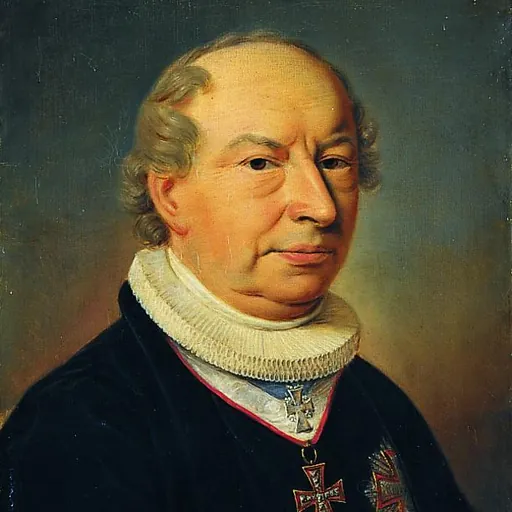
About Friedrich Münter
Lived 1761 – 1830 (aged 68). Friedrich Münter was a Danish archaeologist, presbyter, protestant theologian, university teacher, philologist and orientalist.
Friedrich Christian Carl Heinrich Münter (14 October 1761 – 9 April 1830) was a German-Danish scholar, theologian, and Bishop of Zealand from 1808 until his death. His name has also been recorded as Friederich Münter.
In addition to his position as the Bishop of Zealand within the Church of Denmark, Münter was also a professor of theology at the University of Copenhagen, an orientalist, church historian, archaeologist, and freemason.
Personal life Friedrich Münter was born on 14 October 1761 in Gotha to Balthasar Münter, a clergyman. His father moved with his family to Copenhagen in 1765 to become vicar at St. Peter's Church. While in Copenhagen, Friedrich was privately tutored at the vicarage and enjoyed the company of many of his father's renowned acquaintances including the archaeologist Carsten Niebuhr, professor of theology Johann Andreas Cramer, and the poets Friedrich Gottlieb Klopstock and Heinrich Wilhelm von Gerstenberg. Münter's sister, Sophie Christiane Friederike Brun was a renowned author and member of the upper class.
In 1791, he married Maria Elisabeth Krohn (1771–1842). Their first son, Balthasar (1794–1867), was born in Copenhagen and became a pastor. Their second son, Carl Vilhelm Theodor Münter (1798–1841), was a public servant. Their daughter, Maria Frederica Franzisca Münter (1796-1871), went by the name "Fanny." In 1815, Fanny married Jacob Peter Mynster who went on to become bishop of Zealand four years after Münter's death.
Career
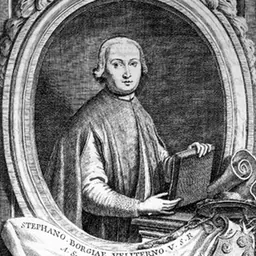
In 1781 he began his studies at the University of Göttingen, and in 1784 he was the first Protestant to receive a doctorate of philosophy from the University of Fulda. Afterwards, King Christian VII of Denmark sent him to Italy and Sicily to continue his education. In Rome, Münter had contact with Stefano Borgia, who later became cardinal. There he learned the Coptic language. In 1787 he returned to Copenhagen and became a professor at the University of Copenhagen. Münter also studied inscriptions from Persepolis, and played an important early part in the decipherment of cuneiform scripts. He discovered that the words in the inscriptions were divided from one another by an oblique wedge and that the monuments must belong to the age of Cyrus and his successors. One word , which occurs without any variation towards the beginning of each inscription, he correctly inferred to signify "king". These findings were fundamental to the decipherment of Old Persian cuneiform by Grotefend in 1802.
Münter's main work is "Religion der Karthager" (Copenhagen, 1816). The second edition (1821) was expanded and included new research. Other works include "Sendschreiben an Kreuzer über Sardische Idole" (Copenhagen, 1822), "Der Tempel der himmlichen Göttin zu Paphos" (Copenhagen, 1824), and "Religion der Babylonier" (Copenhagen, 1827). Some small archaeological works of Münter were included in his "Antiquarische Abhandlungen" (Copenhagen, 1816).
On numismatics Münter wrote: "De numo plumbео Zenobiae reginae Orientis et aeneo Palmyreno" (Petersburg, 1823) and "Ueber die Münzen der Vandalischen Könige von Karthago" ("Antiquarische Abhandlungen", p. 301).
In 1829, he was elected a member to the American Philosophical Society.
Works
Sinnbilder und Kunstvorstellungen der alten Christen (1825) Betrachtung über die natürliche Religion (1805) De aetate versionum Novi Testamenti copticorum (1790) Dr. Balthasar Münters Leben und Charakteristik (1793) Nachrichten über beide Sizilien (1790) Efterretninger om begge Sicilierne (1790) Statutenbuch des Ordens der Tempelherren (1794) Vermischte Beyträge zur Kirchengeschichte (1798) Die Offenbarung Johannis metrisch ins Deutsche übersetzt (1784) Fragmenta Patrum Graecorum edidit & illustr (1788)
Don’t just read it —
keep it.
Full-length biographies made to live with: read them, listen on the way to work, watch them tonight.
- E-book
- Audio
- Video
Instant download · yours to keep · every purchase keeps this site free
Important facts
People in Friedrich Münter's life
Named in this biography and alive at the same time



Related people
Same field, nearest in time


Contemporaries
People whose lives overlapped Friedrich Münter's




Frequently asked questions
Who was Friedrich Münter?
Danish bishop (1761-1830)
When was Friedrich Münter born?
Friedrich Münter was born on 14 October 1761 in Gotha.
When did Friedrich Münter die?
Friedrich Münter died on 9 April 1830 in Copenhagen.
What was Friedrich Münter's occupation?
Friedrich Münter was an archaeologist, presbyter, protestant theologian, university teacher, philologist and orientalist.
What nationality was Friedrich Münter?
Friedrich Münter was Danish.
Sources & further reading
Cite this page
APA: Biography.guide. (2026). Friedrich Münter. https://biography.guide/friedrich-munter/
MLA: "Friedrich Münter." Biography.guide, https://biography.guide/friedrich-munter/.
Chicago: "Friedrich Münter." Biography.guide. https://biography.guide/friedrich-munter/.
Data last updated: 2026-09-21 · Spot an error? Report a correction.
Portrait: Wikimedia Commons · author & licence
Page generated 2026-09-27 05:00 UTC