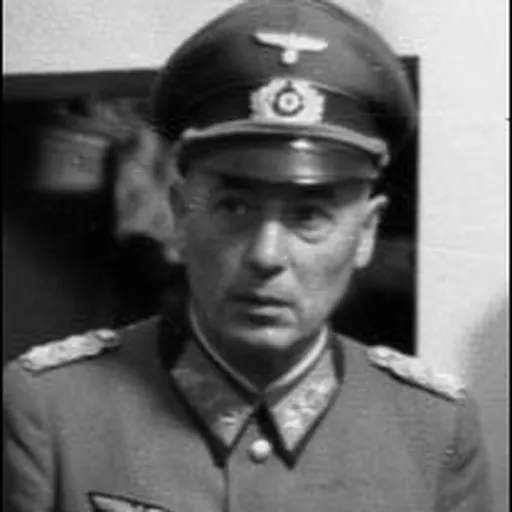
About Friedrich Dollmann
Lived 1882 – 1944 (aged 62). Friedrich Dollmann was a military personnel, soldier and generaloberst.
Friedrich Karl Albert Dollmann (2 February 188229 June 1944) was a German general during World War II who commanded the 7th Army during the Invasion of France and the early phases of the Allied invasion of Normandy until his death in June 1944.
World War I
Born in 1882, Dollmann joined the army in 1899. He studied in the War Academy for General Staff starting in 1909. He served as an aerial observer for the first two years of the First World War. Dollmann was assigned to the wartime General Staff on 5 November 1917, as part of the 6th Infantry Division. He was transferred to the Bavarian General Staff, where on 21 January 1918 he took command of the 6th Army. In March 1919, he was appointed to the Ministry of Military Affairs and then onto the Peace Commission of the General Staff. Having distinguished himself, Dollmann was promoted at the end of 1936 to the rank of full general, along with 11 other officers of the twelve Wehrkreise.
Many historians who have analyzed Dollmann's career and life assert that, while he did exhibit on occasion a pro-Nazi attitude, he was not a committed Nazi. On the other hand, historian notes that Dollmann's orders were imbued with a discernible Nazi impetus. He therefore believes that Dollmann had a stronger inclination to National Socialism than otherwise presumed. A directive from Dollmann dated 8 February 1935 shows that he instructed his officers to cooperate fully with the authorities of the NSDAP. There is also evidence that he demanded that all his officers should fully support the Nazi Party and admonished them to adjust their opinions accordingly; he even insisted that his officers' wives should actively participate in the National Socialist Women's League. Along similar lines, Dollmann expected his officers to hang pictures of the Führer in their offices and in the mess hall instead of pictures of the Kaiser. In 1937, Dollmann harangued Catholic chaplains for not being fervent enough in their support of the Nazi regime, telling them that as members of the Wehrmacht and bearers of National Socialism, they should always display "a clear and unresolved acknowledgment of the Führer, State, and People!"
On 25 August 1939, Dollmann was elevated to commander of the 7th Army. Just under a week later Hitler ordered the invasion of Poland. Dollmann's only son, who had aspired to the rank of lieutenant in the 15th Infantry Regiment, was killed during the campaign against Poland.
Invasion of France Dollman inspects an artillery observation post that bears his name, near the French border, 1940. During the invasion of France in 1940, Dollmann's assignment placed him at the southern edge of the Siegfried Line, opposite the Maginot Line. While the French Maginot Line had proven impregnable to frontal assault in the past, Hitler was unconcerned, as its defenses were easily outflanked during the invasion. Throughout the invasion of France, Dollmann's 7th Army was not placed on the offensive until most of the French army had been destroyed, at which point he linked up with the 1st Panzer Division of Panzer Group Guderian, encircling 400,000 French troops in the Vosges Mountains – an action which was followed by a French surrender. Hitler rewarded the participating generals with promotions for their part in this mission, including Dollmann, who thereby attained the rank of Generaloberst (colonel general).
Occupation of France In the wake of the French defeat, Dollmann's 7th Army remained in the West. Along with Field Marshal Erwin von Witzleben, Dollmann was the only commander of the western campaign who did not see service against the Soviet Union along the Eastern Front. The historian Peter Lieb suggests that the reason might be that Dollmann was considered too inflexible and technically unsuited for the warfare in the East. Dollmann did not keep up with contemporary tactical military developments nor did he follow the course of the war all that closely. Instead he became complacent, overweight, and followed the lead of his immediate superior, Field Marshal Gerd von Rundstedt, neglecting the coastal defenses of France in the process.
For four years, Dollmann and Rundstedt did little to fortify the defensive positions along the French coast. Only when his command came under Army Group B Field Marshal Erwin Rommel's scrutiny in December 1943 did Dollmann begin decisive and feverish construction to improve French coastal fortifications. But it was too late. Dollmann's chief of staff claimed that efforts to strengthen the defensive section were not supported by the higher leadership.
Dollman tried to enjoy his time living in France during the occupation, frequently attending religious services and visiting cathedrals and museums. At the same time he fell into a deep depression and let himself go, overindulging in wine and cigars. Meanwhile, Dollmann's deteriorating health was mirrored in his diminishing knowledge of battlefield tactics and the importance of air superiority – all of which made him under-prepared for the imminent Allied invasion of Normandy on D-Day. History was soon to prove that the German defenses were inadequate to repulse the massive and highly coordinated assault which took place on 6 June 1944.
D-Day Up to 60 German divisions were tasked with defending of coastline from the Riviera to the North Sea, composed of varying troops – Cossacks, Volga Tartars, Georgians, among others, equipped with weapons captured from France, Poland, and Yugoslavia. Aside from what he considered troop deficiencies, Rundstedt thought it ludicrous to scatter the German troops so thinly along the French coast, and disagreed with Rommel's ideas for the Atlantic Wall. The fortifications were inconsistent, with some sections well-constructed while other sections left much to be desired. Also, the ability to direct fire and the capability to deliver firepower along the varying portions of shoreline were equally unreliable.
Several days prior to the invasion, the Germans received intelligence reports about the activities occurring across the channel. Deception measures by the Allied intelligence services kept the Germans convinced that the attack would occur near Norway or close to Calais. Although reconnaissance reports as late as 5 June 1944 indicated that something significant was afoot, none of this intelligence was relayed to the OKW at Berchtesgaden, nor was it forwarded to Dollmann's 7th Army. It is doubtful whether this would have led to a redistribution of forces, since Hitler remained convinced that the main Allied attack would occur at Pas de Calais.
On 5 June 1944, under the cover of darkness, the invasion at Normandy began. By nightfall June 6, up to 130,000 troops and approximately 800 Allied tanks were ashore under a curtain of naval bombardment.
Dollmann tried to organize an immediate counter-attack with the 21st Panzer Division. Lieutenant General Fritz Bayerlein protested; he felt a column march in daytime was merely an invitation to the Allied air forces to decimate his division. He suggested alternative plans, but Dollmann remained adamant. Thus, it was not until 9 June 1944 that Rommel was able to muster his forces.
Part of the effort to repel the Allied attack included strategic placement of troops over what appeared to be a growing front. Dollman's 7th Army (over 16 divisions and five corps commands) was sent to the left wing of the invasion front. They learned on 21 June 1944 that the supplies needed to conduct a sustained resistance could not be assured. Although they rendered vigorous resistance, the German forces could only slow the Allied advance. Throughout the course of defending the coastline and in spite of the disastrous circumstances, Dollmann continued to discipline his soldiers by the threat of severe penalties.
Inaccurate Wehrmacht intelligence reports and Hitler's assurance that a second invasion was due at any moment left the equivalent of an entire German Army Group, comprising five Luftwaffe divisions, two Panzer divisions, and 24 infantry divisions, sitting immobile awaiting further instructions. In the meantime, the German High Command issued orders for Rommel and Rundstedt to launch a massive armored counterattack against an Allied force of "929,000 men, 177,000 vehicles, and 586,000 tons of materiel", an order which was impossible to obey.
Cherbourg and death The French port of Cherbourg fell on 26 June 1944 when it was surrendered by Lieutenant General Karl-Wilhelm von Schlieben. This enraged Hitler and prompted a court-martial investigation from Field Marshal Wilhelm Keitel. Hitler summoned Rundstedt and Dollmann to Berchtesgaden on 28 June 1944 and insisted that Dollmann be court-martialed. Rundstedt rejected this idea since Dollmann was no more accountable for the failure than himself. Still unsatisfied, Hitler demanded that Dollmann at the very least should be relieved of command, which stimulated another defense, this time from Rommel. Undeterred, Hitler waited until the men left to relieve Dollmann of command, replacing him with Paul Hausser of the Waffen-SS. Hitler relieved Rundstedt of command a short time later.
Unaware that he had been relieved of command, Dollmann was nonetheless worn out and stressed. He died on 29 June 1944. The exact circumstances of his death remain controversial. Some sources say he suffered a heart attack, while others say he committed suicide by taking poison. In 2003, a theory was put forward that like Rommel, Dollmann was forced to commit suicide by Hitler. He was buried in France on 2 July 1944, where the field marshals Rundstedt, Rommel and Hugo Sperrle were present. On the same day, he received posthumously the Knight's Cross of the Iron Cross with Oak Leaves. Later, Hitler delivered a laudatory obituary on behalf of Dollmann. He is buried at the Champigny-Saint-André German war cemetery.
Awards Iron Cross (1914) 2nd Class (18 September 1914) 1st Class (22 February 1916) 518th Oak Leaves on 1 July 1944 as Generaloberst and commander-in-chief of the 7. Armee
Don’t just read it —
keep it.
Full-length biographies made to live with: read them, listen on the way to work, watch them tonight.
- E-book
- Audio
- Video
Instant download · yours to keep · every purchase keeps this site free
Important facts
People in Friedrich Dollmann's life
Named in this biography and alive at the same time

Related people
Same field, nearest in time





Contemporaries
People whose lives overlapped Friedrich Dollmann's




Frequently asked questions
Who was Friedrich Dollmann?
German general (1882–1944)
When was Friedrich Dollmann born?
Friedrich Dollmann was born on 2 February 1882 in Würzburg.
When did Friedrich Dollmann die?
Friedrich Dollmann died on 28 June 1944 in Le Mans.
What was Friedrich Dollmann's occupation?
Friedrich Dollmann was a military personnel, soldier and generaloberst.
What nationality was Friedrich Dollmann?
Friedrich Dollmann's recorded nationality: Nazi Germany.
Sources & further reading
· Wikipedia: Friedrich Dollmann
Cite this page
APA: Biography.guide. (2026). Friedrich Dollmann. https://biography.guide/friedrich-dollmann/
MLA: "Friedrich Dollmann." Biography.guide, https://biography.guide/friedrich-dollmann/.
Chicago: "Friedrich Dollmann." Biography.guide. https://biography.guide/friedrich-dollmann/.
Data last updated: 2026-09-22 · Spot an error? Report a correction.
Portrait: Wikimedia Commons · author & licence
Page generated 2026-09-27 05:02 UTC