
About Frederick Sandys
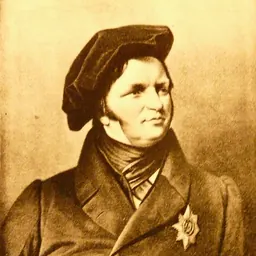
Lived 1829 – 1904 (aged 75). Frederick Sandys was a British painter and illustrator.
Anthony Frederick Augustus Sandys (born Antonio Frederic Augustus Sands), 1 May 1829 – 25 June 1904, usually known as Frederick Sandys, was a British painter, illustrator, and draughtsman, associated with the Pre-Raphaelites. He was also associated with the Norwich School of painters.
Biography
Artistic studies Frederick Sandys was born on 1 May 1829 in Norwich, and received his earliest lessons in art from his father, Anthony Sands, who was himself a painter. He was educated at Norwich School and later attended the Norwich School of Design in 1846. In the same and next year his talent was recognized by the Royal Society of Arts.
Personal relationships Sandys married Georgiana Creed, but this marriage only lasted three years, although they never divorced. He had a long affair with the Romany woman Keomi Gray, who sat as a model both for him and Dante Gabriel Rossetti (The Beloved, 1865-66), and perhaps also for Simeon Solomon. He and Gray had two daughters and two sons.
In 1862 Sandys met actress Mary Emma Jones, known as Miss Clive, when she modeled for The Magdalen, now owned by the Norwich Castle Museum. A relationship developed between the two; he became devoted to her, taking her as his common-law wife for the rest of his life. She gave birth to a large number of children, 10 of whom were raised under the name of Neville and survived after Sandys's death. She appears in paintings such as Sandys's Love's Shadow and his 1867 work Proud Maisie, which was inspired by Mary--so much so that he made at least 11 versions by 1904. The caricaturist turned the horse of Sir Isumbras into a laughing donkey labelled "J. R., Oxon.", understood as a reference to John Ruskin. Upon the donkey was seated Millais himself, in the character of the knight, with Rossetti and Holman Hunt replacing the two children, one before and one behind.
Rossetti and Sandys became close friends, and from May 1866 to July 1867, Sandys lived with Rossetti at 16, Cheyne Walk, Chelsea. Sandys began drawing in the 1860s for Once a Week, the Cornhill Magazine, Good Words and other periodicals, his work influenced by Albrecht Dürer, Ambrosius Holbein, and Alfred Rethel. Sandys made a total of 26 between 1859 and 1866, but each was a fine representation of this genre, faithfully engraved by professional wood-engravers, including the Dalziel brothers and Joseph Swain, and they are worthy of the collector's portfolio. Sandys had an eye and talent for exacting detail, an intention to accurately reflect the subject, revealed in the quality of his works, equally impressive for its technical detail as for its imaginative point of view.
Sandys's The Death of King Warwulf is an example of his ability to create drawings that translated well for the engravings. Swirling shapes of flames, the curve of the boat, its sail and the king's clothes that surround him create a feeling of movement. The focal point is the king's bowed head.
He worked exclusively for magazines, and no books illustrated by him have been documented. His drawings can be found in bound periodical volumes, as well as in publications such as Dalziel’s Bible Gallery and the Cornhill Gallery, and in illustrated books that were intended for display in drawing rooms.
Study for Autumn, made in 1860, is one of the many studies Sandys made before painting Autumn and provides evidence of Sandys's skill as a draughtsman. He captures minute details, such as the soldier's uniform and the plants and flowers. The study is much like the finished painting, except that the ginger jar is in the foreground.
Paintings
Early in the 1860s he began to exhibit the paintings which set the seal upon his fame. The best known of these are Vivien (1863), Morgan le Fay (1864), Cassandra and Medea (1868).
Sandys never became a popular painter. He painted little, and the dominant influence upon his art was the influence exercised by lofty conceptions of tragic power. There was in it a sombre intensity and an almost stern beauty which lifted it far above the ideals of the crowd. The Scandinavian Sagas and Le Morte d'Arthur gave him subjects after his own heart, and The Valkyrie and Morgan le Fay represent some of his best work.
Don’t just read it —
keep it.
Full-length biographies made to live with: read them, listen on the way to work, watch them tonight.
- E-book
- Audio
- Video
Instant download · yours to keep · every purchase keeps this site free
Important facts
People in Frederick Sandys's life
Named in this biography and alive at the same time



Related people
Same field, nearest in time



Contemporaries
People whose lives overlapped Frederick Sandys's



Frequently asked questions
Who was Frederick Sandys?
Pre-Raphaelite painter (1829-1904)
When was Frederick Sandys born?
Frederick Sandys was born on 1 May 1829 in Norwich.
When did Frederick Sandys die?
Frederick Sandys died on 25 June 1904 in London.
What was Frederick Sandys's occupation?
Frederick Sandys was a painter and illustrator.
What nationality was Frederick Sandys?
Frederick Sandys was British.
Sources & further reading
Cite this page
APA: Biography.guide. (2026). Frederick Sandys. https://biography.guide/frederick-sandys/
MLA: "Frederick Sandys." Biography.guide, https://biography.guide/frederick-sandys/.
Chicago: "Frederick Sandys." Biography.guide. https://biography.guide/frederick-sandys/.
Data last updated: 2026-09-20 · Spot an error? Report a correction.
Page generated 2026-09-27 05:32 UTC