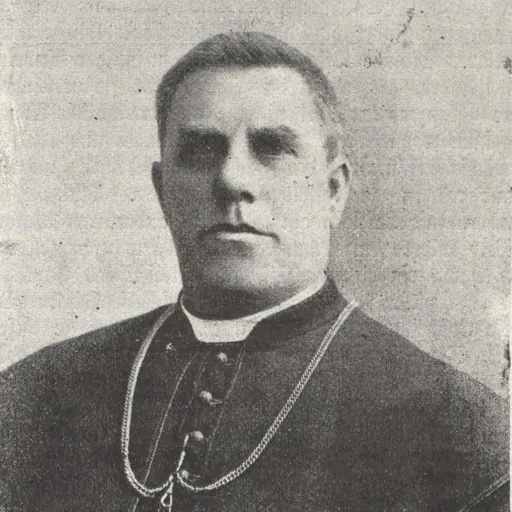
About Frederick Katzer
Lived 1844 – 1903 (aged 59). Frederick Katzer was an American and Austrian catholic priest and catholic bishop.
Frederick Xavier Katzer (February 7, 1844 – July 20, 1903) was an Austrian-born American Catholic prelate who served as archbishop of Milwaukee in Wisconsin from 1891 to 1903. He previously served as bishop of Green Bay in Wisconsin (1886–1891).
Early life Frederick Katzer was born on February 7, 1844, in Ebensee, Upper Austria in the Austrian Empire (today part of Austria) to Carl and Barbara Katzer. The family later moved to Gmunden in Upper Austria. Katzer received his early education there while also working in a textile factory. In 1857, he entered the minor seminary run by the Jesuits in Freinberg in Upper Austria to pursue his classical studies.
While studying at the Jesuit seminary, Katzer met Reverend Francis Pierz, a missionary working with the Native American tribes in the State of Minnesota in the United States. Pierz recruited Katzer to finish his seminary studies in Minnesota and serve as a missionary there. With the help of a grant from the Leopoldine Society in Vienna, Katzer was able to pay for passage to the United States. However, after arriving there, the Diocese of Saint Paul told Katzer that it was unable to sponsor him in a seminary. At this point, Katzer considered joining the Jesuit order.
Priesthood
After finishing at Saint Francis de Sales, Katzer was ordained a priest for the Archdiocese of Milwaukee on December 21, 1866, by Bishop John Henni.
After his 1866 ordination, Saltzmann appointed Katzer appointed to the faculty of Saint Francis de Sales, where he taught mathematics, philosophy, and theology. That same year, Krautbauer appointed Katzer as vicar general of the diocese. In the 1890 election, Katzer strongly endorsed the Democratic gubernatorial candidate George Wilbur Peck, who when elected repealed the Bennett Law in 1891.
Archbishop of Milwaukee
After Heiss died in March 1890 the bishops of Wisconsin recommended three German-speaking candidates to replace him to Leo XIII. Their top candidates was Katzer. However, his nomination sparked a backlash among the other archbishops in the United States. During this period, the American Catholic hierarchy was split into two camps.
The Americanist camp of prelates wanted the Vatican to appoint an English-speaking prelate who would help assimilate Wisconsin immigrants into American society. The Conservative camp, in this case the bishops in Wisconsin, wanted a German prelate to preserve the language and traditions of the mainly German population.
Since Katzer was Austrian, the Americanists opposed his appointment.
During a meeting of archbishops in July 1890, the Americanist camp succeeded in creating a list of non-German candidates for archbishop of Milwaukee In 1899, the Conservatives registered another victory with the Testem benevolentiae nostrae, an apostolic letter from Leo XIII. Katzer praised the pope's condemnation of "the errors called by the name of Americanism with all the more joy and gratitude because the decision of the infallible See appeared to us very opportune." The following year, he wrote a letter to the Vatican protesting the appointment of Bishop John J. Keane as archbishop of Dubuque, claiming that Keane belonged to the "liberal Americanists" and that his appointment to a nearby diocese would be hazardous to Milwaukee.
Katzer denied those allegations and wrote to Cardinal Gibbons, a leader in the Americanist camp. In the letter, Katzer said, "If I hold different opinions...is that a reason to belie me in manner which is almost diabolical?"
Katzer was a strong critic of Archbishop's Ireland's Faribault–Stillwater plan. It was an educational experiment started in 1873 with the public school system in Poughkeepsie, New York. In the plan, the Archdiocese of New York placed several parish in the public school system with the provision that the students receive religious instruction outside school hours. Katzer and Corrigan both forwarded their objections to the Vatican. added his name to a letter written by Archbishop Michael Corrigan of New York opposing the plan, and was considered along with Ireland for presenting both sides of the school question to Rome. The Holy Office issued a condemnation of these societies in 1894, but gave the bishops discretion in publicizing it. By his final year as archbishop in 1903, the Archdiocese had 329 priests, 321 churches, 148 parochial schools, and 280,861 Catholics.
Frederick Katzer died from liver cancer at Fond du Lac, Wisconsin, on July 20, 1903. He is buried in a small cemetery on the grounds of Saint Francis de Sales.
Don’t just read it —
keep it.
Full-length biographies made to live with: read them, listen on the way to work, watch them tonight.
- E-book
- Audio
- Video
Instant download · yours to keep · every purchase keeps this site free
Important facts
People in Frederick Katzer's life
Named in this biography and alive at the same time


Related people
Same field, nearest in time

Contemporaries
People whose lives overlapped Frederick Katzer's

Frequently asked questions
Who was Frederick Katzer?
Catholic archbishop (1844–1903)
When was Frederick Katzer born?
Frederick Katzer was born on 7 February 1844 in Ebensee am Traunsee.
When did Frederick Katzer die?
Frederick Katzer died on 23 July 1903 in Milwaukee, Fond du Lac.
What was Frederick Katzer's occupation?
Frederick Katzer was a catholic priest and catholic bishop.
What nationality was Frederick Katzer?
Frederick Katzer was American and Austrian.
Sources & further reading
Cite this page
APA: Biography.guide. (2026). Frederick Katzer. https://biography.guide/frederick-katzer/
MLA: "Frederick Katzer." Biography.guide, https://biography.guide/frederick-katzer/.
Chicago: "Frederick Katzer." Biography.guide. https://biography.guide/frederick-katzer/.
Data last updated: 2026-09-21 · Spot an error? Report a correction.
Portrait: Wikimedia Commons · author & licence
Page generated 2026-09-27 05:01 UTC