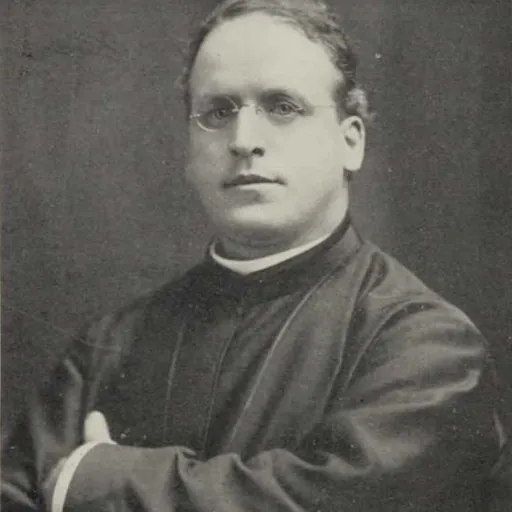
Charles William Lyons
American Jesuit priest and academic administrator
About Charles William Lyons
Lived 1868 – 1939 (aged 71). Charles William Lyons was an American catholic priest, academic administrator, university teacher and missionary.
Charles William Lyons (January 31, 1868 – January 31, 1939) was an American Catholic priest who became the only Jesuit and likely the only educator in the United States to have served as the president of four colleges. Born in Boston, Massachusetts, he attended the local public schools before entering the wool industry. He abandoned his career in industry to enter the Society of Jesus. While a novice in Maryland, he suffered a nervous breakdown and was sent to Georgetown University as prefect. He then resumed his studies at Woodstock College, teaching intermittently at Gonzaga College in Washington, D.C. and Loyola College in Baltimore. After his ordination, he became a professor at St. Francis Xavier College in New York City and at Boston College.
In 1908, Lyons became the rector of Gonzaga College, where he remained for a year before being appointed the president of Saint Joseph's College in Philadelphia. While there, he had constructed a new building for the faculty, and his tenure came to an end when he became the president of Boston College in 1914. He continued the major construction plan of his predecessor, overseeing the completion of St. Mary's Hall and Alumni Field. He also dealt with the severe downturn in enrollment due to World War I. His term came to an end in 1919, and for the next several years, he taught at Boston College, was a priest at the Church of St. Ignatius Loyola in New York, oversaw the construction of Weston College, and led retreats around the country.
He was finally appointed president of Georgetown University in 1923. While he managed construction of the New North building, he was regarded as a poor leader, and his term ended in 1928. Lyons spent his final years as a missionary, and was awarded the Order of the Star of Romania.
Early life and education Charles William Lyons was born on January 31, 1868, in Boston, Massachusetts. He eventually became a member of the association's board of directors. He remained in this position for one year, before resuming his studies in Frederick. Lyons completed his juniorate in 1895 and commenced his study of philosophy at Woodstock College. There, he gained a reputation as being a good tenor singer, and he assisted with the annual plays. During this time, he was also a catechist at St. Alphonsus Church in Woodstock, Maryland.
Following his philosophical studies, Lyons was sent to Gonzaga College in Washington, D.C., where he taught chemistry to the high school students. He was then sent to Loyola College in Baltimore, Maryland in 1901 to teach grammar and mathematics. The following year, Lyons returned to Woodstock for his theological studies. At Woodstock, he was ordained a priest in 1904. In 1906, he returned to Georgetown as the prefect of discipline.
Following his tertianship, Lyons was appointed a professor of philosophy and political economy at St. Francis Xavier College in New York City. He then transferred to Boston College as a professor of psychology. Shortly after he took office, an earthquake struck Messina, Italy, and the school offered a solemn high requiem mass for the victims, which was celebrated by Bishop Diomede Falconio and sung by Bonaventura Cerretti. In attendance were Bishop Denis J. O'Connell, Attorney General Charles Joseph Bonaparte, the Italian ambassador to the United States, Joseph Himmel, and priests from the Dominican, Franciscan, and Paulist orders. A banquet was held to honor the new president on February 10, which was attended by Congressman William Bourke Cockran.
Saint Joseph's College Following his tenure at Gonzaga College, Lyons was appointed the rector and president of Saint Joseph's College in Philadelphia in July 1909, Upon his assumption of the presidency, he simultaneously became pastor of the Church of the Gesú.
Lyons oversaw the construction of a new building for the college faculty on 18th and Thompson Streets. Its ground was broken in the fall of 1910, and the building was complete by September 1911. Lyons' presidency ended in 1914, when he was succeeded by J. Charles Davey. At the same time, he served as the pastor of the Church of the Immaculate Conception. His selection was praised by many due to his experience in managing building projects. He continued the work of his predecessor, Thomas I. Gasson, to expand the college's campus. With construction already underway, he had architects modify the plan for St. Mary's Hall to add a fourth floor, as well as expand the size of the chapel to accommodate 250 people. St. Mary's Hall was completed on January 4, 1917.
With respect to the curriculum, Lyons terminated the granting of graduate degrees to students in the newly established adult night education department in 1914, upon the request of the faculty, who argued that the program would strain the faculty and facilities. The Philomatheia Club was also established, Boston College High School was physically separated from the rest of the college for the first time in 1917, but Lyons continued as rector of both. He also began discussions to create the School of Education, which were not realized until 1919. In 1918, he was made a member of the Massachusetts Board of Education.
Pastoral work in New York Upon the end of his presidency in 1919, Lyons was transferred to the Church of St. Ignatius Loyola in New York City, where he did pastoral work, He also gave lectures on philosophy to various groups in Boston. He was also tasked with overseeing the construction of the Weston College.
Georgetown University
Lyons was appointed the president of Georgetown University in October 1924, succeeding John B. Creeden. Upon his appointment, he became the only Jesuit and likely the only educator in the United States to have been president of four different colleges. Lyons showed little interest in leading Georgetown, and his presidency was considered unsuccessful. The fundraising campaign begun by Creeden floundered during his presidency and ended far short of its goal. He was frequently away from the university, as he preferred to preach and lead retreats. he oversaw the construction of the New North building in 1925, which was completed in June 1926 in the Colonial Revival style. The interior of Old North was then gutted and redesigned to house classrooms and student services. New North doubled the amount of housing on campus. He also oversaw construction of a new wing of the Georgetown University Hospital. Lyons was invited by Calvin Coolidge to his 1925 presidential inauguration, and sat among the cabinet. President Coolidge also appointed him to a federal commission that would plan the 150th anniversary of the Battle of Bunker Hill. During this time, he was awarded the Order of the Star of Romania, with the rank of commander.
Later years Upon the end of his leadership of Georgetown, Lyons joined the Jesuit mission band in Boston, with which he traveled throughout New England, New York, and Maryland for eight years. His health began to deteriorate in 1936, so the Jesuit superiors stationed him at Weston College as the spiritual father of the theology students.
In 1938, having seemingly recovered, he went to Boston College High School, but proved unable to continue working. While residing there, he suffered another heart attack, and was sent to St. Margaret's Hospital in Dorchester, where he died on January 31, 1939. He was buried in the Jesuit cemetery at the College of the Holy Cross. Lyons Hall at Boston College, which opened 1951, was named in his honor.
Don’t just read it —
keep it.
Full-length biographies made to live with: read them, listen on the way to work, watch them tonight.
- E-book
- Audio
- Video
Instant download · yours to keep · every purchase keeps this site free
Important facts
People in Charles William Lyons's life
Named in this biography and alive at the same time





Related people
Same field, nearest in time

Contemporaries
People whose lives overlapped Charles William Lyons's



Frequently asked questions
Who was Charles William Lyons?
American Jesuit priest and academic administrator
When was Charles William Lyons born?
Charles William Lyons was born on 31 January 1868 in Boston.
When did Charles William Lyons die?
Charles William Lyons died on 31 January 1939 in Boston.
What was Charles William Lyons's occupation?
Charles William Lyons was a catholic priest, academic administrator, university teacher and missionary.
What nationality was Charles William Lyons?
Charles William Lyons was American.
Sources & further reading
· Wikipedia: Charles William Lyons
Cite this page
APA: Biography.guide. (2026). Charles William Lyons. https://biography.guide/charles-william-lyons/
MLA: "Charles William Lyons." Biography.guide, https://biography.guide/charles-william-lyons/.
Chicago: "Charles William Lyons." Biography.guide. https://biography.guide/charles-william-lyons/.
Data last updated: 2026-09-21 · Spot an error? Report a correction.
Portrait: Wikimedia Commons · author & licence
Page generated 2026-09-27 04:59 UTC