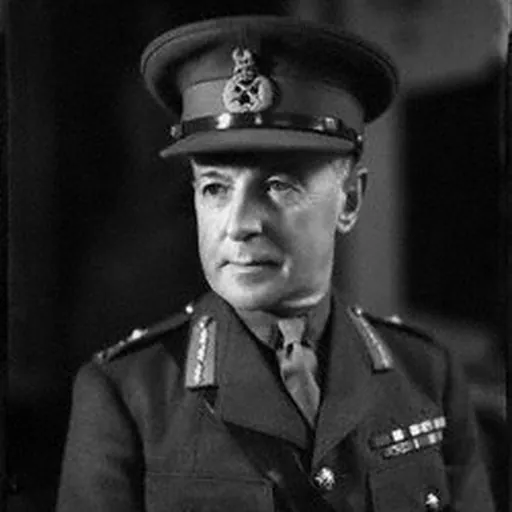
About Frederick Alfred Pile
Lived 1884 – 1976 (aged 92). Frederick Alfred Pile was a British military personnel.
General Sir Frederick Alfred Pile, 2nd Baronet, (14 September 1884 – 14 November 1976) was a senior British Army officer who served in both World Wars. In the Second World War he was General Officer Commanding Anti-Aircraft Command, one of the elements that protected Britain from aerial attack.
Early life Pile was born in Dublin as the second child of Sir Thomas Devereux Pile, 1st Baronet and his wife, Caroline Maude Nicholson. Sir Thomas served as the Lord Mayor of Dublin from 1900 to 1901.
Pile had an older sister and two younger brothers. His youngest brother, Cyril John Pile, served in the Royal Flying Corps during the First World War, and was killed in action in 1917.
After attending the Royal Military Academy at Woolwich, Pile was commissioned into the Royal Artillery in July 1904. He initially served in India, together with Britain and South Africa. and the Distinguished Service Order during the war.
After the war he was appointed a Brigade Major at Brighton and Shoreham District. In 1928 he became commander of the 1st Experimental Mechanized Force and assistant director of mechanisation at the War Office. In 1939, at the start of the Second World War, he was made General Officer Commanding-in-Chief of Anti-Aircraft Command, a position he held throughout the war. His plan for "Engagement of Long Range Rockets with AA Gunfire" (gunfire into a radar-predicted airspace to intercept the V-2 rocket) was ready on 21 March 1945 but the plan was not used due to the danger of shells falling on Greater London.
Tim Pile was considered as CIGS to replace John Dill in October 1941 at Beaverbrook's urging (Pile had been spending weekends with Beaverbrook). Alan Brooke who replaced Dill said that "Tim" Pile had certain valuable qualities but he could not think of a worse selection as CIGS.
In March 1944, MI5 considered him the most likely source of the classified information leak concerning the location of the planned Normandy landings to B. H. Liddell Hart.
Pile was created a Knight Grand Cross of the Order of the Bath (GCB) in the 1945 New Year Honours. After the War he became Director General of Housing with the Ministry of Works.
Commemoration
In 1948, a locomotive of the Southern Railway SR Battle of Britain Class was named after Pile at Waterloo station in London. After residing at Woodham Brothers scrapyard in Barry, South Wales it was initially preserved at the Avon Valley Railway for many years, and then moved to the Watercress Line in 2011. Hornby Railways have released a model of this locomotive.
Arms
Don’t just read it —
keep it.
Full-length biographies made to live with: read them, listen on the way to work, watch them tonight.
- E-book
- Audio
- Video
Instant download · yours to keep · every purchase keeps this site free
Important facts
People in Frederick Alfred Pile's life
Named in this biography and alive at the same time

Related people
Same field, nearest in time





Contemporaries
People whose lives overlapped Frederick Alfred Pile's

Frequently asked questions
Who was Frederick Alfred Pile?
British Army general (1884-1976)
When was Frederick Alfred Pile born?
Frederick Alfred Pile was born on 14 September 1884 in Dublin.
When did Frederick Alfred Pile die?
Frederick Alfred Pile died on 14 November 1976 in London.
What was Frederick Alfred Pile's occupation?
Frederick Alfred Pile was a military personnel.
What nationality was Frederick Alfred Pile?
Frederick Alfred Pile was British.
Sources & further reading
· Wikipedia: Frederick Alfred Pile
Cite this page
APA: Biography.guide. (2026). Frederick Alfred Pile. https://biography.guide/frederick-alfred-pile/
MLA: "Frederick Alfred Pile." Biography.guide, https://biography.guide/frederick-alfred-pile/.
Chicago: "Frederick Alfred Pile." Biography.guide. https://biography.guide/frederick-alfred-pile/.
Data last updated: 2026-09-21 · Spot an error? Report a correction.
Portrait: Wikimedia Commons · author & licence
Page generated 2026-09-27 05:00 UTC