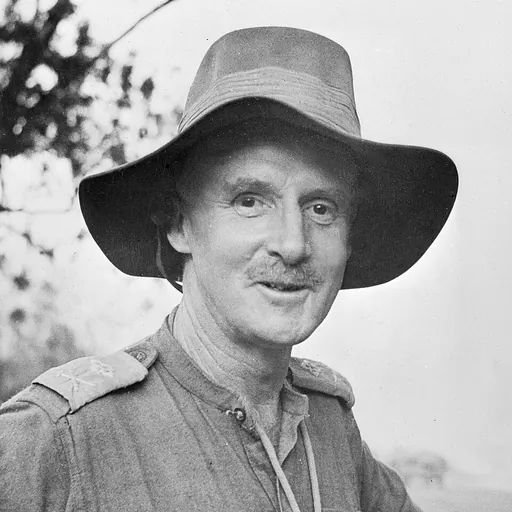
About Frank Messervy
Lived 1893 – 1974 (aged 80). Frank Messervy was a British military personnel.
General Sir Frank Walter Messervy, (9 December 1893 – 2 February 1974) was a British military officer who served as the first Commander-in-Chief of the Pakistan Army from 1947 to 1948. Prior to Pakistan's independence, he served in the British Indian Army in the First and Second World Wars, and as the General Officer Commanding-in-Chief for Northern Command of British India in 1946 and 1947.
Early life and education Messervy was born in Trinidad on 9 December 1893, the oldest child of Walter John Messervy (born in Jersey in the English Channel), a bank manager in the colony (and later England) and his wife Myra Naida de Boissiere from Trinidad.
Sent to England from Trinidad, Messervy was initially educated at Eton College and the Royal Military College, Sandhurst, and was commissioned into the Indian Army in January 1913
Military career In 1914 Messervy joined 9th Hodson's Horse. which later became part of the 4th Duke of Cambridge's Own Hodson's Horse. He would see action in the First World War in France, Palestine and Syria from 1914 to 1918. He later served in Kurdistan in 1919.
After attending the Staff College, Camberley, from 1925 to 1926, Messervy was appointed as an instructor at the Staff College, Quetta from 1932 to 1936, where Bernard Montgomery was among his fellow instructors. He was made commanding officer of the 13th Duke of Connaught's's Own Lancers, then in British India, during 1938 and 1939. was promoted to command XIII Corps in North Africa Messervy, a brigadier for only six weeks, was appointed to take his place. He was promoted to the acting rank of major general as a result of his new appointment.
On 20 August, a letter signed by Messervy went out to all the brigade headquarters in northwest Pakistan, attaching plans for a certain Operation Gulmarg. According to the plan, 20 lashkars of Pashtun tribesmen were to be armed and trained in various brigade locations in northwest Pakistan for an armed invasion of Kashmir. The information leaked out, one of the letters having fallen into the hands of an Indian officer Major Onkar Singh Kalkat. Kalkat was put under house arrest, but he escaped and made his way to India. By the D-day of 22 October, when the attack was launched, Messervy was away in London, leaving General Douglas Gracey, the Chief of General Staff, as the Acting Commander-in-Chief On his return, he stopped in Delhi, where Lord Mountbatten made him swear that he had not been asked for, nor had he provided, any help to the tribesmen. But within a week he was found providing arms and ammunition to the Pakistani invading forces.
Pakistani officers narrate that both Messervy and Gracey were involved in running the day-to-day operations of Pakistan's Kashmir War. Officers were loaned out for commanding the rebel forces and shown on records as being absent. Nevertheless, Messervy issued a statement on 12 November 1947, denying that any "serving Pakistan Army officers are directing operations in Kashmir", which was cited by Pakistan in the UN Security Council debates as proof of Pakistan's innocence.
Messervy was relieved of his post on 15 February 1948, leading to his retirement on 22 August that year. He was granted the honorary rank of general. He opined that if the pro-India National Conference party was allowed to hold power in Kashmir, India would likely win a plebiscite, but if Pakistan was allowed to hold on to the areas that it had captured, a Pakistan win was 'even more certain'. He had 'few doubts' as to which dominion most people of Kashmir would choose. Historian Gowher Rizvi states that influences of this kind persuaded the Secretary of State for Commonwealth Affairs Philip Noel-Baker to ensure that Pakistan's viewpoint was "not ignored" in the UN Security Council.
Messervy died at home in the small village of Heyshott, in the south of England, on 2 February 1974.
Family In 1927 Messervy married Patricia Waldegrave Courtney daughter of Lt Col Edward Arthur Waldegrave Courtney. They had a daughter and two sons. Commissioned into the 9th Hodson's Horse (1914) Brigade Major – (1928–1932) Instructor (GSO2) at Command and Staff College, Quetta (1932–1936) Commanding Officer, 13th Duke of Connaught's Own Lancers (1938–1939) General Staff Officer 1, Indian Infantry Division, East Africa (1939–1941) Commanding Officer Gazelle Force, Sudan and Eritrea (1940–1941) Commanding Officer, 9th Indian Brigade, Ethiopia (1941) General Officer Commanding, Indian Infantry Division, North Africa (1941–1942) General Officer Commanding, 1st Armoured Division, North Africa (1942) General Officer Commanding, 7th Armoured Division, North Africa (1942) Deputy Chief of the General Staff, HQ Middle East Command (1942) General Officer Commanding, Indian 43rd Armoured Division (1942–1943) Director Armoured Fighting Vehicles, India (1943) General Officer Commanding, 7th Indian Infantry Division, India (1943–1944) General Officer Commanding, IV Corps, Burma (1944–1945) General Officer Commander-In-Chief, Malaya Command (1945–1946) General Officer Commander-In-Chief, Northern Command, India (1946–1947) Commander-in-Chief of the Pakistan Army (1947–1948) Retired (1948)
Promotions Second Lieutenant-22 January 1913 Lieutenant – 22 April 1915 Captain – 22 January 1917 Acting Major – 23 November to 27 December 1918 Brevet Major – 1 July 1929 Major – 22 January 1931 Local Lieutenant-Colonel – 1 September 1932 Brevet Lieutenant-Colonel – 1 July 1933 Lieutenant-Colonel – 10 April 1938 Colonel – 19 April 1940 Acting Major-General (Temporary Brigadier) – 14 April 1941 Temporary Major-General – 14 April 1942 Major-General – 17 April 1943 Acting Lieutenant-General – 8 December 1944 Lieutenant-General – 1 June 1945 Acting General – 15 August 1947 Honorary General – 1948
Don’t just read it —
keep it.
Full-length biographies made to live with: read them, listen on the way to work, watch them tonight.
- E-book
- Audio
- Video
Instant download · yours to keep · every purchase keeps this site free
Important facts
People in Frank Messervy's life
Named in this biography and alive at the same time





Related people
Same field, nearest in time





Contemporaries
People whose lives overlapped Frank Messervy's


Frequently asked questions
Who was Frank Messervy?
British Army General (1893-1974)
When was Frank Messervy born?
Frank Messervy was born on 9 December 1893 in Trinidad.
When did Frank Messervy die?
Frank Messervy died on 2 February 1974 in Heyshott.
What was Frank Messervy's occupation?
Frank Messervy was a military personnel.
What nationality was Frank Messervy?
Frank Messervy was British.
Sources & further reading
Cite this page
APA: Biography.guide. (2026). Frank Messervy. https://biography.guide/frank-messervy/
MLA: "Frank Messervy." Biography.guide, https://biography.guide/frank-messervy/.
Chicago: "Frank Messervy." Biography.guide. https://biography.guide/frank-messervy/.
Data last updated: 2026-09-24 · Spot an error? Report a correction.
Portrait: Wikimedia Commons · author & licence
Page generated 2026-09-27 05:08 UTC