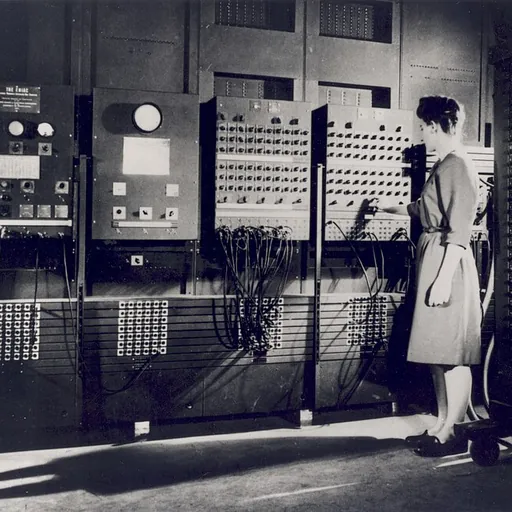
Frances Spence
American physicist and computer scientist
About Frances Spence
Lived 1922 – 2012 (aged 90). Frances Spence was an American mathematician, engineer, programmer, computer scientist and physicist.
Frances V. Spence ( Bilas; March 2, 1922 – July 18, 2012 ) was an American physicist and computer scientist. She was one of the original programmers for the ENIAC (the first electronic digital computer). She is considered one of the first computer programmers in history. Her parents both held jobs in the education sector, her father as an engineer for the Philadelphia Public School System and her mother as a teacher. its computational development was led by a team of six programmers (called "Computers"), all women from similar backgrounds as Spence. Despite her importance as one of the original programmers of the ENIAC, the role that she and the other female programmers took on was largely downplayed at the time due to the stigma that women were not interested in technology.
Photos of the women working on the computer often went without credit in newspapers at the time, and when the ENIAC was completed and unveiled to the public on February 15, 1946, the US Army failed to mention the names of the female programmers who had programmed the machine to run such sophisticated calculations. This further contributed to the perceived disconnect between women and computing.
Frances Bilas and the other women were originally hired by the University of Pennsylvania's Moore School of Engineering to create the ENIAC, which was needed to compute ballistics trajectories as part of a team of eighty women. The Moore School of Engineering was funded by the US Army, and at the time they were hiring female programmers in particular due to the fact that many young American men were fighting overseas in World War II.
Legacy In 1997, Spence was inducted into the Women in Technology International Hall of Fame, along with the other original ENIAC programmers. Their work paved the way for the electronic computers of the future, and their innovation kick-started the rise of electronic computing and computer programming in the Post-World War II era.
In 2010, a documentary called, "Top Secret Rosies: The Female "Computers" of WWII" was released. The film centered around in-depth interviews of three of the six women programmers, focusing on the commendable patriotic contributions they made during World War II.The ENIAC team is the inspiration behind the award-winning 2013 documentary The Computers. This documentary, created by Kathy Kleiman and the ENIAC Programmers Project, combines actual footage of the ENIAC team from the 1940s with interviews with the female team members as they reflect on their time working together on the ENIAC. It is the first documentary of a series of three, and parts two and three will be entitled The Coders and The Future-Maker, respectively.
Don’t just read it —
keep it.
Full-length biographies made to live with: read them, listen on the way to work, watch them tonight.
- E-book
- Audio
- Video
Instant download · yours to keep · every purchase keeps this site free
Important facts
Related people
Same field, nearest in time



Contemporaries
People whose lives overlapped Frances Spence's
Frequently asked questions
Who was Frances Spence?
American physicist and computer scientist
When was Frances Spence born?
Frances Spence was born on 2 March 1922 in Philadelphia.
When did Frances Spence die?
Frances Spence died on 18 July 2012.
What was Frances Spence's occupation?
Frances Spence was a mathematician, engineer, programmer, computer scientist and physicist.
What nationality was Frances Spence?
Frances Spence was American.
Sources & further reading
Cite this page
APA: Biography.guide. (2026). Frances Spence. https://biography.guide/frances-spence/
MLA: "Frances Spence." Biography.guide, https://biography.guide/frances-spence/.
Chicago: "Frances Spence." Biography.guide. https://biography.guide/frances-spence/.
Data last updated: 2026-09-22 · Spot an error? Report a correction.
Page generated 2026-09-27 05:10 UTC