
About Filipp Rudkin
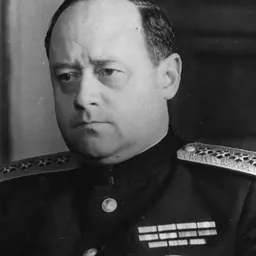
Lived 1893 – 1954 (aged 60). Filipp Rudkin was a Russian military personnel.
Filipp Nikitovich Rudkin (; 27 November 1893 12 October 1954) was a Belarusian Soviet Army major general and a Hero of the Soviet Union.
After fighting in World War I, he successively became a Cheka, OGPU, and NKVD officer, seeing action in the Russian Civil War. Rudkin was transferred to the reserve in 1938 but reinstated two years later. After the Operation Barbarossa, the German invasion of the Soviet Union, began on 22 June 1941, he became an armor officer in the Red Army. Given command of a separate tank brigade, Rudkin led it in the Ostrogozhsk–Rossosh Offensive, Operation Star, and the Third Battle of Kharkov in early 1943. For his leadership he received the title Hero of the Soviet Union in March, and became commander of the 15th Tank Corps in June. After leading the unit in Operation Kutuzov, he was considered unsuited for corps command and relieved, being demoted to command a rear area tank training unit. Rudkin was sent back to the front in January 1944, and led the 11th Tank Corps until July, when his corps suffered heavy losses after advancing into a German counterattack, after which he became deputy commander of the 3rd Belorussian Front's armored and mechanized troops, a position he ended the war in. Postwar, he served in several armored and mechanized forces posts in the Soviet Army, retiring in 1952.
Early life and military career A Belorussian, Rudkin was born on 27 November 1893 in the village of Chyornaya Sosna, Belitsky volost, Cherikovsky Uyezd, Mogilev Governorate (now in Mstsislaw District, Mogilev Region) to a peasant family. He joined the Russian Social Democratic Labor Party in 1914. After the beginning of World War I, Rudkin was conscripted into the Russian Imperial Army in October 1915, serving in the 16th Siberian Reserve Battalion. In December of that year he was arrested and imprisoned. He was sent to the Western Front in February 1917, serving as a private in the 138th Infantry Division's 551st Veliky Ustyug Regiment on the Dvinsk line. Rudkin actively participated in the Russian Revolution, and in November 1917 he was elected commander and commissar of his division as the Imperial Army dissolved. and was promoted to major general on 7 June.
Rudkin took command of the 15th Tank Corps on 11 June, leading it during the Operation Kutuzov in July and August. On 26 July, the corps was converted into the 7th Guards Tank Corps for its actions. Rudkin was relieved of command on 6 August because he was considered unfit for corps command, and became the commander of the Tambov Tank Camp. On 12 January 1944 he was sent back to the front as commander of the 11th Tank Corps. During his time in command, the corps participated in the Proskurov-Chernivtsi Offensive and Operation Bagration as part of the 13th Army and the 47th Army. During Operation Bagration, on 7 July, the 47th Army and the tank corps attacked in the Kovel area, with the corps ordered to exploit the breakthrough by taking to Liuboml and Opalin, crossing the Western Bug, and advancing on Lublin. Although the 47th Army's attack made little progress, the corps was still sent into combat, due to the Soviet assumption that the German troops were still retreating, along with a lack of reconnaissance. The 11th Tank Corps suffered heavy losses in a German counterattack, and Rudkin was relieved of command on 14 July. In a Stavka order dated 16 July, he was blamed for the corps' loss of 75 tanks, and its attack without infantry or artillery support. In August, he became deputy commander of the armored and mechanized forces of the 3rd Belorussian Front, fighting in the Gumbinnen Operation and the East Prussian Offensive.
Postwar In June 1945, Rudkin became deputy commander of the armored and mechanized forces of the Baranovichi Military District. From December, he was at the disposal of the chief of the Ground Forces. Rudkin served as a senior inspector of the armored and mechanized forces of the Inspectorate of the Ground Forces between June 1946 and March 1947. In August, he became commander of the armored and mechanized forces of the 3rd Shock Army. In June 1950, Rudkin transferred to the South Ural Military District to command its armored and mechanized forces. After retiring in November 1952, he lived and worked in Moscow. Rudkin died on 12 October 1954 and was buried in the Vvedenskoye Cemetery.
Awards and honors
Don’t just read it —
keep it.
Full-length biographies made to live with: read them, listen on the way to work, watch them tonight.
- E-book
- Audio
- Video
Instant download · yours to keep · every purchase keeps this site free
Important facts
Related people
Same field, nearest in time





Contemporaries
People whose lives overlapped Filipp Rudkin's

Frequently asked questions
Who was Filipp Rudkin?
Soviet military personnel (1893-1954)
When was Filipp Rudkin born?
Filipp Rudkin was born on 27 November 1893 in Mstsislaw District.
When did Filipp Rudkin die?
Filipp Rudkin died on 12 October 1954 in Moscow.
What was Filipp Rudkin's occupation?
Filipp Rudkin was a military personnel.
What nationality was Filipp Rudkin?
Filipp Rudkin was Russian.
Sources & further reading
Cite this page
APA: Biography.guide. (2026). Filipp Rudkin. https://biography.guide/filipp-rudkin/
MLA: "Filipp Rudkin." Biography.guide, https://biography.guide/filipp-rudkin/.
Chicago: "Filipp Rudkin." Biography.guide. https://biography.guide/filipp-rudkin/.
Data last updated: 2026-09-20 · Spot an error? Report a correction.
Page generated 2026-09-27 05:03 UTC