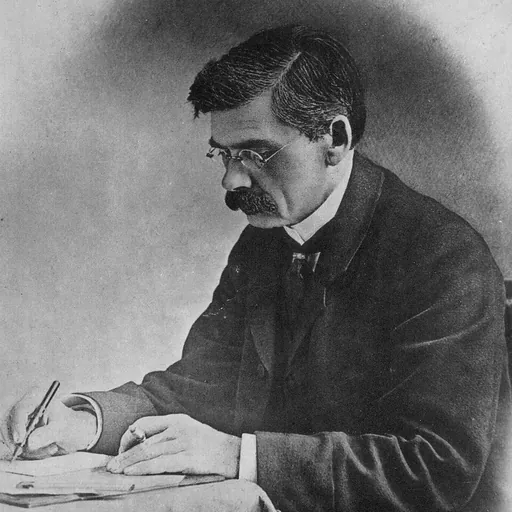
About Ferdinand Hurter
Lived 1844 – 1898 (aged 53). Ferdinand Hurter was a Swiss chemist and photographer, known for Chemistry and Photography.
Ferdinand Hurter (15 March 1844 – 12 March 1898) was a Swiss industrial chemist who settled in England. He also carried out research into photography.
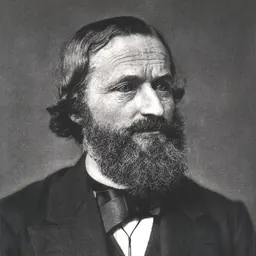
Early life Ferdinand Hurter was born in Schaffhausen, Switzerland, the only son of Tobias Hurter, a bookbinder, and his wife Anna Oechslein. His father died when Ferdinand was aged only two and his mother worked as a nurse to support him and his sister Elizabeth. She later married her late husband's half-brother, David, and Ferdinand developed a strong relationship with his stepfather. After education at the local Gymnasium he became an apprentice to a dyer in Winterthur before moving to Zürich to work in a silk firm. He then attended Zürich Polytechnic before going to Heidelberg University. Here he studied chemistry under Robert Bunsen and physics under Gustav Kirchhoff. He graduated Ph.D. with the highest honours in 1866.
Career Hurter was offered a professorship in Aarau but declined this and, with a few letters of introduction, arrived in Manchester in 1867. He joined Henry Deacon and Holbrook Gaskell at their alkali manufacturing business, Gaskell, Deacon & Co., in Widnes, Lancashire. Here he became chief chemist and worked with Deacon to develop a process to convert hydrochloric acid, a waste by-product of the Leblanc process of making alkali, to chlorine which was then used to manufacture bleaching powder. He was a pioneer in applying the principles of physical chemistry and thermodynamics to industrial processes and by 1880 was considered to be a world authority on the manufacture of alkali. He was a strong defender of the Leblanc process against the other methods of manufacturing alkali being developed at the time although he did research the ammonia-soda process but without any success. He argued against the production of alkali by the electrolysis of brine because of the enormous amount of electrical power this would require although he was later to have second thoughts.
When the Leblanc factories merged in 1890 to form the United Alkali Company, Hurter was placed in charge of developing a research laboratory in Widnes. This was later named after him. He played a part in the foundation of the Society of Chemical Industry in 1881, becoming its chairman in 1888–1890. He published 24 papers in English journals alone. He gave many lectures to try to popularise scientific subjects. As chief chemist to the United Alkali Company, despite his failing health, he travelled to a number of countries in Europe and also made one visit to the USA. The Society of Chemical Industry endowed the Hurter Memorial Lecture in his name. He enjoyed music and played the clarinet and piano. He also took an interest in photography, collaborating in research with Vero Charles Driffield, an engineer at the Gaskell-Deacon works. Together they published many papers (in addition to Hurter's papers in chemistry). They were jointly awarded the Progress Medal of the Royal Photographic Society in 1898. The results of their research revolutionised photography. Hurter campaigned for free education and for the introduction of the metric system into Britain. He died at his home in Cressington Park, Liverpool and was buried in the churchyard of Farnworth church. His estate was valued at slightly less than £6,300.
Don’t just read it —
keep it.
Full-length biographies made to live with: read them, listen on the way to work, watch them tonight.
- E-book
- Audio
- Video
Instant download · yours to keep · every purchase keeps this site free
Important facts
People in Ferdinand Hurter's life
Named in this biography and alive at the same time

Related people
Same field, nearest in time



Contemporaries
People whose lives overlapped Ferdinand Hurter's

Frequently asked questions
Who was Ferdinand Hurter?
Swiss chemist (1844–1898)
When was Ferdinand Hurter born?
Ferdinand Hurter was born on 15 March 1844 in Schaffhausen.
When did Ferdinand Hurter die?
Ferdinand Hurter died on 12 March 1898 in Widnes.
What was Ferdinand Hurter's occupation?
Ferdinand Hurter was a chemist and photographer.
What was Ferdinand Hurter known for?
Ferdinand Hurter was known for Chemistry and Photography.
What nationality was Ferdinand Hurter?
Ferdinand Hurter was Swiss.
Sources & further reading
Cite this page
APA: Biography.guide. (2026). Ferdinand Hurter. https://biography.guide/ferdinand-hurter/
MLA: "Ferdinand Hurter." Biography.guide, https://biography.guide/ferdinand-hurter/.
Chicago: "Ferdinand Hurter." Biography.guide. https://biography.guide/ferdinand-hurter/.
Data last updated: 2026-09-23 · Spot an error? Report a correction.
Portrait: Wikimedia Commons · author & licence
Page generated 2026-09-27 05:08 UTC