
About Ethel M. Elderton
Lived 1878 – 1954 (aged 75–76). Ethel M. Elderton was a British statistician, mathematician and eugenicist.
Ethel Mary Elderton (1878–1954) was a British biometrician, statistician and eugenics researcher who worked with Francis Galton and Karl Pearson.
Early life and education Ethel Mary Elderton was born on 31 December 1878 in Fulham, London. Her father, William Alexander Elderton was a private tutor and her mother, Sarah Isabella, née Lapidge was school headmistress. The couple had eight children, of which Elderton was the third and the eldest girl. Her eldest brother was Sir William Palin Elderton, a statistician who worked as an actuary and became head of Equitable Life Assurance Society and also a friend of biostatistician Karl Pearson. Another brother, Thomas Howard Elderton was the president of the Calcutta Trust. Her father, William, and one of her younger brothers graduated with top of their classes mathematics degrees from Cambridge, becoming Cambridge Wranglers. Her exceptional mathematical abilities, stemming from family tradition, laid the foundation for her career.
Elderton was educated at Streatham High School before entering Bedford College in London in 1895 and studying under the Faculty of Arts program. There she was taught by Alice Lee, who employed by Professor Karl Pearson, and became a school teacher, which she continued to do until she resigned in 1905. She was promoted to Edgar Schuster's assistant, who was the first Galton Research Fellow. Later, Elderton was also named a Galton Research Fellow, a title she held for the rest of her career, and was named as one of the three chief assistants in the Galton Laboratory in 1907, along with David Heron and Amy Barrington.
Her work over the years in the Galton Eugenics Laboratory was known to have extremely impressed Francis Galton. He stated, "I cannot think of the Laboratory without Miss Elderton, she is the life and soul of the place"
In 1925 she was appointed to an Assistant Professor in the Galton Eugenics Laboratory (renamed the Department of Human Genetics and Biometry in 1966) at University College London. Elderton and her brother William Palin Elderton, took up this suggestion and, leveraging their exceptional statistical skills, co-published Primer of Statistics which was officially published in 1909. The journal The Economic Bulletin reviewed the Primer of Statistics, stating that its presentation of the theory of statistics was well-written, understandable to people who do not have an advanced knowledge of higher mathematics, and would be a great resource for students.
A first study of the Influence of parental alcoholism on the physique and ability of the offspring, Eugenics Laboratory Memoir Series, (1910), co-authored with Karl Pearson
One of Elderton's most well-known works, which claimed that alcoholism was inherited, which brought much backlash from other scientists and medical professionals. Many scientists of the day disagreed with this argument, reviews stated that Elderton and Pearson's approach put too much emphasis on inheritable characteristics rather than environmental variables. Shortly after, Elderton and Pearson published, A Second Study of the Influence of Parental Alcoholism on the Physique and Ability of the Offspring (1910) in response to the critiques, in which they only furthered the claims made in the first edition.
Following its founding in 1925, Elderton helped edit Pearson's journal, Annals of Eugenics. She often provided or edited eugenics articles to be included in the journal. Others who participated and regularly contributed to the journal were: Mary Noel Karm, Margaret Moul, Percy Stocks, and Geoffrey Morant.
The Inheritance of Physical Characters, Biometrika, (1907), co-authored with Edgar Schuster The Inheritance of Ability, Eugenics Laboratory Memoir Series, (1907), co-authored with Edgar Schuster On the Measure of the Resemblance of First Cousins, Eugenics Laboratory Memoir Series, (1907), co-authored with Karl Pearson A second study on the statistics of pulmonary tuberculosis: marital infection, Cambridge University Press, (1908), co-authored with E G Pope and Karl Pearson On the Association of Drawing with Other Capacities in School Children, Biometrika, (1909) The Relative Strength of Nurture and Nature, Eugenics Laboratory Lecture Series, (1909) On the Marriage of First Cousins, Eugenics Laboratory Lecture Series, (1909) Primer of Statistics, Journal of the Royal Statistical Society, (1909), co-authored with William P Elderton The Influence of Parental Occupation and Home Conditions on the Physique of the Offspring, (1909), Eugenics Laboratory Memoir Series (unpublished) On the Correlation of Death-Rates, Journal of the Royal Statistical Society, (1910), co authored with Karl Pearson and Alice Lee A first study of the Influence of parental alcoholism on the physique and ability of the offspring, Eugenics Laboratory Memoir Series, (1910), co-authored with Karl Pearson A second study of the influence of parental alcoholism on the physique and ability of the offspring, Eugenics Laboratory Memoir Series, (1910), co-authored with Karl Pearson On the Relation of Stature and Weight to Pigmentation, Biometrika, (1912) On the Hereditary Character of General Health, Biometrika, (1913), co-authored with Karl Pearson On the Correlation of Fertility with Social Value. A Co-Operative Study, Eugenics Laboratory Memoir Series, (1913), Co-authored with Amy Barrington, G H Jones, E M M de G Lamotte, H J Laski, and K Pearson Note on Infantile Mortality and Employment of Women, Biometrika, (1914) Height and Weight of School Children in Glasgow, Biometrika, (1914) Report on the English Birthrate, Part I: England North of the Humber, Eugenics Laboratory Memoir Series, (1914) Further Evidence of Natural Selection in Man, Biometrika, (1915), co-authored with Karl Pearson The Influence of Isolation in the Diphtheria Attack- and Death-Rates, Biometrika, (1915) co-authored with Karl Pearson On the torsion resulting from flexure in prisms with cross-sections of uni-axial symmetry only, Cambridge University Press, (1918), co-authored with A W Young and Karl Pearson On the Nest and Eggs of the Common Tern (S Fluviatilis), A Cooperative Study, Biometrika, (1919), co-authored with W Rowan, E Wolff, P L Sulman, K Pearson, E Isaacs, and M Tildesley Life-History Albums, Biometrika, (1919) On the Inheritance of the Finger-Print, Biometrika, (1920) On the Variate Difference Method, Biometrika, (1923), co-authored with Karl Pearson A Summary of the Present Position with Regard to the Inheritance of Intelligence, Biometrika, (1923) Correlation Between Prognosis Based on Condition of the Tuberculous Patient at Entry to a Sanatorium and the Issue, Annals of Human Genetics, (1927), co-authored with B Perott On the Growth Curves of Certain Characters in Women and the Interrelationship of these Characters, Annals of Human Genetics, (1928), co-authored with Margaret Moul On the Relative Value of the Factors with Influence Infant Welfare, Eugenics Laboratory Memoir Series, (1928) On the Distribution of the First Product Moment-Coefficient in Samples Drawn from a Indefinitely Large Norman Population, Biometrika, (1929), co-authored with Karl Pearson and G B Jeffery Note on Variability in Girls and Boys (Glasgow) for Height and Weight, Biometrika, (1929) Table of the Values of the Differences of the Powers of Zero, Biometrika, (1931), co-authored with Margaret Moul The Mean and Second Moment Coefficient of the Multiple Correlation Coefficient, in Samples from a Normal Population, Biometrika, (1931), authored by J Wishart. E Elderton and T Kondo credited with an Appendix On the Normality or Want of Normality in the Frequency Distributions of Cranial Measurements, Biometrika, (1932), co-authored with T L Woo The Lanarkshire Milk Experiment, Annals of Human Genetics, (1933) Strength of Vision in Relation to Eye and Hair Pigmentation, Biometrika, (1935), co-authored with Catherine M Thompson
Don’t just read it —
keep it.
Full-length biographies made to live with: read them, listen on the way to work, watch them tonight.
- E-book
- Audio
- Video
Instant download · yours to keep · every purchase keeps this site free
Important facts
People in Ethel M. Elderton's life
Named in this biography and alive at the same time


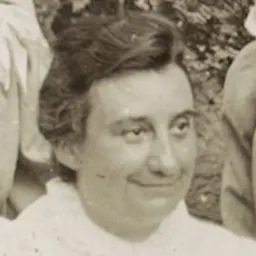




Related people
Same field, nearest in time

Contemporaries
People whose lives overlapped Ethel M. Elderton's




Frequently asked questions
Who was Ethel M. Elderton?
British mathematician
When was Ethel M. Elderton born?
Ethel M. Elderton was born in 1878 in Parsons Green.
When did Ethel M. Elderton die?
Ethel M. Elderton died in 1954 in Watford.
What was Ethel M. Elderton's occupation?
Ethel M. Elderton was a statistician, mathematician and eugenicist.
What nationality was Ethel M. Elderton?
Ethel M. Elderton was British.
Sources & further reading
· Wikipedia: Ethel M. Elderton
Cite this page
APA: Biography.guide. (2026). Ethel M. Elderton. https://biography.guide/ethel-m-elderton/
MLA: "Ethel M. Elderton." Biography.guide, https://biography.guide/ethel-m-elderton/.
Chicago: "Ethel M. Elderton." Biography.guide. https://biography.guide/ethel-m-elderton/.
Data last updated: 2026-09-20 · Spot an error? Report a correction.
Page generated 2026-09-27 05:22 UTC