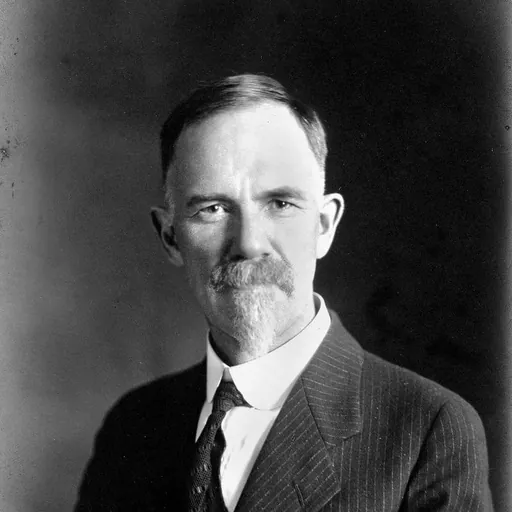
Charles Benedict Davenport
American botanist, zoologist and eugenicist
About Charles Benedict Davenport
Lived 1866 – 1944 (aged 77). Charles Benedict Davenport was an American statistician, geneticist, university teacher, zoologist, eugenicist and biologist.
Charles Benedict Davenport (June 1, 1866 – February 18, 1944) was a biologist and eugenicist influential in the American eugenics movement. He taught at Harvard University and the University of Chicago. Davenport was exceedingly proud of his ancestry, claiming in 1942 that he had been an American "for over three hundred years" because he was "composed of elements that were brought to this country during the 17th century." His father had eleven children by two wives, and Charles grew up with his family on Garden Place in Brooklyn Heights. His mother's strong beliefs tended to rub off onto Charles and he followed her example. During the summer months, Charles and his family spent their time on a family farm near Stamford. His father had a significant influence on his early career, as he encouraged Charles to become an engineer. However, this was not his primary interest, and after working for a few years to save up money, Charles enrolled in Harvard College to pursue his genuine interest of becoming a scientist. He graduated with a Bachelor's after two years, and earned a Ph.D. in biology in 1892. In 1903, he helped to found the American Breeders' Association, which later became the American Genetic Association.
In 1904, He founded the Eugenics Record Office there in 1910, with a grant from railroad heiress Mary Averell Harriman, whose daughter Mary Harriman Rumsey had worked with Davenport at Cold Spring Harbor while she was a student at Barnard College. During his time at Cold Spring Harbor Laboratory, Davenport began a series of investigations into aspects of the inheritance of human personality and mental traits, and over the years he generated hundreds of papers and several books on the genetics of alcoholism, pellagra (later shown to be due to a vitamin deficiency), criminality, feeblemindedness, tendency to seafaring, bad temper, intelligence, manic depression, and the biological effects of race crossing. His 1911 book, Heredity in Relation to Eugenics, was used as a college textbook for many years. During Davenport's tenure at Cold Spring Harbor, several reorganizations took place there. In 1918 the Carnegie Institution of Washington took over funding of the ERO with an additional handsome endowment from Mary Harriman. and to the National Academy of Sciences in 1912. In 1921, he was elected as a Fellow of the American Statistical Association.
Davenport's research was guided by the racism and classism of his time, which he bought into wholeheartedly. Although he was one of the first scientists to recognize polygenic inheritance (the influence of many genes on a single trait), he continued to employ simple Mendelian models when convenient for making racist and classist claims. Davenport drew on the Mendelian concept of dihybrid crossing—according to which characteristics segregate during reproduction and therefore recombine in different ways in the offspring—to argue that "a hybridized people" (a category which, for Davenport, included the offspring of unions between partners from different parts of Europe as well as the offspring of unions between partners from different continents) were "a badly put together people and a dissatisfied, restless, ineffective people."
Davenport founded the International Federation of Eugenics Organizations (IFEO) in 1925, with Eugen Fischer as chairman of the Commission on Bastardization and Miscegenation (1927). Davenport aspired to found a World Institute for Miscegenations, and "was working on a 'world map' of the 'mixed-race areas, which he introduced for the first time at a meeting of the IFEO in Munich in 1928."
Together with his assistant Morris Steggerda, Davenport attempted to develop a comprehensive quantitative approach to human miscegenation. The results of their research was presented in the book Race Crossing in Jamaica (1929), which attempted to provide statistical evidence for biological and cultural degradation following interbreeding between white and black populations. Particularly caustic was the review of the book published by Karl Pearson at Nature, where he considered that "the only thing that is apparent in the whole of this lengthy treatise is that the samples are too small and drawn from too heterogeneous a population to provide any trustworthy conclusions at all".
Influence on immigration policy in the United States Another way Charles Davenport's work manifested in the public sphere is regarding the topic of immigration. He believed that race determined behavior, and that many mental and behavioral traits were hereditary. His support of Mendelian genetics fueled this belief, as he believed allowing certain groups of people to enter the country would negatively impact the nation's genetic pool. Domestically, he also supported the prevention of "negative eugenics" through sterilization and sexual segregation of people who were considered genetically inferior. Sharing the racist views of many scientists during this time, those that Davenport considered to be genetically inferior included Black people and Southeastern Europeans. In a 1938 Letter to the Editor of Life magazine, he included both Franklin Roosevelt and Joseph Goebbels as examples of crippled statesmen who, motivated by their physical defects, have "led revolutions and aspired to dictatorships while burdening their country with heavy taxes and reducing its finances to chaos."
Although many other scientists had stopped supporting eugenics due to the rise of Nazism in Germany, Charles Davenport remained a fervent supporter until the end of his life. Six years after he retired in 1934, Davenport held firm to these beliefs even after the Carnegie Institute pulled funding from the eugenics program at Cold Spring Harbor in 1940. "I believe in striving to raise the human race to the highest plane of social organization, of cooperative work and of effective endeavor." "I believe that I am the trustee of the germ plasm that I carry; that this has been passed on to me through thousands of generations before me; and that I betray the trust if (that germ plasm being good) I so act as to jeopardize it, with its excellent possibilities, or, from motives of personal convenience, to unduly limit offspring." "I believe that, having made our choice in marriage carefully, we, the married pair, should seek to have 4 to 6 children in order that our carefully selected germ plasm shall be reproduced in adequate degree and that this preferred stock shall not be swamped by that less carefully selected." "I believe in such a selection of immigrants as shall not tend to adulterate our national germ plasm with socially unfit traits." "I believe in repressing my instincts when to follow them would injure the next generation."
Death Davenport was the director and curator of the Cold Spring Harbor Whaling Museum. In 1944, a whale washed up on a nearby beach; Davenport resolved to take its head and use it for a museum exhibit. During the process of preparing the whale's skull, Davenport caught a cold that developed into a fatal case of pneumonia.
Don’t just read it —
keep it.
Full-length biographies made to live with: read them, listen on the way to work, watch them tonight.
- E-book
- Audio
- Video
Instant download · yours to keep · every purchase keeps this site free
Important facts
Family & relationships
People in Charles Benedict Davenport's life
Named in this biography and alive at the same time



Related people
Same field, nearest in time


Contemporaries
People whose lives overlapped Charles Benedict Davenport's


Frequently asked questions
Who was Charles Benedict Davenport?
American botanist, zoologist and eugenicist (1866 – 1944)
When was Charles Benedict Davenport born?
Charles Benedict Davenport was born on 1 June 1866 in Stamford.
When did Charles Benedict Davenport die?
Charles Benedict Davenport died on 18 February 1944 in Cold Spring Harbor.
What was Charles Benedict Davenport's occupation?
Charles Benedict Davenport was a statistician, geneticist, university teacher, zoologist, eugenicist and biologist.
What nationality was Charles Benedict Davenport?
Charles Benedict Davenport was American.
Sources & further reading
· Wikipedia: Charles Benedict Davenport
Cite this page
APA: Biography.guide. (2026). Charles Benedict Davenport. https://biography.guide/charles-benedict-davenport/
MLA: "Charles Benedict Davenport." Biography.guide, https://biography.guide/charles-benedict-davenport/.
Chicago: "Charles Benedict Davenport." Biography.guide. https://biography.guide/charles-benedict-davenport/.
Data last updated: 2026-09-23 · Spot an error? Report a correction.
Portrait: Wikimedia Commons · author & licence
Page generated 2026-09-27 05:07 UTC