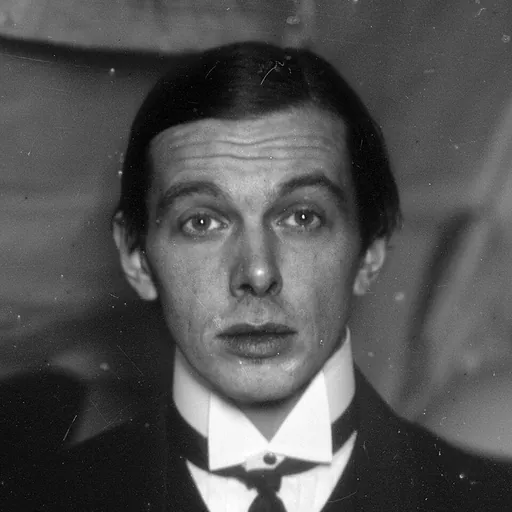
Ernst Ludwig Kirchner
German painter, sculptor, engraver and printmaker
About Ernst Ludwig Kirchner
Lived 1880 – 1938 (aged 58). Ernst Ludwig Kirchner was a painter, illustrator, photographer, graphic artist, sculptor and printmaker.
Ernst Ludwig Kirchner (6 May 1880 – 15 June 1938) was a German expressionist painter and printmaker. He was one of the founders of the artists group Die Brücke or "The Bridge", a key group leading to the foundation of Expressionism in 20th-century art. Kirchner volunteered for army service in the First World War, but soon suffered a breakdown and was discharged. His work was branded as "degenerate" by the Nazis in 1933, and in 1937 more than 600 of his works were sold or destroyed.
Early life and education Ernst Ludwig Kirchner was born in Aschaffenburg, Bavaria. His parents were of Prussian descent and his mother was a descendant of the Huguenots, a fact to which Kirchner often referred. As Kirchner's father searched for a job, the family moved frequently. Kirchner attended schools in Frankfurt and Perlen until his father earned the position of Professor of Paper Sciences at the College of Technology in Chemnitz, where Kirchner attended secondary school. While in attendance, he became close friends with Fritz Bleyl, whom Kirchner met during the first term. They discussed art together and also studied nature,
Kirchner continued studies at the Polytechnic School of Munich and the Debschitz-Schule in Munich from 1903 to 1904, returning to Dresden in 1905 to complete his degree. The group met initially in Kirchner's first studio, which had previously been a butcher's shop. Bleyl described it as "that of a real bohemian, full of paintings lying all over the place, drawings, books and artist's materials — much more like an artist's romantic lodgings than the home of a well-organised architecture student".
A group manifesto written by Kirchner in 1906 stated that "Everyone who reproduces, directly and without illusion, whatever he senses the urge to create, belongs to us".
In September and October 1906, the first group exhibition was held, focused on the female nude, in the showroom of K.F.M. Seifert and Co. in Dresden. At this time, he established an individual identity with his first solo exhibition, which took place at the Essen Folkwang Museum.
Grisebach visited him in March 1917, writing to Helene Spengler of Kirchner's condition: "I spent two mornings with Kirchner which I shall never forget. I found him sitting on a very low chair next to a small, hot stove in a yellow-painted, sloping-roofed attic. Only with the help of a stick was he able to walk, staggering around the room. ... A colourfully painted curtain concealed a large collection of paintings. When we began to look at them, he came alive. Together with me, he saw all his experiences drift by on canvas, the small, timid-looking woman set aside what we had seen and brought a bottle of wine. He made short explanatory remarks in a weary voice. Each picture had its own particular colourful character, a great sadness was present in all of them; what I had previously found to be incomprehensible and unfinished now created the same delicate and sensitive impression as his personality. Everywhere a search for style, for psychological understanding of his figures. The most moving was a self- portrait in uniform with his right hand cut off. Then he showed me his travel permit for Switzerland. He wanted to go back to Davos... and implored me to ask father for a medical certificate. ... As the woman with him rightly said, though many people want to help him, nobody is able to do so any longer. ... When I was leaving, I thought of Van Gogh's fate and thought that it would be his as well, sooner or later. Only later will people understand and see how much he has contributed to painting". Erna Schilling, his life partner, visited him periodically in Frauenkirch, while also maintaining a residence in Berlin to take care of Kirchner's business there. Three days later, Kirchner was laid to rest in the Waldfriedhof cemetery. In 1921, U.S. museums began to acquire his work and did so increasingly thereafter. In 1992, the National Gallery of Art, Washington, held a monographic show, Ernst Ludwig Kirchner: Paintings, Drawings, and Prints, using its existing collection and private collection loans. A major international loan exhibition Ernst Ludwig Kirchner took place in 2003 (exhibited 2 March–1 June 2003) and the Royal Academy of Arts, London (exhibited 20 June–21 September 2003).
In November 2006 at Christie's, Kirchner's Street Scene, Berlin (1913) fetched $38 million, a record for the artist. To celebrate the Neue Galerie’s partial acquisition of Berlin Street Scene it exhibited Ernst Ludwig Kirchner: Berlin Street Scene from 26 July–17 September 2007, along with other works from its collection.
From 3 August to 10 November 2008, the Museum of Modern Art in New York held a major exhibition Kirchner and the Berlin Street that "probably comprises the very best of his oeuvre."
From 9 December 2015–10 April 2016, Singer Laren museum in the Netherlands mounted the “Kirchner: Paradise in the Mountains,” an exhibition that examined his time in a sanitorium in Davos.
From 16 November 2018–3 March 2019 the Bundeskunsthalle, Bonn, exhibited Ernst Ludwig Kirchner’s Imaginary Travels, organized by the Art Centre Basel.
From 15 December 2018–31 March 2019, the Brücke-Museum exhibited Ernst Ludwig Kirchner The Swiss Years: Masterpieces from the Collection of E. W. Kornfeld.
From 3 October 2019–13 January 2020, the Neue Galerie, New York, exhibited Ernst Ludwig Kirchner, an exhibit that focused on his use of color.
From 4 September–5 December 2021, the Stedelijk Museum Amsterdam exhibited Kirchner and Nolde: Expressionism Colonialism.
In 2024, the Yale University Art Gallery hosted Munch and Kirchner: Anxiety and Expression which examined the prints of both artists and “…how these artists suffered from—and attempted to cope with—the anxieties of their age.”
From 15 June 2025–7 September 2025, the Kirchner Museum Davos exhibited Ernst Ludwig Kirchner. Between Painting and Photography.
Many of Kirchner's collectors were Jewish and persecuted by the Nazis for that reason. They either sold off their collections in order to flee the Nazis or had their collections seized. The Kirchner paintings "Berlin Street Scene" and "Judgement of Paris" were owned by the Jewish art collector Alfred Hess whose widow was forced to relinquish them before fleeing. Kirchner's 1915 painting Artillerymen was owned by the important art dealer of modern art, the German Jewish Alfred Flechtheim whose art gallery was Aryanized (seized by Nazis) in 1933 before he fled Germany. Kirchner's painting Sand Hills in Engadine, which had been seized by the Nazis in 1935 after its owner, Max Fischer, fled Germany for the United States, found its way into the collection of the MoMA, but was returned to Fischer's heirs in 2015.
Gallery
Publications Krämer, Felix. Kirchner, Hatje Cantz, 2010. Wye, Deborah. Kirchner and the Berlin Street, The Museum of Modern Art, New York, 2008. Kort, Pamela. Ernst Ludwig Kirchner: Berlin Street Scene, Neue Galerie New York, 2008. Ernst Ludwig Kirchner: Imaginary Travels Prestel, 2018 Spira, Freyda, 2024. Munch and Kirchner: Anxiety and Expression. New Haven: Yale University Press.
Don’t just read it —
keep it.
Full-length biographies made to live with: read them, listen on the way to work, watch them tonight.
- E-book
- Audio
- Video
Instant download · yours to keep · every purchase keeps this site free
Important facts
more
Ernst-Ludwig KirchnerPeople in Ernst Ludwig Kirchner's life
Named in this biography and alive at the same time




Related people
Same field, nearest in time

Contemporaries
People whose lives overlapped Ernst Ludwig Kirchner's






Frequently asked questions
Who was Ernst Ludwig Kirchner?
German painter, sculptor, engraver and printmaker (1880–1938)
When was Ernst Ludwig Kirchner born?
Ernst Ludwig Kirchner was born on 6 May 1880 in Aschaffenburg.
When did Ernst Ludwig Kirchner die?
Ernst Ludwig Kirchner died on 15 June 1938 in Davos Frauenkirch.
What was Ernst Ludwig Kirchner's occupation?
Ernst Ludwig Kirchner was a painter, illustrator, photographer, graphic artist, sculptor and printmaker.
What nationality was Ernst Ludwig Kirchner?
Ernst Ludwig Kirchner's recorded nationality: German Reich.
Sources & further reading
· Wikipedia: Ernst Ludwig Kirchner
· DBpedia: Ernst Ludwig Kirchner
Cite this page
APA: Biography.guide. (2026). Ernst Ludwig Kirchner. https://biography.guide/ernst-ludwig-kirchner/
MLA: "Ernst Ludwig Kirchner." Biography.guide, https://biography.guide/ernst-ludwig-kirchner/.
Chicago: "Ernst Ludwig Kirchner." Biography.guide. https://biography.guide/ernst-ludwig-kirchner/.
Data last updated: 2026-09-23 · Spot an error? Report a correction.
Portrait: Wikimedia Commons · author & licence
Page generated 2026-09-27 05:07 UTC