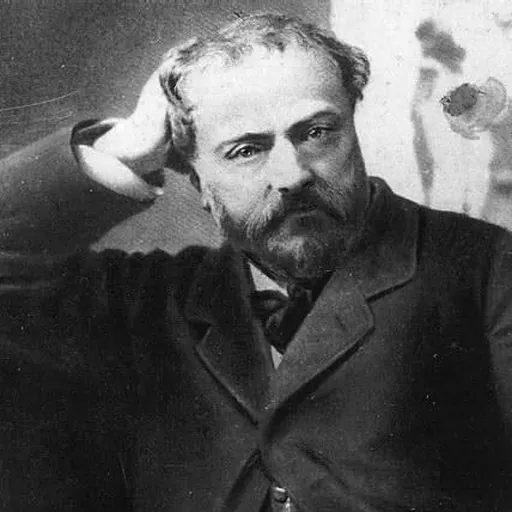
About Emmanuel Chabrier
Lived 1841 – 1894 (aged 53). Emmanuel Chabrier was a French composer and pianist.
Alexis-Emmanuel Chabrier (; 18 January 184113 September 1894) was a French Romantic composer and pianist. His bourgeois family did not approve of a musical career for him, and he studied law in Paris and then worked as a civil servant until the age of thirty-nine while immersing himself in the modernist artistic life of the French capital and composing in his spare time. From 1880 until his final illness he was a full-time composer.
Although known primarily for two of his orchestral works, España and Joyeuse marche, Chabrier left a corpus of operas (including L'étoile), songs, and piano music, but no symphonies, concertos, quartets, sonatas, or religious or liturgical music. His lack of academic training left him free to create his own musical language, unaffected by established rules, and he was regarded by many later composers as an important innovator and a catalyst who paved the way for French modernism. He was admired by, and influenced, composers as diverse as Debussy, Ravel, Richard Strauss, Satie, Poulenc, Stravinsky, and others of the group of composers known as Les Six. Writing at a time when French musicians were generally proponents or opponents of the music of Wagner, Chabrier steered a middle course, sometimes incorporating Wagnerian traits into his music and at other times avoiding them.
Chabrier was associated with some of the leading writers and painters of his time. Among his closest friends was the painter Édouard Manet, and Chabrier collected Impressionist paintings long before they became fashionable. A number of such paintings from his personal collection by artists known to him are now housed in some of the world's leading art museums. He penned a large number of letters to friends and colleagues which offer an insight into his musical opinions and character.
Chabrier died in Paris at the age of fifty-three from a neurological disease, probably caused by syphilis.
Life Early years
Chabrier was born in Ambert, (Puy-de-Dôme), a town in the Auvergne region of central France. He was the only son of a lawyer, Jean Chabrier, and his wife, Marie-Anne-Evelina, née Durosay or Durozay. The Chabriers were of old Auvergne stock, originally of peasant origin (the surname comes from "chevrier" – goat-herd), but in recent generations merchants and lawyers had predominated in the family. A key member of the household was the boy's nanny Anne Delayre (whom he called "Nanine" and "Nanon"), who remained close to him throughout her life. |group= n
Chabrier began taking music lessons at the age of six; his early teachers were from cosmopolitan backgrounds: at Ambert he studied with a Carlist Spanish refugee called Saporta, and after the family moved to Clermont-Ferrand in 1852 he studied at the Lycée imperial with a Polish musician, Alexander Tarnovsky . He moved the family to Paris in 1856, so that Chabrier could enrol at the Lycée Saint-Louis. After graduating from the law school in 1861 he joined the French civil service at the Ministry of the Interior, where he worked for nineteen years. In a study of the composer published in 1935 Jacques-Gabriel Prod'homme commented that it would be wrong to class Chabrier as merely an amateur in this period: "For, while in quest of the technique of his art, he displayed a curiosity in the painting and literature of the 'modernists' of his day that, among musicians, had few parallels."
From 1862 Chabrier was among the circle of the Parnassians in Paris. Among his friends were Auguste Villiers de l'Isle-Adam and Paul Verlaine; with the latter he planned a comic opera in the fashionable style of Offenbach, Vaucochard et fils Ier. He did not complete it, but four fragments (dating from about 1864 or 1865) have survived. His full-time official post severely restricted Chabrier's ability to compose large-scale works. He began an opera on a Hungarian historical theme entitled Jean Hunyade, to a libretto by Henry Fouquier, but abandoned it, after completing four numbers, in 1867. Another attempt at operatic comedy, Fisch-Ton-Kan, with Verlaine and Lucien Viotti, was performed in March 1875 at the same club with Chabrier at the piano; five fragments survive.
There are several descriptions of Chabrier's piano-playing at around this time; many years later the composer Vincent d'Indy wrote, "Though his arms were too short, his fingers too thick and his whole manner somewhat clumsy, he managed to achieve a degree of finesse and a command of expression that very few pianists – with the exception of Liszt and Rubinstein – have surpassed." The composer and critic Alfred Bruneau said of Chabrier, "he played the piano as no one has ever played it before, or ever will…" The wife of the painter Renoir, a friend of the composer, wrote:
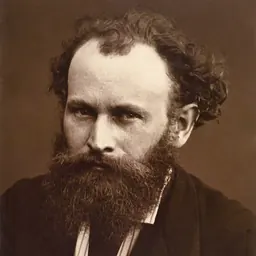
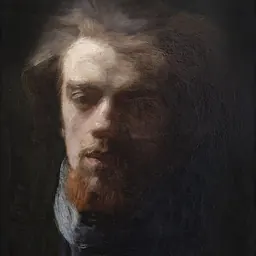
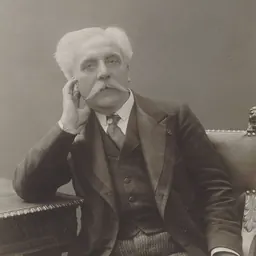
Both Chabrier's parents died within the space of eight days in 1869. During the Franco-Prussian War (1870–1871) and Commune, he continued in his official post as the ministry moved from Tours to Bordeaux then to Versailles. In 1873 he married Marie Alice Dejean, the granddaughter of Louis Dejean, who had gained his fortune as founder and manager of the Cirque d'été and the Cirque Napoléon. Alice and Chabrier had three sons, one of whom died at birth. Chabrier's friends in Paris included the composers Gabriel Fauré, Ernest Chausson, and Vincent d'Indy; painters including Henri Fantin-Latour, Edgar Degas and Édouard Manet, whose Thursday soirées Chabrier attended; and writers such as Émile Zola, Alphonse Daudet, Jean Moréas, Jean Richepin and Stéphane Mallarmé.
During the 1870s Chabrier began several stage works. The first to be completed was a three-act opéra-bouffe L'étoile (The Star), commissioned by the Bouffes-Parisiens, the spiritual home of Offenbach. He secured the commission through his many contacts in the world of arts and letters: he had met the librettists, Albert Vanloo and Eugène Leterrier through the painter Alphonse Hirsch, whom he had got to know as a member of Manet's set. The opera was modestly successful, running for 48 performances in 1877, but was not revived in his lifetime. The rhythmic verve of España is found also in the Joyeuse marche, which goes further in orchestral invention. Not all of Chabrier's orchestral pieces are in this exuberant vein: his Lamento (1874), unpublished in his lifetime, is an unusually poignant work.
A few of Chabrier's piano works were later orchestrated. The composer arranged the four movements of the Suite pastorale from the ten Pièces pittoresques. Chabrier began an orchestration of Bourrée fantasque in 1891 (completed in 1994 by Robin Holloway) but his friend and champion Felix Mottl orchestrated it in 1898, proving popular; he did the same for Trois valses romantiques in 1900, and in 1917–18 Ravel arranged the "Menuet pompeux" from the Pièces pittoresques. (Huebner applies this comment to d'Indy's Fervaal and Chausson's Le roi Arthus as well to Gwendoline.) Although the plot was described by a reviewer in 2016 as "wilfully unfathomable and illogical", the libretto was professional and polished, in contrast with other libretti set by Chabrier. The critic Elizabeth Forbes calls the score, "light as thistle-down … in the best tradition of Offenbachian opéra bouffe, with each singer perfectly characterized in his or her music".
Une éducation manquée (An Incomplete Education), a one-act opérette about a young couple seeking essential advice on their wedding night, received a single private performance in 1879, and was not performed in public until 1913. Forbes wrote in 1992, "Why this charming little work had to wait so many years for a public performance remains a total mystery. The subject is treated with the greatest delicacy… Musically, the piece is quite enchanting, in particular the central duet for the two high voices, while the bass has a fine comic number."
Chabrier's only completed serious opera was Gwendoline, composed between 1879 and 1885 and premiered in 1886. Mendès's libretto was a liability: Henri Büsser commented that it lacked the verve and movement the composer needed;
Chabrier was known for his continual contacts with contemporary artists, particularly painters of the Impressionist school. He left a rich collection of paintings by contemporary French painters; Edward Lockspeiser felt that "if ever it could be reassembled [the collection] would be rivalled, among collections of other composers, only by that of Chausson, which consisted largely of Delacroix". A sale of his collection at the Hôtel Drouot on 26 March 1896 included works by Cézanne, Manet, Monet, Renoir, and Sisley.
Chabrier himself was frequently painted or sketched by his artist friends. Two of these portraits are reproduced above: a drawing of Chabrier at the piano (1887) by Édouard Detaille and Manet's Portrait de Chabrier (oil on canvas, 1881). He is seen at the piano in Autour du piano by Henri Fantin-Latour (right).
Johnson comments that although it now seems extraordinary that the owner of such magnificent works of art should have money worries, this was before Impressionist paintings became sought-after and expensive, and "in any case, this was a composer who regarded his collection as a spiritual necessity rather than a financial asset".
Notes, references and sources
Don’t just read it —
keep it.
Full-length biographies made to live with: read them, listen on the way to work, watch them tonight.
- E-book
- Audio
- Video
Instant download · yours to keep · every purchase keeps this site free
Important facts
People in Emmanuel Chabrier's life
Named in this biography and alive at the same time



Related people
Same field, nearest in time


Contemporaries
People whose lives overlapped Emmanuel Chabrier's
Frequently asked questions
Who was Emmanuel Chabrier?
French Romantic composer and pianist
When was Emmanuel Chabrier born?
Emmanuel Chabrier was born on 18 January 1841 in Ambert.
When did Emmanuel Chabrier die?
Emmanuel Chabrier died on 13 September 1894 in 9th arrondissement of Paris.
What was Emmanuel Chabrier's occupation?
Emmanuel Chabrier was a composer and pianist.
What nationality was Emmanuel Chabrier?
Emmanuel Chabrier was French.
Sources & further reading
· Wikipedia: Emmanuel Chabrier
Cite this page
APA: Biography.guide. (2026). Emmanuel Chabrier. https://biography.guide/emmanuel-chabrier/
MLA: "Emmanuel Chabrier." Biography.guide, https://biography.guide/emmanuel-chabrier/.
Chicago: "Emmanuel Chabrier." Biography.guide. https://biography.guide/emmanuel-chabrier/.
Data last updated: 2026-09-21 · Spot an error? Report a correction.
Portrait: Wikimedia Commons · author & licence
Page generated 2026-09-27 04:59 UTC