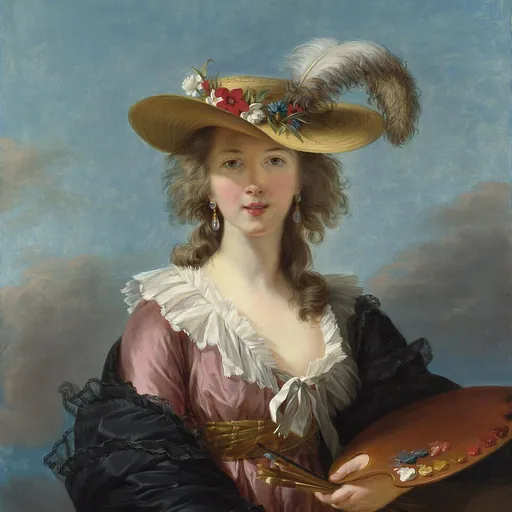
About Élisabeth Louise Vigée Le Brun
Lived 1755 – 1842 (aged 86). Élisabeth Louise Vigée Le Brun was a French painter, salonnière, writer and artist.
Élisabeth Louise Vigée Le Brun (; ; 16 April 1755 – 30 March 1842), also known as Louise Élisabeth Vigée Le Brun or simply Madame Le Brun, was a French painter who mostly specialized in portrait painting, in the late 18th and early 19th centuries.
Her artistic style is generally considered part of the aftermath of Rococo with elements of an adopted Neoclassical style. Her subject matter and color palette can be classified as Rococo, but her style is aligned with the emergence of Neoclassicism. Vigée Le Brun created a name for herself in Ancien Régime society by serving as the portrait painter to Marie Antoinette. She enjoyed the patronage of European aristocrats, actors, and writers, and was elected to art academies in ten cities. Some famous contemporary artists, such as Joshua Reynolds, viewed her as one of the greatest portraitists of her time, comparing her with Flemish (notably Rubens) and the old Dutch masters.
Vigée Le Brun created 660 portraits and 200 landscapes. In addition to many works in private collections, her paintings are owned by major museums, such as the Louvre in Paris, Hermitage Museum in Saint Petersburg, National Gallery in London, Metropolitan Museum of Art in New York, and many other collections in Europe and the United States. Her personal habitus was characterized by a high sensitivity to sound, sight and smell. Between 1835 and 1837, when Vigée Le Brun was in her eighties, with the help of her nieces Caroline Rivière and , she published her memoirs in three volumes (Souvenirs), some of which are in epistolary format. They also contain many pen portraits as well as advice for young portraitists. Élisabeth Louise Vigée was the daughter of Jeanne (; 1728–1800), a hairdresser from a peasant background,
In her memoir, Vigée Le Brun directly stated her feelings about her stepfather: "I hated this man; even more so since he made use of my father's personal possessions. He wore his clothes, just as they were, without altering them to fit his figure." She greatly disliked the contemporary High Rococo fashion, and often solicited her sitters to allow her to alter their apparel. Inspired by Raphael and Domenichino, she often draped her subjects in shawls and long scarves; these styles would later become ubiquitous in her portraiture. After her studio was seized for her practicing without a license, she applied to the Académie de Saint-Luc, which unwittingly exhibited her works in its Salon. In 1774, she was made a member of the Académie. Dutch and Flemish influences have also been noted in The Comte d'Espagnac (1786) and Portrait of Madame Perregaux (1789).
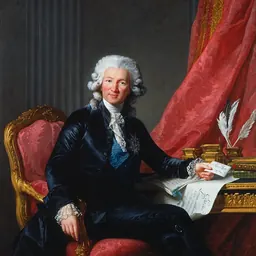
In yet another of the series of scandals that marked her early career, her 1784 Portrait of Charles Alexandre de Calonne depicting Louis XVI's minister of finance, Charles Alexandre de Calonne, was the target of a public scandal after it was exhibited in the Salon of 1785. Rumors circulated that the minister had paid the artist a very large sum of money, while other rumors circulated that she had had an affair with de Calonne. The famous Paris Opera soprano Sophie Arnould commented on the portrait "Madame Le Brun had cut off his legs so he could not escape". More rumors and scandals followed soon after as, to the painter's dismay, M. Le Brun began building a mansion on the Rue de-Gros-Chenet, with the public claiming that de Calonne was financing the new home – although her husband did not finish constructing the house until 1801, shortly before her return to France after her long exile. She was also rumored to have had another affair, with Joseph Hyacinthe François de Paule de Rigaud, Comte de Vaudreuil, who was one of her most devoted patrons. Their correspondence published later strongly affirmed the status of this affair. These rumors spiraled into an extensive defamation campaign targeting the painter throughout 1785.
In 1787, she caused a minor public scandal when her Self-portrait with her Daughter Julie was exhibited at that year's Salon showing her smiling and open-mouthed, which was in direct contravention of traditional painting conventions going back to antiquity. The court gossip-sheet Mémoires secrets commented: "An affectation which artists, art-lovers and persons of taste have been united in condemning, and which finds no precedent among the Ancients, is that in smiling, [Madame Vigée LeBrun] shows her teeth." In light of this and her other Self-portrait with her Daughter Julie (1789), Simone de Beauvoir dismissed Vigée Le Brun as narcissistic in The Second Sex (1949): "Madame Vigée-Lebrun never wearied of putting her smiling maternity on her canvases."
In 1788, Vigée Le Brun was impressed with the faces of the Mysorean ambassadors of Tipu-Sultan, and solicited their approval to take their portraits. The ambassador responded by saying he would only agree if the request came from the King, which Vigée Le Brun procured, and she proceeded to paint the portrait of Dervish Khan, followed by a group portrait of the ambassador and his son.
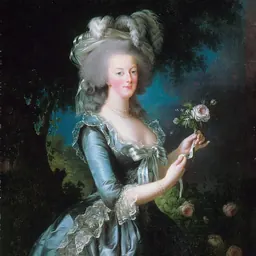
Marie Antoinette Marie Antoinette with a Rose, 1783. Palace of Versailles.As her career blossomed, Vigée Le Brun was granted patronage by Marie Antoinette. Despite the grand hat, a scandal was prompted by both the informality of the attire and the Queen's decision to be shown in that way. Vigée Le Brun immediately had the portrait removed from the Salon and quickly repainted it, this time with the Queen in more formal attire. The portrait shows the Queen at home in the Palace of Versailles, engaged in her official function as the mother of the King's children, but also suggests Marie Antoinette's uneasy identity as a foreign-born queen whose maternal role was her only true function under Salic law. The child, Louis Joseph, on the right is pointing to an empty cradle, which signified the Queen's recent loss of a child, further emphasizing Marie Antoinette's role as a mother. Vigée Le Brun was initially afraid of displaying this portrait due to the Queen's unpopularity and fear of another negative reaction to it, to such a degree that she locked herself in at home and prayed incessantly for its success. However, she was soon greatly pleased at the positive reception for this group portrait, which was presented to the King by M. de Angevilliers, Louis XVI's minister of arts. Vigée Le Brun herself was also presented to the King, who praised the painting and told her "I know nothing about painting, but I grow to love it through you". The portrait was hung in the halls of Versailles, so that Marie Antoinette passed it on her way to mass, but it was taken down after the Dauphin's death in 1789.
Later on, during the First Empire, she painted a posthumous portrait of the Queen ascending to heaven with two angels, alluding to the two children she had lost, and Louis XVI seated on two clouds. This painting was titled The Apotheosis of the Queen. It was displayed in the chapel of the Infirmerie Marie-Thérèse, rue Denfert-Rochereau, but vanished at some point in the 20th century. She also painted numerous other posthumous portraits of the Queen, and of King Louis XVI.
Académie royale de peinture et de sculpture Peace bringing back abundance, 1783. Louvre. Vigée Le Brun's submission to the Académie royale de peinture et de sculpture upon her admission there
On 31 May 1783, Vigée Le Brun was received as a member of the Académie royale de peinture et de sculpture. She was one of only 15 women to be granted full membership in the Académie between 1648 and 1793. Vigée Le Brun was initially refused on the grounds that her husband was an art dealer, but eventually the Académie was overruled by an order from Louis XVI because Marie Antoinette put considerable pressure on the King on behalf of her portraitist. As her reception piece, Vigée Le Brun submitted an allegorical painting, Peace Bringing Back Abundance (La Paix ramenant l'Abondance), instead of a portrait, even though she was not asked for a reception piece. Life Study of Lady Hamilton as the Cumaean Sybil, 1792, Metropolitan Museum of Art. This was widely considered to be one of Vigée Le Brun's greatest works, and was greatly received wherever it was displayed.
Vigée Le Brun witnessed many of the events that accelerated the already rapid deterioration of the Ancien Régime. While travelling to Romainville to visit the Maréchal de Ségur in July 1788, the artist experienced the massive hailstorm that swept the country, and observed the resultant devastation of crops. As the turmoil of the French Revolution grew, the artist's house on the Rue de-Gros-Chenet was harassed by sans-culottes due to her association with Marie Antoinette. Stricken with an intense anxiety, Vigée Le Brun's health deteriorated. M. and Mme. Brongniart pleaded with her to live with them to convalesce and recover her health, to which she agreed and spent several days in their apartment at Les Invalides. Later in her life, in a letter to the Princess Kourakin, the artist wrote:
As the situation in Paris and France continued to deteriorate with the rising tide of the revolution, the artist decided to leave Paris, and obtained passports for herself, her daughter and their governess. The very next day a large band of national guards entered her house and ordered her not to leave or else face punishment. Two sympathetic national guards from her neighborhood later returned to her house, and advised her to leave the city as fast as possible, but to take the stagecoach instead of her carriage. Vigée Le Brun then ordered three places on the stagecoach out of Paris, but had to wait two weeks to obtain seats as there were many people departing the city. Vigée Le Brun visited her mother before leaving. On 5 October 1789, the King and Queen were driven from Versailles to the Tuilleries by a large crowd of Parisians – mostly women. Vigée Le Brun's stagecoach departed at midnight of the same day, with her brother and husband accompanying them to the Barrière du Trône. She, her daughter and governess dressed shabbily to avoid attracting attention. Vigée Le Brun travelled to Lyon where she stayed for three days with acquaintances (Mme. and M. de Artaut), where she was barely recognized due to her changed features and shabby clothes, and then continued her journey across the Beauvoisin bridge, she was relieved to be finally out of France, although throughout her journey she was accompanied by Jacobin spies who tracked her movement. Her husband, who remained in Paris, claimed that Vigée Le Brun went to Italy "to instruct and improve herself", In her 12-year absence from France, she lived and worked in Italy (1789–1792), Austria (1792–1795), Russia (1795–1801) and Germany (1801), and remained a committed royalist throughout her life. The painting represents the Cumaean Sibyl, as indicated by the Greek inscription on the figure's scroll, which is taken from Virgil's fourth Eclogue. The Sibyl was Vigée Le Brun's favorite work; The portraits depict the Liechtenstein sisters-in-law in unornamented Roman-inspired garments that show the influence of Neoclassicism, and which may have been a reference to the virtuous republican Roman matron Cornelia, mother of the Gracchi. Vigée Le Brun painted Catherine's granddaughters (daughters of Paul I of Russia), Elena and Alexandra Pavlovna, in Grecian tunics with exposed arms. The Empress's favorite, Platon Zubov, commented to Vigée Le Brun that the painting had scandalized the Empress due to the amount of bare skin the short sleeves revealed. Vigée Le Brun was greatly worried by this and considered it a hurtful remark and replaced the tunics with the muslin dresses the princesses wore, and added long sleeves (called Amadis in Russia). Vigée Le Brun was later reassured in a conversation with Catherine that she made no such remark, but by then the damage had already been done. When Paul later became Emperor, he expressed having been upset with the alterations Vigée Le Brun made to the painting. When Vigée Le Brun told him what Zubov told her, he shrugged and said "They played a joke on you". Vigée Le Brun painted many other people during her stay in Russia, including the emperor Paul and his consort.
Catherine herself also agreed to sit for Vigée Le Brun, but she died the very next day, which was when she had promised to sit for the artist.
Exhibitions During her lifetime, Vigée Le Brun's work was publicly exhibited in Paris at the Académie de Saint-Luc (1774), Salon de la Correspondance (1779, 1781, 1782, 1783) and Salon of the Académie in Paris (1783, 1785, 1787, 1789, 1791, 1798, 1802, 1817, 1824). It was subsequently shown at the Metropolitan Museum of Art in New York City (2016) and the National Gallery of Canada in Ottawa (2016).
Portrayal in popular culture The 2014 docudrama made for French television, Le fabuleux destin d'Élisabeth Vigée Le Brun, directed by Arnaud Xainte, and starring Marlène Goulard and Julie Ravix as the young and old Élisabeth respectively, is available in English as The Fabulous Life of Élisabeth Vigée Le Brun.
An episode of the 1980 BBC television series, 100 Great Paintings, presented by the art historian and author, Anita Brookner, featured Vigée Le Brun's Self-portrait with her Daughter, 1789.
In the episode "The Portrait" from the BBC series Let Them Eat Cake (1999) written by Peter Learmouth, starring Dawn French and Jennifer Saunders, Madame Vigée Le Brun (Maggie Steed) paints a portrait of the Comtesse de Vache (Jennifer Saunders) weeping over a dead canary.
Vigée Le Brun is one of only three characters in Joel Gross's Marie Antoinette: The Color of Flesh (premiered in 2007), a fictionalized historical drama about a love triangle set against the backdrop of the French Revolution.
Vigée Le Brun's portrait of Marie Antoinette is featured on the cover of the 2010 album Nobody's Daughter by Hole.
Élisabeth Vigée Le Brun is a dateable non-player character in the historically-based dating sim video game Ambition: A Minuet in Power published by Joy Manufacturing Co.
Singer-songwriter Kelly Chase released the song "Portrait of a Queen" in 2021 to accompany the History Detective Podcast, Season 2, Episode 3 Marie Antionette's Portrait Artist: Vigée Le Brun.
In the PBS historical drama series Marie Antoinette (2022), Elisabeth Vigée Le Brun is portrayed by actress Leïla Muse. In the episode "Treacherous Legacy" (Season 2, Episode 3), she is shown painting the queen in her iconic portrait Marie Antoinette in a Chemise Dress (1783), which sparked backlash for depicting the queen in informal attire. Following the controversy, the painting was revised and became the more familiar Marie Antoinette with a Rose (1783).
Gallery Portraits painted in France
Portraits painted in Italy
Portraits painted in Austria
Portraits painted in Prussia and Russia
Don’t just read it —
keep it.
Full-length biographies made to live with: read them, listen on the way to work, watch them tonight.
- E-book
- Audio
- Video
Instant download · yours to keep · every purchase keeps this site free
Important facts
more
Elizabeth Vigee Le Brun, Marie Louise Elisabeth Le Brun, Louise-Elisabeth Vigee Le Brun, Louise Elisabeth Vigée- Lebrun, Elizabeth-Louise Vigee Le Brun, Elizabeth-Louise Vigee-Le Brun, Marie Louise Elizabeth Vigee-LeBrun, Louise-Elisabeth Vigee-Le Brun, Madme. Lebrun, e. vigee le brun, Louise ElisabethFamily & relationships
People in Élisabeth Louise Vigée Le Brun's life
Named in this biography and alive at the same time



Related people
Same field, nearest in time




Contemporaries
People whose lives overlapped Élisabeth Louise Vigée Le Brun's




Frequently asked questions
Who was Élisabeth Louise Vigée Le Brun?
French portrait painter (1755–1842)
When was Élisabeth Louise Vigée Le Brun born?
Élisabeth Louise Vigée Le Brun was born on 16 April 1755 in Paris.
When did Élisabeth Louise Vigée Le Brun die?
Élisabeth Louise Vigée Le Brun died on 30 March 1842 in Paris.
What was Élisabeth Louise Vigée Le Brun's occupation?
Élisabeth Louise Vigée Le Brun was a painter, salonnière, writer and artist.
What nationality was Élisabeth Louise Vigée Le Brun?
Élisabeth Louise Vigée Le Brun was French.
Sources & further reading
· Wikipedia: Élisabeth Louise Vigée Le Brun
· DBpedia: Élisabeth Vigée Le Brun
Cite this page
APA: Biography.guide. (2026). Élisabeth Louise Vigée Le Brun. https://biography.guide/elisabeth-louise-vigee-le-brun/
MLA: "Élisabeth Louise Vigée Le Brun." Biography.guide, https://biography.guide/elisabeth-louise-vigee-le-brun/.
Chicago: "Élisabeth Louise Vigée Le Brun." Biography.guide. https://biography.guide/elisabeth-louise-vigee-le-brun/.
Data last updated: 2026-09-20 · Spot an error? Report a correction.
Page generated 2026-09-27 05:10 UTC