
About Edward Kellog Strong, Jr.
Lived 1884 – 1963 (aged 79). Edward Kellog Strong, Jr. was an American psychologist.
Edward Kellog Strong Jr. (August 18, 1884 – December 4, 1963) was a professor of Applied Psychology at Stanford University, who specialized in organizational psychology and career theory and development. Edward Strong's contributions to the field of vocational counseling and research are still evident today. He is most well known for the Strong Interest Inventory, an inventory which matches an individual with a career based on their interests and perceived abilities. He also published several books related to vocational interests and guidance, including Vocational Interests of Men and Women.
Biography
Early life Edward Strong was born in August 1884 in Syracuse, New York. He graduated from the University of California, Berkeley with a biology degree in 1906. After his work in forestry, he returned to school to complete a master's degree in psychology in 1909. where he met his wife, Margaret Hart. He completed his Ph.D. program at Columbia University and married his wife in 1911. He left his teaching position and joined the Committee on Classification of Personnel in the Army during World War I in 1917. He trained life insurance salespeople and wrote the book The Psychology of Selling Life Insurance. In 1923, he became a full-time faculty member at Stanford University, where he remained for the rest of his career.
Death and legacy Strong died in Menlo Park, California on December 4, 1963. He conducted longitudinal research that measured vocational interests across periods ranging from 1 to 22 years, and found high test-retest reliability on a vocational interest scale which supported his theory of stable interests across time. Strong believed that it was possible to predict career fit with his interest inventory at a rate that is better than chance, although he acknowledged that a score on a vocational interest inventory has limitations and needs to be taken into consideration with various other factors. Strong believed in the importance of vocational guidance, and stated this guidance is needed throughout the lifespan, as opposed to the traditional implementation of career counseling only during high school. In his book Vocational Interests 18 Years After College, he stated: "The need for guidance is similar to the need of a dentist. Only once in a while is guidance desired, but then it should be provided. And the need is not restricted to youth- it occurs all through life. Adults, as well as boys and girls, have serious problems."
Strong Interest Inventory Edward Strong first published research in vocational interest measurement in 1926. Strong hypothesized that an interest inventory can predict a person's entry into an occupation at a better rate than chance. Eventually this led to the creation of the Strong Vocational Interest Blank (SVIB) in 1927, followed by a form for women in 1933. He eventually developed the Strong Interest Inventory, which has been reviewed and modified since his death, but is still in use today.
Cross cultural research Strong believed that cultural sensitivity and awareness is important in studying vocational interests. Strong conducted a study that investigated the vocational interests in an African-American sample compared to a Caucasian sample. The results of the study found relatively few differences between the samples and concluded that the study demonstrated evidence for validity of the measures in the study with African-American samples. Strong also hypothesized that vocational interests are similar across cultures. More recent research has confirmed Strong's original theories and findings that vocational interests are similar across cultures.
Theories on ability, interest, and achievement Strong theorized that abilities, interests, and achievements all reciprocally worked together to influence vocational development. He used an analogy in his book, Vocational Interests of Men and Women to explain this relationship: "The relationship among abilities, interests, and achievements may be likened to a motor boat with a motor and a rudder. The motor (abilities) determines how fast the boat can go, the rudder (interests) determines which way the boat goes."
Don’t just read it —
keep it.
Full-length biographies made to live with: read them, listen on the way to work, watch them tonight.
- E-book
- Audio
- Video
Instant download · yours to keep · every purchase keeps this site free
Important facts
People in Edward Kellog Strong, Jr.'s life
Named in this biography and alive at the same time

Related people
Same field, nearest in time


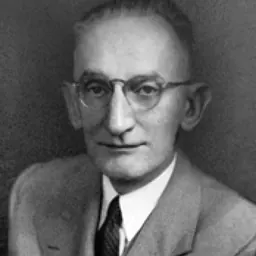

Contemporaries
People whose lives overlapped Edward Kellog Strong, Jr.'s

Frequently asked questions
Who was Edward Kellog Strong, Jr.?
American psychologist
When was Edward Kellog Strong, Jr. born?
Edward Kellog Strong, Jr. was born on 18 August 1884 in Syracuse.
When did Edward Kellog Strong, Jr. die?
Edward Kellog Strong, Jr. died on 4 December 1963 in Menlo Park.
What was Edward Kellog Strong, Jr.'s occupation?
Edward Kellog Strong, Jr. was a psychologist.
What nationality was Edward Kellog Strong, Jr.?
Edward Kellog Strong, Jr. was American.
Sources & further reading
· Wikipedia: Edward Kellog Strong, Jr.
· DBpedia: Edward Kellog Strong Jr.
Cite this page
APA: Biography.guide. (2026). Edward Kellog Strong, Jr.. https://biography.guide/edward-kellog-strong-jr/
MLA: "Edward Kellog Strong, Jr.." Biography.guide, https://biography.guide/edward-kellog-strong-jr/.
Chicago: "Edward Kellog Strong, Jr.." Biography.guide. https://biography.guide/edward-kellog-strong-jr/.
Data last updated: 2026-09-22 · Spot an error? Report a correction.
Page generated 2026-09-27 05:02 UTC