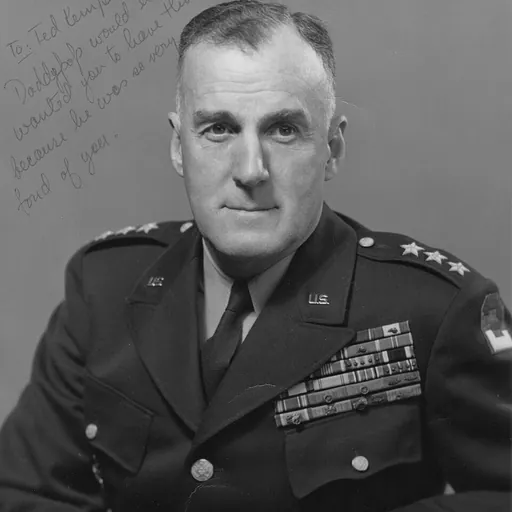
About Edward H. Brooks
Lived 1893 – 1978 (aged 85). Edward H. Brooks was an American military personnel, banking and engineering.
Lieutenant General Edward Hale Brooks (April 25, 1893 – October 10, 1978) was a highly decorated senior officer of the United States Army, a combat veteran of both World War I and World War II, who commanded the U.S. Second Army during the Korean War. He received the Distinguished Service Cross (DSC) for heroism as a junior officer in World War I and, remaining in the army during the interwar period, rose to command the 2nd Armored Division during the Battle of Normandy as well as VI Corps during the subsequent defeat of German forces in World War II.
Early life and military career Edward Hale Brooks was born on April 25, 1893, in Concord, New Hampshire. His father, Edward Waite Brooks, was a Concord grocer. His mother was the former Mary Frances Hale, a native of Dover, Kent, England. Brooks had three sisters, Harriott, Gertrude and Alice Brooks. Both Gertrude and Alice died in their infancy. He graduated from Concord High School in June 1911 (where he lettered in football), after which he attended Norwich University (The Military College of Vermont) in Northfield, Vermont, graduating in 1916 with a Bachelor of Science Degree in Civil Engineering. In 1949, he received the honorary degree of Master of Military Science from Norwich University. In 1952, Brooks was awarded an honorary Doctor of Military Science degree from Pennsylvania Military College.
Brooks began his military career in June 1915 as a captain with the 1st Cavalry Regiment of the Vermont National Guard, a position he held until July 1916. For the following year, he worked as a civil engineer before his National Guard unit was called up for federal service.
On Thanksgiving Day, 1917, Brooks married the former Beatrice Aurora Leavitt. They had two children: Elizabeth Allen Brooks (b. December 27, 1918) and Edward Hale Brooks, Jr. (b. June 6, 1920).
Following the Armistice with Germany on November 11, 1918, he served with the Army of Occupation in Germany until returning to the United States in August 1919 with station at Camp Pike, Arkansas. In July 1920 he was transferred from the Cavalry Branch to the Field Artillery Branch.
Brooks entered the U.S. Army Field Artillery School at Fort Sill, Oklahoma, in September 1921. Upon graduation in June 1922 he remained as an instructor in gunnery until November 1926, when he was assigned to the command of Battery 'D' of the 24th Field Artillery Regiment, a pack mule outfit at Fort Stotsenburg, in the Philippines. He attended the U.S. Army War College from 1936 to 1937 and was then detailed as an instructor in the attack section of the Command and General Staff College. In September 1941, Major General Jacob L. Devers requested that Brooks be named to the staff of the new armored force being formed at Fort Knox, Kentucky. With this came a promotion to the one-star general officer rank of brigadier general in the Army of the United States (AUS) on December 15, 1941. at Fort Knox, Kentucky, preparing them for the impending invasion of continental Europe. His results with the 11th Armored Division caught the eye of senior commanders, resulting in his selection for overseas assignment to command the 2nd "Hell on Wheels" Armored Division, then stationed in England training for the Allied invasion of Normandy. At the conclusion of their North African Theater intelligence gathering, the B-17 they were on ("Stinky") crash-landed in neutral Ireland. They were treated by the locals with hospitality and were transferred across the border to Northern Ireland the next day. Devers and Brooks pressed on to inspect the European Theater of Operations, then technically still under the command of Lt. Gen. Eisenhower. They toured England using the train supplied by Logistics Chief Major General John C. H. Lee, witnessing joint operations with the British, and many Services of Supply installations as well. They flew back to Washington on 28 January. and was the first Allied division commander to enter that country by assault. (They made the objective behind enemy lines and outside their operational zone, with hours to spare.)
From training in England, through the Normandy landings, the hedgerow fighting, the breakthrough and the race northeastward across France, through Belgium to the Albert Canal, Brooks had guided the division through two campaigns and scores of operations. During this period, seven units of his command were awarded the Presidential Distinguished Unit Citation. At Marchiennes, France near the Belgian border on September 2, 1944, he himself had personally participated in and directed an operation which annihilated a German convoy of 165 vehicles and earned him an oak leaf cluster to his Silver Star. The Army Distinguished Service Medal was awarded to Brooks for his leadership of the 2nd Armored Division.
Major General Brooks walking with General Eisenhower, Lieutenant General Bradley and Colonel Palmer.
In early November, VI Corps was confronted with three problems: to bring the corps' right and left flanks up to the salient held by the 3rd Infantry Division along the Meurthe, thus straightening a "jump" line for another offensive; to introduce the newly arrived 100th and 103rd Infantry Divisions into combat, and to make final plans and regroup the entire corps for an attack to cross the Meurthe, to crack the German Winter Line, to penetrate the Vosges passes, and to reach the Rhine. The Seventh Army's assault was marked by success. VI Corps drove through to its objectives. German defenses of the Vosges passes were taken, Strasbourg was captured and the River Rhine reached.
The army changed its direction of attack on November 24. This resulted in major disengagements, reliefs and redeployments. All were accomplished by December 5. VI Corps, teamed with XV Corps, was ready to attack to the north—objective the Lauter River and invasion of Germany. Hurdles ahead were the Maginot Line, the Haguenau Forest and the Siegfried Line. By mid-December the VI Corps was crossing the Lauter River into Germany and assaulting the Siegfried Line.
Luger pistol surrendered by General der Panzertruppe Erich Brandenberger to Major General Brooks, along with the German 19th and 24th Armies, on May 5, 1945, in Innsbruck, Austria. Currently in the collection of the Sullivan Museum and History Center, Norwich University.
On the night of December 20 the Seventh Army's offensive was called off and all troops ordered to prepare defensive lines. This resulted from the apparent success of the German counter-offensive in Belgium and Luxembourg, known as the "Battle of the Bulge." Forced on the defensive by this turn of events and in the face of determined and repeated enemy counterattacks Brooks organized a flexible defense which stopped the enemy attacks. During VI Corps' resistance to a January 1, 1945, enemy counterattack through the Low Vosges Mountains (Operation Nordwind), VI Corps executed a difficult withdrawal from close contact with the enemy to a predetermined line along the Moder River. All hostile attacks against that position were repulsed. All was quiet on the corps' front until March. For his performance in command of the VI Corps, from December 5, 1944, to March 1945, Brooks was awarded an oak-leaf cluster to the Army Distinguished Service Medal.
The great spring offensive began in March. VI Corps crossed the Rhine and captured Heidelberg. then came Heilbronn. Turning south and crossing the Danube, the corps drove on to the Italian border to meet the U.S. Fifth Army via Brenner Pass.
On May 5, 1945 (two days before Victory in Europe Day) Brooks accepted the surrender of the German 19th Army and 24th Army from General der Panzertruppe Erich Brandenberger in Innsbruck, Austria, thus terminating hostilities in his sector more than 24 hours before the general surrender in Germany and the end of World War II in Europe. died in a B-17 crash in Belgium while returning from a night training flight.
After World War II Upon return to the United States at the close of the European war, General Brooks assumed command of the Fourth Service Command at Atlanta, Georgia. He was appointed deputy commander of the Seventh Army at Atlanta in June 1946, and the following March became deputy commander of the Third Army there. He assumed command of the Antilles Department at Fort Brooke, San Juan, Puerto Rico, in September 1947 and, two months later, was designated Commanding General United States Army Caribbean, with station at Quarry Heights, Panama Canal Zone. On 24 July 1948, he was awarded the Chilean Grand Cross of the Star of Military Merit, 1st Class, for his long service in their national defense. He then served as commanding general of the U.S. Second Army at Fort Meade, Maryland, from June 1951 until he retired from active service on April 30, 1953.
Dates of rank
Awards and decorations
Civilian life Brooks spent the rest of his years in Concord and Melvin Village, New Hampshire. He was executive director, Association of Military Colleges and Schools from 1953 to 1964, served on the board of directors of a local bank, was a founding member of the Association of the United States Army, and indulged his love of fly-fishing and his family, among other hobbies.
Death The grave of Lieutenant General Edward H. Brooks at Arlington National Cemetery.
Lieutenant General Edward Hale Brooks died in Concord, NH on October 10, 1978, leaving his wife of 61 years, Beatrice Leavitt Brooks, their daughter, Elizabeth Brooks Campbell, four grandchildren and six great-grandchildren.
Eulogizing Brooks, General Charles D. Palmer said: "He was an exceptional and courageous leader who inspired confidence, demanded much of his subordinates but gave more of himself, was very strict but fair, never sought personal power and glory. He pushed forward deserving subordinates, but never pushed forward himself, was very modest and very human. Subordinates sometimes referred to him as a "lucky general" not meaning that he himself was lucky but that he was lucky for them — such was their confidence that he and they would succeed."
Don’t just read it —
keep it.
Full-length biographies made to live with: read them, listen on the way to work, watch them tonight.
- E-book
- Audio
- Video
Instant download · yours to keep · every purchase keeps this site free
Important facts
People in Edward H. Brooks's life
Named in this biography and alive at the same time



Related people
Same field, nearest in time




Contemporaries
People whose lives overlapped Edward H. Brooks's




Frequently asked questions
Who was Edward H. Brooks?
American Army general
When was Edward H. Brooks born?
Edward H. Brooks was born on 25 April 1893 in Concord.
When did Edward H. Brooks die?
Edward H. Brooks died on 10 October 1978 in Concord.
What was Edward H. Brooks's occupation?
Edward H. Brooks was a military personnel, banking and engineering.
What nationality was Edward H. Brooks?
Edward H. Brooks was American.
Sources & further reading
Cite this page
APA: Biography.guide. (2026). Edward H. Brooks. https://biography.guide/edward-h-brooks/
MLA: "Edward H. Brooks." Biography.guide, https://biography.guide/edward-h-brooks/.
Chicago: "Edward H. Brooks." Biography.guide. https://biography.guide/edward-h-brooks/.
Data last updated: 2026-09-21 · Spot an error? Report a correction.
Portrait: Wikimedia Commons · author & licence
Page generated 2026-09-27 04:58 UTC