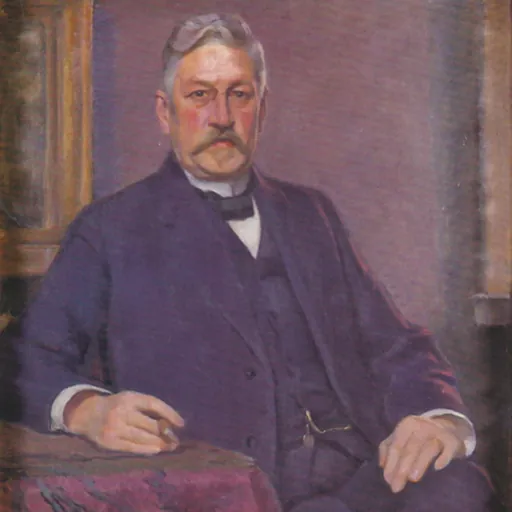
About Eduard Polón
Lived 1861 – 1930 (aged 69). Eduard Polón was a Finnish politician and business executive, known for Nokia.
Ulrik Wilhelm Eduard Polón (16 June 1861 – 30 September 1930) was a Finnish business leader His interests were eventually known as the Nokia group.
Polón opposed the Russification of Finland during the periods of oppression and was active in leading the resistance organization Kagal. He was a representative of the bourgeois estate in the parliament from 1905 to 1906. His involvement in the resistance caused him to be deported to Russia in 1916–1917. He was of Polish descent. He studied at a Swedish lyceum in Porvoo, becoming friends with his classmate, Werner Söderström, a bookseller who introduced him to a model of a money-making business when he established a publishing house. Polón helped him create a network of agents.
Entrepreneurship In 1898, Polón participated in the founding of the rubber company Suomen Kumitehdas and became the company's deputy manager the following year. He served as CEO from 1900 to 1929 and from 1921 he was chairman of the board. It was decided to transfer the plant to the city of Nokia in 1904. Initially, the company faced major financial difficulties. As a result, a number of board members, led by Karl Alfred Paloheimo, wanted to oust Polón as CEO. Polón settled the dispute by buying the shares of Paloheimo and his other opponents and in 1915 became the company's majority shareholder.
Political resistance and expulsion Members of Kagaal in Träskända Manor in Espoo on 10 April 1903. Eero Erkko second from the right, PE Svinhufvud behind the door and Eduard Polón second from the top. Eduard Polón photographed for the Siberian deportation passport in 1916.
During the first period of oppression, Polón participated in the resistance, becoming the leader of Kagal. He was therefore forced to resign as Chancellor of the Prison Administration in 1903. Between the periods of oppression, Polón represented the city of Helsinki in the bourgeois estate in the last days of the 1904–1905 and 1905–1906 estates. He was also a member of the Helsinki City Council from 1906 to 1911.
During the second oppression, Polón was expelled to Russia's governorate of Kostroma in 1916. He was able to return to Finland the following year.
Deportation did not discourage Polón, as he kept track of domestic affairs through correspondences and magazines that were filtered through the war censorship. He managed the Finnish Rubber Factory in Siberia and traded shares on the Helsinki Stock Exchange which led to significant gains during his exile. Finland's best-known banker at the time was Polón's friend, Wilhelm Bensow, who twice traveled to Siberia to meet his customer.
Other activities Polón accumulated substantial wealth through successful stock investments and was a major shareholder in many companies. He performed charitable work, donating to Marttaliitto, among others. He also was Marttaliitto's anchor investor.
Former president Pehr Evind Svinhufvud wanted to award Polón the title of Finland's first mountain councilor, but Polón refused.
Family Polón's was married to the writer Edith Polón. They had six children, one of whom died young. His wife predeceased him in 1915.
Polón's eldest son, Eino Polón, went to Germany in January 1916 as a member of the Jäger movement. It was one of the reasons for his father's expulsion. The younger son, Tauno, was expelled together with Eduard Polón.
Death Polón died in Helsinki's Kaivopuisto on 30 September 1930.
Don’t just read it —
keep it.
Full-length biographies made to live with: read them, listen on the way to work, watch them tonight.
- E-book
- Audio
- Video
Instant download · yours to keep · every purchase keeps this site free
Important facts
People in Eduard Polón's life
Named in this biography and alive at the same time
Related people
Same field, nearest in time





Contemporaries
People whose lives overlapped Eduard Polón's



Frequently asked questions
Who was Eduard Polón?
Finnish business executive politician
When was Eduard Polón born?
Eduard Polón was born on 16 June 1861 in Nastola.
When did Eduard Polón die?
Eduard Polón died on 30 September 1930 in Helsinki.
What was Eduard Polón's occupation?
Eduard Polón was a politician and business executive.
What was Eduard Polón known for?
Eduard Polón was known for Nokia.
What nationality was Eduard Polón?
Eduard Polón was Finnish.
Sources & further reading
Cite this page
APA: Biography.guide. (2026). Eduard Polón. https://biography.guide/eduard-polon/
MLA: "Eduard Polón." Biography.guide, https://biography.guide/eduard-polon/.
Chicago: "Eduard Polón." Biography.guide. https://biography.guide/eduard-polon/.
Data last updated: 2026-09-22 · Spot an error? Report a correction.
Portrait: Wikimedia Commons · author & licence
Page generated 2026-09-27 05:01 UTC