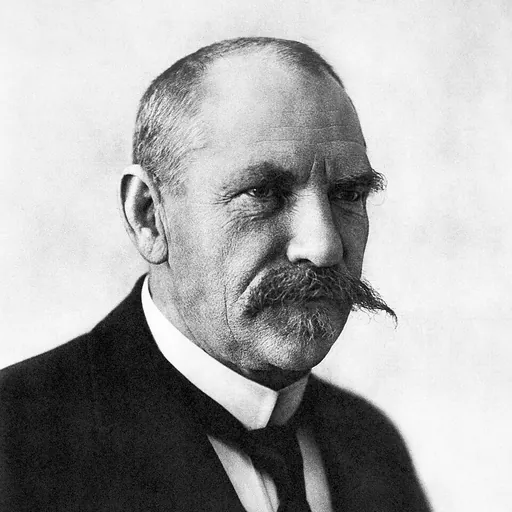
About Pehr Evind Svinhufvud
Lived 1861 – 1944 (aged 82). Pehr Evind Svinhufvud was a Finnish politician, judge, jurist, head of government and lawyer.
Pehr Evind Svinhufvud af Qvalstad (, 15 December 1861 – 29 February 1944) served as the president of Finland from 1931 to 1937. Before 1917, as a lawyer, judge, and politician in the Grand Duchy of Finland (at that time an autonomous state within the Russian Empire), Svinhufvud played a major role in the movement for Finnish independence, and he presented the Declaration of Independence to the Parliament on .
From December 1917 until May 1918, Svinhufvud operated as the first head of government of independent Finland as Chairman of the Senate. before his election as national president in January 1931. During his presidency, Svinhufvud successfully called for an end to the Mäntsälä rebellion of 1932.
As a conservative and nationalist who strongly opposed communism and the Left in general, Svinhufvud did not become a President embraced by all the people, although as the amiable Ukko-Pekka ("Old Man Pekka"), he did enjoy wide popularity. Svinhufvud's sharp line as a defender of Finland's legal rights during the period under Russian rule was especially valued from the early years of independence until the end of World War II, unlike in later decades. After the collapse of the communist bloc and the Soviet Union in the early 1990s, appreciation of Svinhufvud increased.
Family background and early life
Pehr Evind Svinhufvud af Qvalstad was born in Sääksmäki in to a Finnish noble family. He was the son of Pehr Gustaf Svinhufvud af Qvalstad II, a sea captain, and Olga von Becker. His father drowned at sea off Greece in 1863, when Pehr Evind was only two years old. He spent his early childhood at the home of his paternal grandfather, Per Gustaf Svinhufvud af Qvalstad (a provincial treasurer of Häme), at Rapola, where the family had lived for five generations. The Svinhufvuds (literally translated as "Swine-head") are a Finland-Swedish noble family tracing their history back to Dalarna, Sweden. Pehr Gustaf Svinhufvud af Qvalstad, an army lieutenant in the reign of Charles XII, had moved from there to Rapola after the Great Northern War. The family had been ennobled in Sweden in 1574, and it was also introduced to the Finnish House of Nobility in 1818. Rapola was sold when his grandfather shot himself in 1866, and Svinhufvud moved to Helsinki with his mother and his sister.
He attended the Swedish-language high school in Helsinki. In 1878, at the age of 16, he enrolled at the Imperial Alexander University of Helsinki. There he gained a Bachelor's degree in 1881, and then completed a Master of Arts degree in 1882; his main subjects being Finnish, Russian and Scandinavian History. After this, he took a Master of Laws degree, graduating in 1886. In 1889, Svinhufvud married Alma (Ellen) Timgren (1869–1953). They had six children, Yngve (1890–1991), Ilmo Gretel (1892–1969), Aino Mary (1893–1980), Eino (1896–1938), Arne (1904–1942), and Veikko (1908–1969).
Lawyer and a politician Svinhufvud's career in law followed a regular course: he worked as a lawyer, served at district courts, and served as a deputy judge at the Turku Court of Appeal. In 1892 he was appointed as a member of the Senate's law-drafting committee at the relatively young age of 31. For six years he worked in the committee, initially redrafting taxation laws. As head of his family, Svinhufvud participated as a member of the Estate of Nobles in the Diet of Finland in 1894 and 1899–1906.
He found his work on the law-drafting committee tedious and moved to the Court of Appeal as an assistant judge in 1902, his long-term goal being the easy life of a rural judge. Svinhufvud stayed mainly in the background until 1899, when Imperial Russia initiated a Russification policy for the autonomous Grand Duchy. The Finnish answer was mainly legislative and constitutional resistance, of which Svinhufvud became a central figure as a judge in the Court of Appeals.
When some inhabitants of Helsinki lodged a complaint with the Turku Court of Appeal in 1902, concerning violence employed by the Russian Governor of Uusimaa to break up a demonstration against military call-ups, the court initiated proceedings against Governor-General Bobrikov. Bobrikov demanded that they be stopped, and when this did not happen, he used a decree which the Finns regarded as illegal to dismiss sixteen officials of the court, including Svinhufvud.
Originally a moderate of the Finnish Party or Old Finnish Party, after his dismissal Svinhufvud became a strict constitutionalist who regarded the resistance of judges and officials as a question of justice, not believing that political expediency offered compromises. He moved to Helsinki to work as a lawyer and participated in the political activities both of the Diet and of a secret society, Kagal.
He also acted as defence counsel for Lennart Hohenthal, who had murdered procurator Eliel Soisalon-Soininen in 1905. This is how the meeting is told in Svinhufvud's biography Svinhufvud ja itsenäisyyssenaatti written by Erkki Räikkönen:
Svinhufvud's Senate also authorized General Mannerheim to form a new Finnish army on the basis on White Guard, the (chiefly Rightist) volunteer militia called the Suojeluskunta, an act simultaneously coinciding with the beginning of the Civil War in Finland.
During the Civil War, Svinhufvud went underground in Helsinki and sent pleas for intervention to Germany and Sweden. The conflict also turned him into an active monarchist, though not a royalist. In March 1918 he managed to escape via Berlin-Stockholm to the Senate, now located in Vaasa, where he resumed his function as head of government. In this role he pardoned 36,000 Red prisoners in the autumn of 1918. On 18 May, Svinhufvud became Protector of State or Regent, retaining this post as head of state after he stood down as Chairman of the Senate on 27 May.
Svinhufvud actively worked to install a German prince as Finnish king, travelling to Berlin to personally ask Kaiser Wilhelm II to allow his son Prince Oskar to become king. For Svinhufvud, the monarchy was a means of securing German support rather than an ideological conviction. After Germany's defeat in World War I and the failed attempt to make Finland a monarchy under the King of Finland (Frederick Charles of Hesse was elected), Svinhufvud stepped down as Regent in favour of Mannerheim. He appointed Mannerheim as Chairman of the Defence Council, not least of all as an answer to the Lapua Movement's fear of having fought the Civil War in vain.
He resisted both communist agitation and the Lapua Movement's exploits. All Communist members of parliament were arrested. In February 1932 there was a so-called Mäntsälä Rebellion, when the Suojeluskunta-Militia and the Lapua Movement demanded the Cabinet's resignation. The turning point came with the President's broadcast radio speech, in which he called on the rebels to surrender and ordered all Civil Guard members who were heading for Mäntsälä to return to their homes:
His speech stopped the rebellion before anything serious happened.
Svinhufvud made no official state visits during his presidency, nor did any foreign heads of state visit Finland officially during this period. He deliberately delegated most foreign policy matters to his foreign ministers Aarno Yrjö-Koskinen and Antti Hackzell.
Svinhufvud died at Luumäki in 1944, while Finland was seeking peace with the Soviet Union. Grand Cross of the Order of the Cross of Liberty (1918) Grand Gross with Collar of the Order of the Three Stars (14 December 1931)
In popular culture Svinhufvud appears as one of the main characters in the 1976 Finnish-Soviet historical drama film Trust, directed by Viktor Tregubovich and Edvin Laine, which portrays the events leading up to the Finnish Declaration of Independence from Russia in 1917. In the film, Svinhufvud was played by Vilho Siivola.
Don’t just read it —
keep it.
Full-length biographies made to live with: read them, listen on the way to work, watch them tonight.
- E-book
- Audio
- Video
Instant download · yours to keep · every purchase keeps this site free
Important facts
Family & relationships
People in Pehr Evind Svinhufvud's life
Named in this biography and alive at the same time



Related people
Same field, nearest in time





Contemporaries
People whose lives overlapped Pehr Evind Svinhufvud's



Frequently asked questions
Who was Pehr Evind Svinhufvud?
President of Finland (1861–1945)
When was Pehr Evind Svinhufvud born?
Pehr Evind Svinhufvud was born on 15 December 1861 in Sääksmäki, Rapola.
When did Pehr Evind Svinhufvud die?
Pehr Evind Svinhufvud died on 29 February 1944 in Kotkaniemi.
What was Pehr Evind Svinhufvud's occupation?
Pehr Evind Svinhufvud was a politician, judge, jurist, head of government and lawyer.
What nationality was Pehr Evind Svinhufvud?
Pehr Evind Svinhufvud was Finnish.
Sources & further reading
· Wikipedia: Pehr Evind Svinhufvud
· DBpedia: Pehr Evind Svinhufvud
Cite this page
APA: Biography.guide. (2026). Pehr Evind Svinhufvud. https://biography.guide/pehr-evind-svinhufvud/
MLA: "Pehr Evind Svinhufvud." Biography.guide, https://biography.guide/pehr-evind-svinhufvud/.
Chicago: "Pehr Evind Svinhufvud." Biography.guide. https://biography.guide/pehr-evind-svinhufvud/.
Data last updated: 2026-09-21 · Spot an error? Report a correction.
Portrait: Wikimedia Commons · author & licence
Page generated 2026-09-27 04:59 UTC