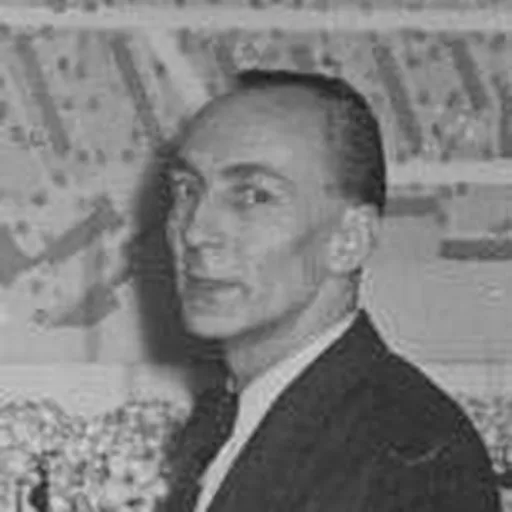
About Edmund Collein
Lived 1906 – 1992 (aged 86). Edmund Collein was a German politician, university teacher, architect, urban planner, photographer and urban designer.
Edmund Collein (10 January 1906 – 21 January 1992) was an East German architect and urban planner. He is also known for his photography while studying at the Bauhaus art school.
As a functionary of the SED, the ruling political party of East Germany, Collein was an important figure in forming and implementing the government's new socialist building policies in the 1950s and 1960s. He was professor of Urban Planning at the Bauakademie der DDR (Building Academy of the GDR), and he was the academy's inaugural vice-president. He was the president of the Bund der Architekten der DDR (Federation of Architects of the GDR) between 1966 and 1975, and he represented East German architects on government bodies and at the International Union of Architects.
Collein was one of the authors of The Sixteen Principles of Urban Design (German: Die Sechzehn Grundsätze des Städtebaus), which from 1950 until 1955 was the primary model for urban planning in the GDR.
Early life and education
Edmund Collein was born on 10 January 1906 in Bad Kreuznach, a spa town in the Rhineland. He studied at the Technische Hochschule in Darmstadt, now the Technische Universität Darmstadt, from 1925 to 1927.
Although he published no photographs after leaving the Bauhaus, some of the works he made as a student are considered to be iconic Bauhaus images, notably Bauatelier Gropius, taken in 1927-28.
In February 1931, he married the photographer and architect Lotte Gerson, who had also studied at the Bauhaus.
Work Departure of East German planners to Moscow. Berlin, 12 April 1950. L to R: Kurt Walter Leucht, Edmund Collein, Lothar Bolz, Waldemar Alder, Walter Piesternick, Kurt Liebknecht
From 1930, Collein worked in Vienna, building apartments for workers' housing associations, and from 1938 he was employed building hospitals in Munich and Berlin. The purpose of the visit, from 12 April to 25 May 1950, was to study Soviet town planning methods in order to develop strategies for rebuilding post-war East Germany. The group was led by Lothar Bolz, the East German Minister of Construction. The delegates were Kurt Walter Leucht, from the Dresden urban planning office, Collein as head of the East Berlin city planning office, Walter Pisternik, head of department of the Ministry of Construction, Waldemar Alder from the Ministry of Industry and Kurt Liebknecht, the director of urban planning and building at the Ministry of Construction. They went to Moscow, Kiev, Leningrad and Stalingrad. The academy was a government agency that operated as the central research institution for architecture and construction in East Germany.
Together with Josef Kaiser and Werner Dutschke, Collein was involved in the second phase of construction of Karl-Marx-Allee (1959–1965), on the section between Strausberger Platz and Alexanderplatz. The street was originally called Große Frankfurter Straße, and between 1949 and 1961 it was Stalinallee. It was a flagship building project of East Germany's post-World War II reconstruction programme. Shortly before German reunification on 3 October 1990, the East German government had the whole of Karl Marx Allee listed as a protected monument.
In 1958, Collein became head of the Institute for District, Town and Village Planning at the Bauakademie der DDR. Between 1963 and 1971 he was chairman of the Academy's Economic Council. In 1966 he succeeded Hanns Hopp as president of the (Federation of Architects of the GDR), and held the post until 1975. He was also Chairman of the Advisory Council for Construction for the Council of Ministers of East Germany from 1955 to 1958. From 1973 to 1978 he represented the Bund der Architekten der DDR at the International Union of Architects.
Awards Patriotic Order of Merit, Silver (1956); Gold (1970) National Prize of East Germany, second class (1962) Order of Karl Marx (1975)
Don’t just read it —
keep it.
Full-length biographies made to live with: read them, listen on the way to work, watch them tonight.
- E-book
- Audio
- Video
Instant download · yours to keep · every purchase keeps this site free
Important facts
People in Edmund Collein's life
Named in this biography and alive at the same time


Related people
Same field, nearest in time





Contemporaries
People whose lives overlapped Edmund Collein's


Frequently asked questions
Who was Edmund Collein?
German politician (1906-1992)
When was Edmund Collein born?
Edmund Collein was born on 10 January 1906 in Bad Kreuznach.
When did Edmund Collein die?
Edmund Collein died on 21 January 1992 in Berlin.
What was Edmund Collein's occupation?
Edmund Collein was a politician, university teacher, architect, urban planner, photographer and urban designer.
What nationality was Edmund Collein?
Edmund Collein was German.
Sources & further reading
Cite this page
APA: Biography.guide. (2026). Edmund Collein. https://biography.guide/edmund-collein/
MLA: "Edmund Collein." Biography.guide, https://biography.guide/edmund-collein/.
Chicago: "Edmund Collein." Biography.guide. https://biography.guide/edmund-collein/.
Data last updated: 2026-09-23 · Spot an error? Report a correction.
Portrait: Wikimedia Commons · author & licence
Page generated 2026-09-27 05:06 UTC