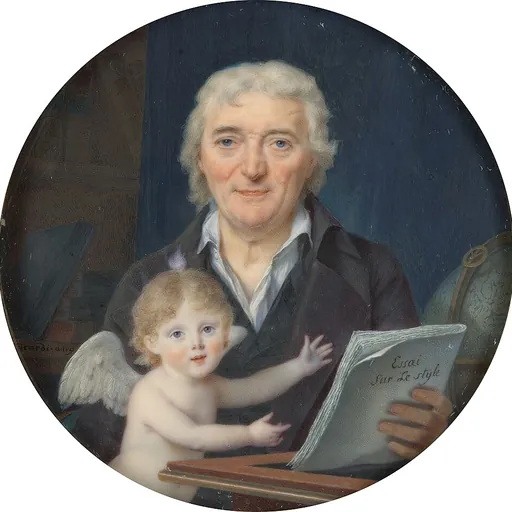
About Dieudonné Thiébault
Lived 1733 – 1807 (aged 73). Dieudonné Thiébault was a French poet, religious person, grammarian, romanist, pedagogue and historian.
Dieudonné Thiébault (La Roche, December 26, 1733 — Versailles, December 5, 1807) was a French man of letters.
Early life and education Thiébault was brought up by the Jesuits who, struck by his keen intelligence, urged him to enter their order, which he did, without however receiving priesthood. Thiébault was taught the humanities, and at the same time he devoted himself to literary work and wrote French and Latin poetry.
In 1762, he left the Jesuits and began to study law.
Career Then he moved to Paris, and decided to follow the career of literature. He entered into relations with the most distinguished men of the literary circles, and earned a fame for himself through published works. In 1765, on the recommendation of d'Alembert and d'Olivet, he became the chair of grammar at the Prussian Academy of Sciences.
Welcomed by Frederick the Great, he soon gained the full confidence of the king, became the reader of all that he sent to the Prussian Academy of Sciences, the corrector of a large number of his works, and the publisher of almost everything he had sent to be published. For twenty years, Thiébault maintained a close relation with Frederick, who had given him a pension and a place at the Academy.
In 1784, he returned to France and settled there. It was then that he entered two projects, one on the formation of a fire insurance company, the other on the reorganization of the Library of France. The first of these projects was rejected as unworkable, though it was later realized; the second so pleased Vidaud de La Tour, Director-General of the Library of France, that he appointed him head of his offices (1785). Subsequently, he obtained custody of the archives and inventories of the Garde-Meuble de la Couronne.
During the Estates General of 1789, Thiébault received the privilege of creating the only newspaper which would be authorized to report on the assembly, and was charged, at the beginning of the Revolution, with the management of the Library of France.
Shortly after, he lost the various functions he held; but, as he was receptive to new ideas, he successively became inspector of rolls at Épinal , commissioner for the reunion of Tournaisis with France, director of a post office for horses, head of the secretariat of the Directory (1795), and president of the École centrale de la rue Saint-Antoine (which occupied the premises of the modern Lycée Charlemagne), where he taught grammar (1799). Finally, in 1803, he was appointed headmaster of the Lycée de Versailles.
Personal life His son was Paul Thiébault.
He died at Versailles on December 5, 1807. On July 22, 1820, his body is transferred to Paris by his son, to the Père Lachaise cemetery (39th division).
Works He mainly published articles in Recueil de l'Académie de Berlin, Literary Journal of this city (1772–1776), and Journal de l'instruction publique (1793–1794). Other writings include
Apologie des jeunes ex-jésuites qui ont signé le serment prescript par arrêt du 6 février 1764. 1764, Discours sur la prononciation. Berlin, 1765 Les adieux du duc de Bourgogne et de l’abbé de Fénelon ou Dialogues sur les différentes formes de gouvernement. 1772 Essai synthétique sur l’origine et la formation des langues. 1774 De l’enseignement dans les écoles centrales. 1796 Traité Sur L’Esprit Public, Levrault u. a., Strasbourg, 1797/1798, (digital, Bavarian State Library.). Traité du style, Lavillette, Paris, 1801
Tome Premier, (digital, Bavarian State Library.). Tome Second, (digital, Bavarian State Library.).
Grammaire philosophique, ou la métaphysique, la logique, et la grammaire, réunies en und seul corps de doctrine, Courcier, Paris, 1802
Tome Premier, (digital, Bavarian State Library.). Tome Second, (digital, Bavarian State Library.).
Principes de lecture et de prononciation. 1802 Mes souvenirs de vingt ans de séjour a Berlin ou Fréderic le Grand, sa famille, sa cour, son gouvernement, son Académie, ses écoles, et ses amis littérateurs et philosophes,
Frédéric le Grand, Tome Premier, (digital, Bavarian State Library.). Frédéric et sa famille, Tome Second, (digital, Bavarian State Library.). Frédéric, sa cour, les voyageurs et les ministres étrangers, Tome Troisieme, (digital, Bavarian State Library.). Frédéric et son gouvernement civil et militaire, Tome Quatrieme, (digital, Bavarian State Library.). Frédéric, son Académie, ses écoles et ses amis littérateurs et philosophes, Tome Cinquieme, (digital, Bavarian State Library.).
Don’t just read it —
keep it.
Full-length biographies made to live with: read them, listen on the way to work, watch them tonight.
- E-book
- Audio
- Video
Instant download · yours to keep · every purchase keeps this site free
Important facts
People in Dieudonné Thiébault's life
Named in this biography and alive at the same time

Related people
Same field, nearest in time


Contemporaries
People whose lives overlapped Dieudonné Thiébault's





Frequently asked questions
Who was Dieudonné Thiébault?
French poet (1733–1807)
When was Dieudonné Thiébault born?
Dieudonné Thiébault was born on 26 December 1733 in Rupt-sur-Moselle.
When did Dieudonné Thiébault die?
Dieudonné Thiébault died on 5 December 1807 in Versailles.
What was Dieudonné Thiébault's occupation?
Dieudonné Thiébault was a poet, religious person, grammarian, romanist, pedagogue and historian.
What nationality was Dieudonné Thiébault?
Dieudonné Thiébault was French.
Sources & further reading
· Wikipedia: Dieudonné Thiébault
· DBpedia: Dieudonné Thiébault
Cite this page
APA: Biography.guide. (2026). Dieudonné Thiébault. https://biography.guide/dieudonne-thiebault/
MLA: "Dieudonné Thiébault." Biography.guide, https://biography.guide/dieudonne-thiebault/.
Chicago: "Dieudonné Thiébault." Biography.guide. https://biography.guide/dieudonne-thiebault/.
Data last updated: 2026-09-20 · Spot an error? Report a correction.
Portrait: Wikimedia Commons · author & licence
Page generated 2026-09-27 04:58 UTC